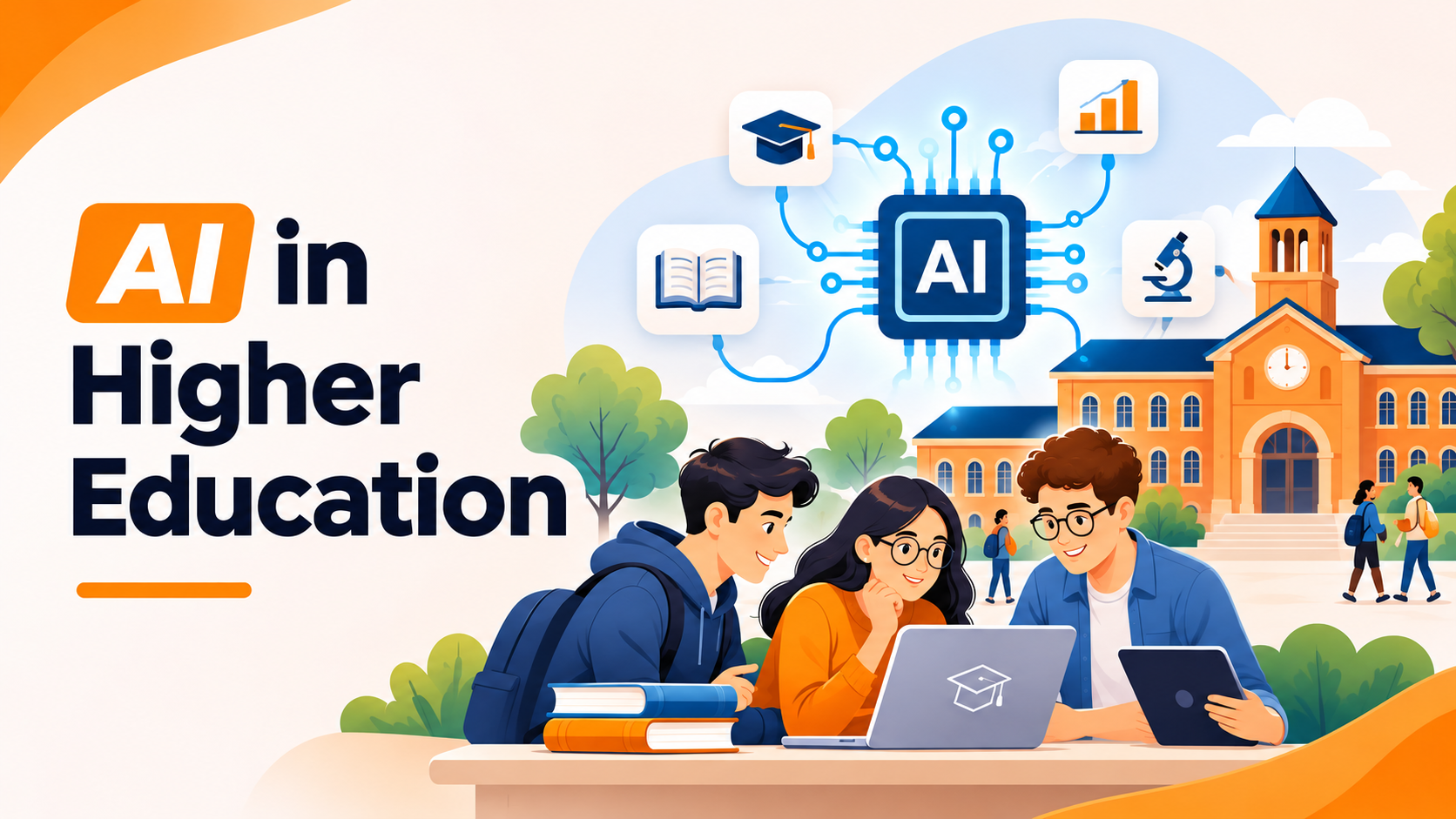
AI in higher education is changing how universities teach, assess students, conduct research, and provide academic support. From intelligent tutoring systems to research assistants, universities are finding ways to make learning more accessible and academic work more efficient.
But the real value of artificial intelligence in higher education is not how much work it can automate. It is whether students develop stronger knowledge, receive better support, and leave university with skills they can demonstrate. Looking at actual university implementations reveals where that value is being created.
Applications of AI in Higher Education
The most practical AI applications in higher education address specific academic needs. They help students understand difficult material, give professors more time for teaching, and improve access to university services.
AI in University Teaching and Learning
AI helps educators prepare course materials, develop exercises, and explain complex concepts through different teaching approaches.
For students, its value lies in interactive learning. Instead of receiving the same explanation repeatedly, a student can request a simpler explanation, work through another example, or practise a difficult concept.
A useful application is a course assistant trained on approved teaching materials. It can answer questions about lectures and assignments while keeping its responses connected to the course.
We see a clear distinction here: an assistant that guides students through a problem supports learning. One that simply provides completed answers removes the intellectual work the assignment was designed to develop.
AI in Student Assessment and Feedback
University professors spend considerable time preparing assessments, developing grading criteria, and reviewing student work.
AI can support these activities by creating draft questions, suggesting feedback aligned with a rubric, and identifying areas that need additional explanation.
The instructor remains responsible for evaluating academic quality and assigning grades.
The more interesting development is how AI changes assessment design itself. When students can generate written answers in seconds, assignments need to reveal how they reason, apply evidence, and defend their conclusions.
AI in Academic Research
AI in universities extends beyond the classroom into academic research.
Researchers can use AI to organize literature, summarize documents, classify information, assist with programming, and explore patterns in datasets.
For example, a research team reviewing hundreds of publications can use AI to organize papers by research method or subject. Researchers then examine the original studies before accepting any findings.
We consider verification essential in this context. An AI generated summary cannot replace the underlying publication, and a proposed citation must correspond to a real, relevant source.
Research interpretation, methodological decisions, and responsibility for published findings remain with human researchers.
AI in University Administration
University administration involves significant amounts of repetitive communication and document processing.
AI assistants can answer questions about registration procedures, explain published university policies, and direct students to appropriate departments.
Admissions teams can use authorized systems to organize application information, while administrative staff can prepare documents and analyze service requests.
The strongest applications reduce time spent on routine work without transferring consequential decisions to an unverified automated system.
AI in Professional Training and Simulations
AI is also changing how universities prepare students for professional situations.
Medical students can practise clinical conversations with simulated patients. Business students can evaluate marketing proposals through interactive scenarios. Language students can practise conversations adapted to their learning level.
These experiences create opportunities to apply knowledge before entering a real professional environment.
Their educational value depends on the quality of the simulation, the feedback students receive, and the connection to course objectives.
Real Examples of AI in Universities
University implementations provide a clearer picture of AI integration in higher education than general descriptions of what the technology could achieve.
Three examples stand out because the institutions have documented how their systems work and where they are being used.
University of Sydney: Cogniti
The University of Sydney developed Cogniti, a platform that allows educators to create AI learning assistants using their own instructions and course materials.
Professors can design assistants that provide feedback, guide students through difficult problems, and simulate learning scenarios.
In engineering and science subjects, educators have used Cogniti agents to explain technical information, quiz students, and provide feedback. Language students have used them to practise conversations suited to their proficiency.
The important feature is educator control. The instructor determines the assistant's educational purpose rather than allowing a general chatbot to define the learning experience.
Georgia Tech: Jill Watson
Georgia Tech introduced Jill Watson as an AI teaching assistant for online education.
The system answers student questions using verified course information and is designed to support teaching without replacing the instructor.
In Georgia Tech's online artificial intelligence course, a version of Jill Watson served more than 600 students.
A controlled classroom comparison reported that students with access to the assistant had slightly higher proportions of A grades than those without access, 66% compared with 62%.
That finding is encouraging, but it represents evidence from a particular educational setting rather than proof that AI tutoring improves performance across all courses.
For us, the most useful lesson is the system's reliance on approved course materials. It demonstrates why educational context matters more than unrestricted chatbot capabilities.
University of Michigan: Maizey
The University of Michigan offers Maizey, which allows faculty, students, and staff to build AI assistants around selected information sources.
A professor can create an assistant that answers questions from course documents. University departments can develop assistants for internal procedures, while researchers can use document collections to support information retrieval.
Maizey also supports integration with university learning systems, including Canvas.
This approach illustrates an important direction for AI in higher education: building specialized assistants for defined university activities instead of relying on a single general purpose tool for everything.
Benefits of AI in Higher Education
The benefits of AI in higher education become meaningful when universities can connect a specific application to a measurable result.
We find it more useful to evaluate the outcome than to count how many AI tools an institution has introduced.
The following table shows how universities can assess the value of different applications.
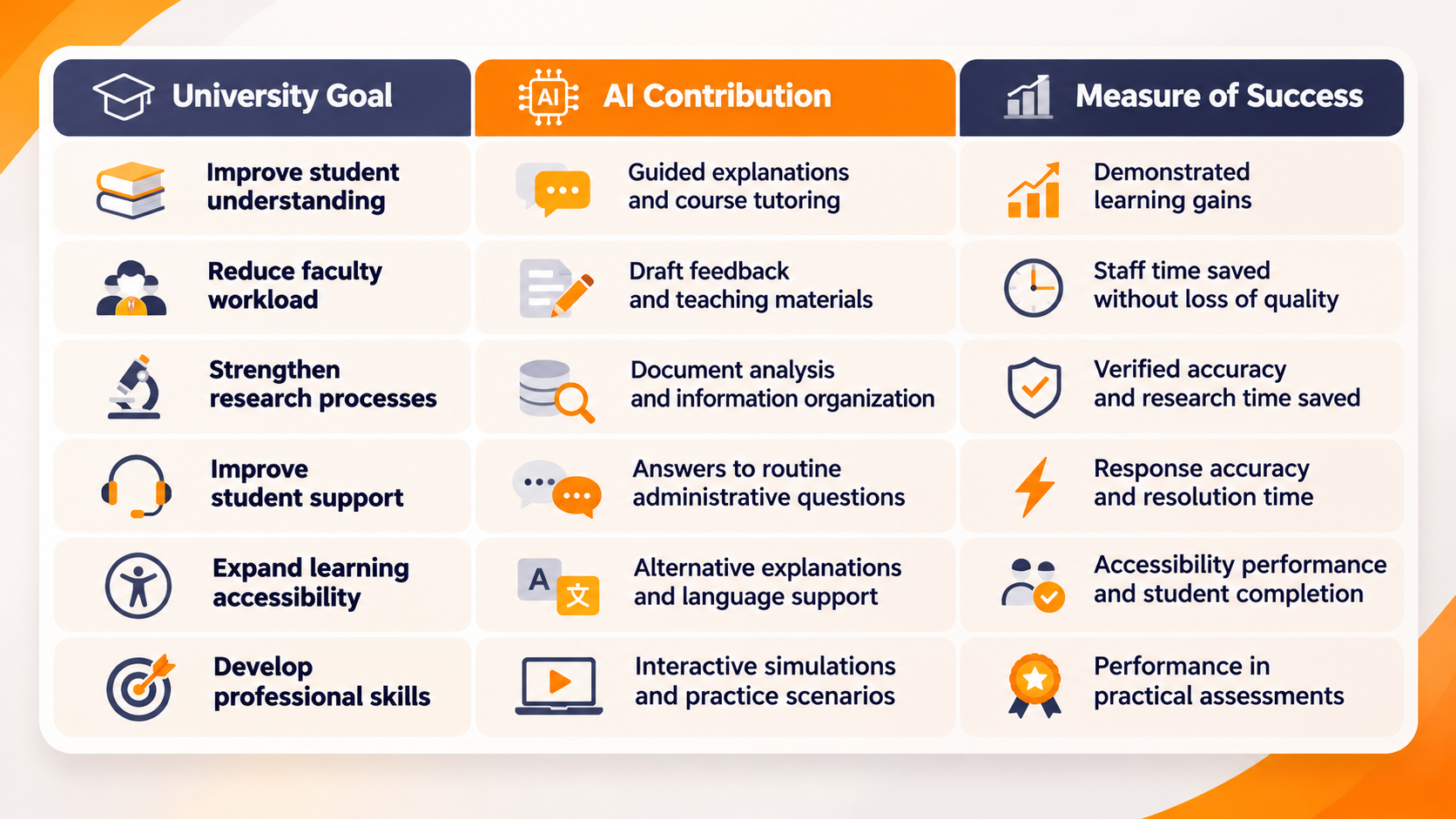
The distinction between activity and achievement matters. A university can report thousands of AI tutoring conversations without demonstrating that students learned more.
We would place greater value on improved assessment performance, independently verified feedback quality, or reduced administrative delays.
These measurements provide a stronger foundation for deciding whether an AI system deserves continued investment.
Impact of AI on Higher Education
The adoption of AI is moving faster than many universities' formal support systems.
The Higher Education Policy Institute's 2026 Student Generative AI Survey examined responses from 1,054 full time undergraduate students in the United Kingdom.
It found that:
95% of respondents had used AI in at least one way.
94% used generative AI to help with assessed work.
38% said their university provided access to AI tools.
49% believed AI had improved their student experience.
These figures reveal an important gap between student behaviour and institutional provision.
They also require careful interpretation. Student perceptions of improved learning experiences do not establish measured improvements in academic achievement.
For universities, the next challenge is evaluating how AI affects understanding, independence, and long term retention of knowledge.
A successful implementation should strengthen those outcomes rather than simply make coursework easier to complete.
Challenges of AI in Higher Education
The rapid expansion of AI in higher education introduces challenges that cannot be resolved through software alone.
Academic Integrity and Student Independence
AI generated assignments complicate the distinction between a student's own understanding and work produced with external assistance.
Traditional written assignments become less informative when an AI system can complete the central task.
The solution requires clear assessment rules and stronger evidence of student understanding.
Cornell University's teaching guidance emphasizes instructor judgment, transparent course policies, and objective evidence when evaluating concerns about inappropriate AI use.
This approach is more defensible than treating an automated detection score as proof of misconduct.
Accuracy and Reliability
Generative AI can produce convincing explanations containing incorrect information, unsupported conclusions, and fabricated references.
In higher education, these errors carry particular consequences because students use educational material to build knowledge and researchers rely on evidence.
A responsible system needs reliable source material, appropriate restrictions, and a process for verifying important outputs.
The requirement becomes even more significant in medicine, law, engineering, and other disciplines where incorrect information carries professional consequences.
Student Privacy and Institutional Data
Universities handle student records, research material, financial information, and other sensitive data.
Submitting this information to an unapproved AI service can conflict with institutional privacy requirements.
Universities need clear rules governing permitted data, storage, provider access, and retention before deploying AI across academic or administrative systems.
Unequal Access to AI Tools
Access to advanced AI tools differs between institutions and students.
Paid subscriptions, device availability, language support, accessibility, and digital literacy influence who can use these systems effectively.
When an assignment assumes students have access to a particular AI tool, the university must consider whether that access is available under fair conditions.
Otherwise, differences in technology access can become differences in educational opportunity.
Responsible AI Integration in Universities
Effective AI integration in higher education starts with the academic task, not the software.
We would evaluate a proposed system through four decisions.
Define the Educational Objective
A university should identify what needs improvement before selecting an AI application.
For a large introductory course, the objective could be providing accurate explanations outside teaching hours. For a research department, it could be reducing time spent organizing documents.
The objective should describe an educational or operational result that can be measured.
Establish Human Responsibility
Students need to know which forms of AI assistance their assignments permit. Faculty need authority over academic decisions, assessment standards, and the quality of instructional materials.
University policies should distinguish between assistance that supports learning and automated work that replaces the student's required contribution.
Clear responsibilities protect both academic standards and students.
Test With Real Academic Work
Before expanding an AI system across departments, universities should test its performance within the intended course or workflow.
A tutoring assistant can be evaluated against approved course materials. A feedback tool can be compared with instructor judgments.
The results should determine whether the application is ready for broader use.
Measure Learning and Operational Results
Implementation should not end when the software becomes available.
Universities need to examine student outcomes, staff workload, accessibility, output accuracy, and user feedback.
The 2026 EDUCAUSE research on learning assessment reinforces the importance of reconsidering assessment practices as AI becomes part of university teaching.
Our assessment is that AI integration succeeds when institutions can demonstrate educational value while preserving human responsibility.
The Future of AI in Higher Education
The future of AI in higher education will depend on how universities redesign learning around technologies students already use.
Course assistants connected to university materials, simulations designed by educators, and AI supported research workflows are practical examples of this transition.
Assessment is becoming especially important. Universities need methods that evaluate students' reasoning, application of knowledge, and ability to verify information produced by AI.
Academic programs must also prepare graduates to work with AI while remaining capable of independent judgment.
The direction is clear: universities need more than access to powerful technology. They need educational practices that preserve the purpose of higher education.
Final Thoughts
AI in higher education has moved beyond experimentation. Universities are using it for tutoring, teaching support, research workflows, and student services.
The most convincing examples share an important characteristic: the technology supports a defined educational objective, and people remain responsible for its results.
As universities expand AI in Education, the measure of progress should be what students understand and can accomplish, not simply how much work artificial intelligence performs.
FAQ
Can I use AI to translate my dissertation before submitting it?
Permission depends on the university, department, and assessment requirements. Students should consult the relevant academic policy before using AI translation for submitted work.
Where translation assistance is permitted, the student remains responsible for preserving the meaning, technical terminology, and accuracy of the original text. Required disclosures must also be completed.
Does my university have to give me a paid AI account?
There is no universal requirement for universities to provide paid AI subscriptions.
Institutional licensing arrangements differ. Students should check their university's official technology services to determine which applications are provided, whether access is included in tuition, and what restrictions apply.
Can I record a lecture and upload it to an AI tool?
Students should obtain the required permission before recording or sharing lecture material with external services.
Recording policies, intellectual property rights, and privacy obligations apply to lectures and other participants. Authorization to record a class does not automatically authorize uploading the recording to a separate AI platform.
Can I use an AI assistant during a closed book university exam?
AI assistance is permitted only when the examination instructions explicitly authorize it.
If external assistance is prohibited, using an AI tool can constitute an academic integrity violation. Students must follow the specific conditions established for that examination.
Can ChatGPT be listed as a coauthor on my research paper?
No. Under the International Committee of Medical Journal Editors' recommendations, AI tools cannot qualify as authors because they cannot accept responsibility for the accuracy, integrity, and originality of published work.
Researchers must follow their journal's disclosure requirements and remain accountable for the manuscript.

Fatemeh Jahangard
Technology & AI Writer at PinerookFatemeh Jahangard covers AI, emerging technologies, and digital innovation for Pinerook, focusing on how technology shapes startups and industries.
 Seen first.