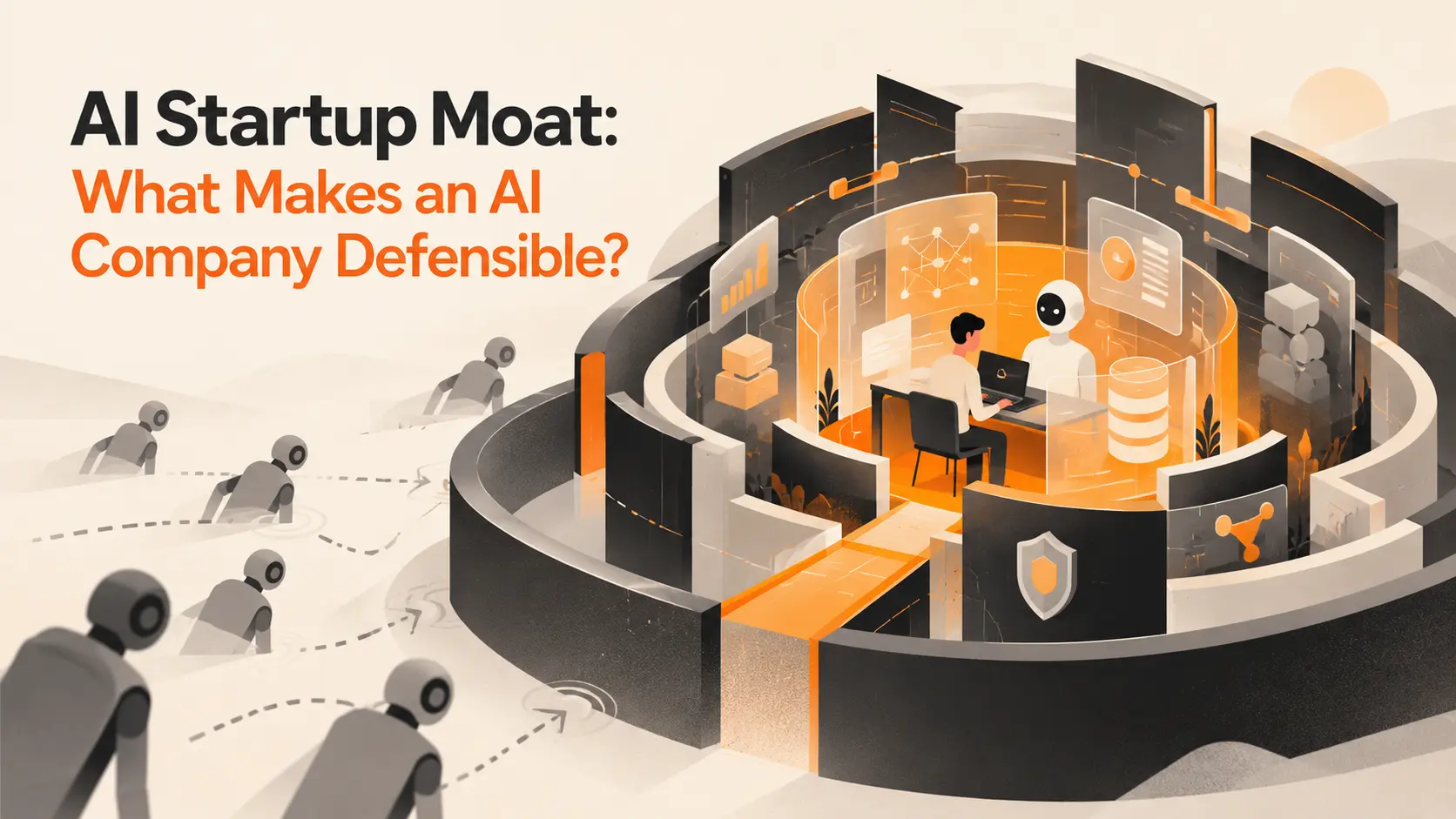
An AI startup moat is a durable reason customers continue to choose a company even after competitors can access similar models and reproduce visible features. It might come from deep ownership of an essential workflow, permissioned customer context, trusted distribution, or a learning process that improves measurable outcomes. The distinction is practical: an impressive demo can win attention, but it does not explain why the business will keep winning next year.
The broader framework of Startup Moats applies to any young company, but AI applications face a particular test: the technology underneath the product may improve, become cheaper, or appear inside an incumbent platform without warning. For these companies, the defensible asset is often what they have earned through customer use rather than the model they currently call.
What Counts as an AI Startup Moat?
An AI startup moat exists when serving customers creates an advantage that a capable rival cannot quickly recreate at a similar cost. The advantage has to matter to buyers. A proprietary evaluation process, for instance, only becomes defensive if it leads to higher accuracy, fewer costly mistakes, faster completion, or another result a customer is willing to pay to preserve. Exclusivity without customer value is not much protection.
It also helps to separate a head start from a compounding advantage. Being first to connect a new model to a familiar task may attract early customers. But if another vendor can deliver the same result next month, speed was a useful opening move, not the moat itself. The more revealing question is what the startup learns, earns, or embeds during that month that a copycat would still lack.
Why Model Access and Prompts Rarely Protect an AI Application
Many AI application companies buy intelligence from a model provider, combine it with an interface, and sell a more convenient experience. This can solve a genuine problem. It can also expose the startup to sudden changes in model capabilities, pricing, and distribution. A feature that once required custom engineering may later be available directly in a larger software suite.
This does not mean technology can never create a moat. A company developing a genuinely difficult model, holding defensible intellectual property, or operating specialized infrastructure may have barriers that others cannot easily match. But an application startup built on widely available foundation models should not assume the underlying model is exclusive. Its strategic work is to make the complete service valuable and difficult to replace, even if the intelligence layer becomes a commodity.
Where Durable AI Defensibility Actually Comes From
Owning an important customer workflow
A product becomes more defensible when it reliably performs work across the messy steps that surround a model response. Consider an AI tool that drafts insurance claims versus a system that receives documents, checks policy rules, flags exceptions, routes approvals, records decisions, and hands the case to the next employee. The second system is harder to replace not because it has more screens, but because several people and processes now depend on its performance. The company must still earn that position by reducing work, not by making the customer artificially dependent.
Learning from useful, permissioned context
Customer corrections, industry terminology, unusual edge cases, and verified outcomes can make an AI service more reliable. Yet collecting documents or storing chat histories is not automatically a data advantage. Teams need permission to use information for a defined purpose, a reliable way to evaluate whether the new context improves performance, and a sensible method for separating one customer’s confidential information from another’s. If the system gets better only in internal demonstrations, the supposed feedback loop has not produced a business moat.
Earning trust and access to distribution
For a buyer making a consequential decision, switching to another AI vendor involves more than comparing features. Procurement checks, security reviews, change management, dependable support, and proof of results can all influence the choice. A trusted partner or a strong reputation in a narrow industry may consistently bring qualified customers to a startup. That position can be difficult for a generic competitor to purchase quickly, although a single platform partnership is fragile if the partner changes its terms.
Improving delivery, not just the demo
The less visible advantage is the ability to produce a dependable outcome at a sustainable cost. An AI service may have to handle exceptions, human review, escalation, evaluation, and model failures. If each deployment reveals reusable patterns that reduce implementation time or support effort, the company becomes more effective with experience. If every new customer requires another large custom project, growing revenue may conceal an increasingly expensive operation rather than a moat.
The Copycat Test: Is the Advantage Real?
Imagine that a major software vendor launches the same visible AI feature tomorrow and sells it at a lower price. A defensible startup should have a specific, evidence based explanation for why a meaningful group of customers would stay. The following checks translate broad moat claims into observations founders can test without waiting for a competitive crisis.
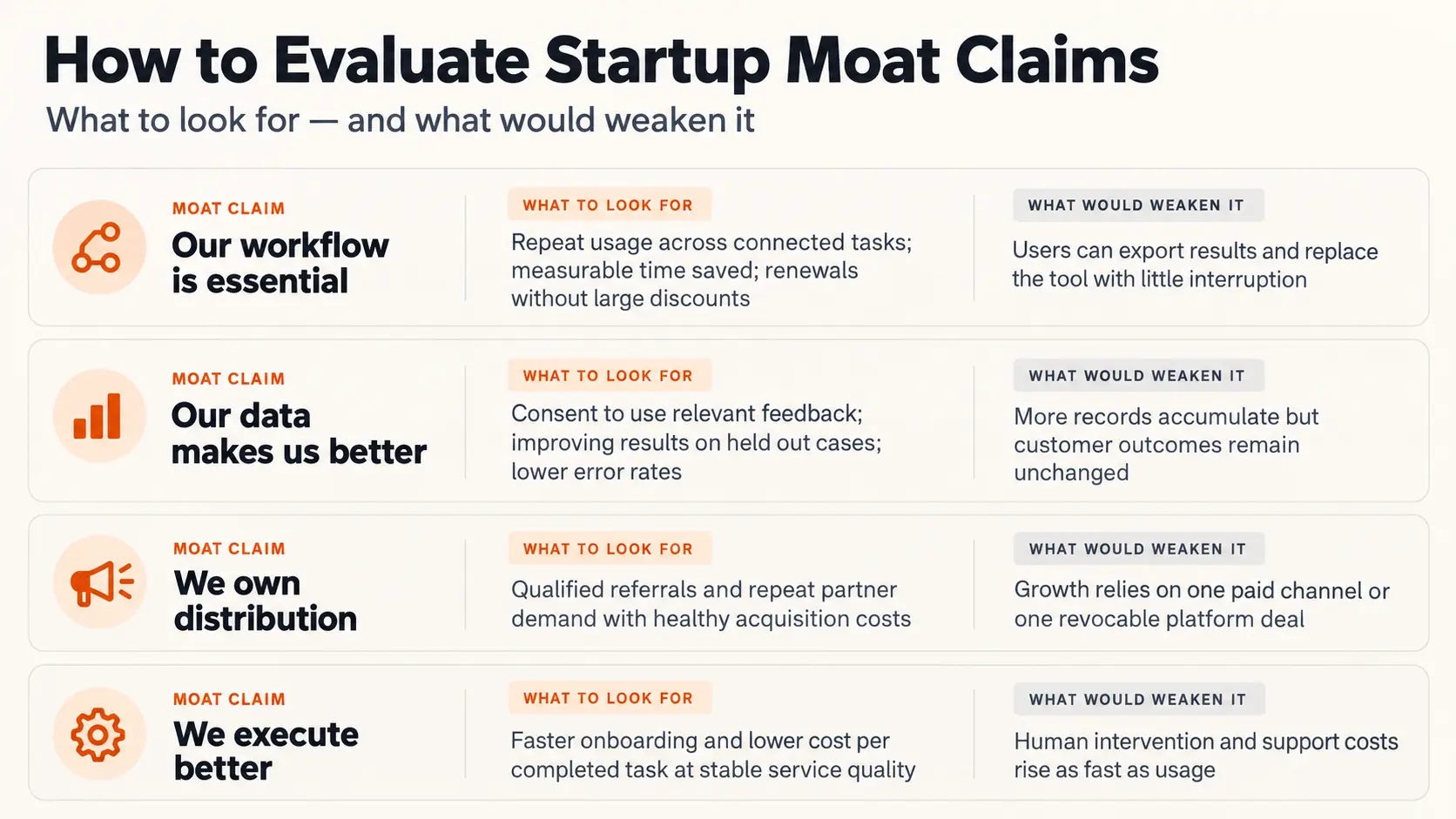
A Realistic Example: AI for Freight Operations
Consider a hypothetical startup that helps freight brokers resolve shipment exceptions. At launch, its product reads emails and suggests the next action. That is useful, but another team can build a similar assistant using the same model APIs. The startup begins developing a more credible advantage only when it connects carrier updates with customer rules, verifies delivery exceptions, records operator decisions, and helps staff close cases consistently. Buyers then evaluate an operational result, not a text generation feature.
Suppose the team measures the share of exceptions resolved correctly without rework, the time required to onboard a new broker, and how often an experienced operator overrides the system. With appropriate customer permissions, patterns in corrected cases can improve future routing and evaluation. If those measures improve while support cost per case remains controlled, the company has early evidence that operating experience is accumulating into an advantage. It still needs to test whether competitors could obtain similar context and whether customers would actually resist switching.
How to Build an AI Startup Moat in 90 Days
First 30 days: identify the irreplaceable outcome
Interview customers about a recurring job they cannot afford to get wrong. Map the full process before and after the AI step: inputs, approvals, exception handling, record keeping, and handoffs. Choose one outcome customers care about, such as fewer manual reviews or faster resolution of verified cases. Write a one sentence moat hypothesis that connects serving another customer to a measurable improvement in that outcome.
Days 31 to 60: instrument the learning loop
Track where the product is used, where people correct it, what errors cost, and how much staff intervention is required. Collect feedback only where rights, privacy safeguards, and customer expectations allow it. Improve one repeated bottleneck rather than collecting more data without a purpose. Compare outcomes using a consistent set of cases, because a better result on easier tasks is not evidence of a stronger moat.
Days 61 to 90: challenge the replacement story
Show customers a credible alternative with similar features and ask what they would lose by switching. Test whether the improvement survives a different underlying model and whether implementation time falls as experience increases. Review renewal intent, depth of workflow use, contribution margin, and customer referrals together. If the case for staying depends mainly on a long contract or an inconvenient export process, the company has friction, not necessarily loyalty.
What Can Destroy an AI Moat?
A model provider can bundle an attractive feature, an open model can narrow a performance gap, or a dominant platform can restrict distribution. New interoperability tools may reduce migration effort, while a customer may refuse broader use of its data. These are not unusual edge cases; they are reasons founders should know exactly which parts of their advantage they control and which rely on external permissions.
The most durable response is not to lock customers in at any cost. It is to keep earning the right to operate in the workflow through measurable value, responsible data practices, reliable delivery, and trusted relationships. A defensible AI company should be able to change models without losing what customers actually pay it for.
The Bottom Line
The most useful question for an AI founder is not whether competitors can copy the interface. They probably can. It is whether another company could reproduce the complete customer outcome, operational knowledge, and earned trust with similar speed and economics. Start with one narrow workflow, measure the advantage honestly, and build around the part of the customer relationship that becomes more valuable with experience.
FAQ
Can an AI wrapper become a defensible company?
Yes. A product that starts as a simple layer on a model can become defensible if it gains meaningful workflow depth, trusted distribution, useful customer context, or reliable execution that competitors cannot easily reproduce. A wrapper is a starting architecture, not a permanent business verdict.
Is proprietary data enough to create an AI startup moat?
Not by itself. The information must be legitimately usable, difficult to replicate, and demonstrably improve outcomes customers value. Storing more data without better decisions, accuracy, or service quality does not establish defensibility.
Should an early stage AI startup focus on a moat before product market fit?
It should identify a plausible path to defensibility while prioritizing evidence that customers need the product. Heavy investment in exclusive infrastructure or complex integrations is hard to justify until the core problem and repeatable demand are clearer.
How often should founders reassess an AI moat?
Review it when a major model release, platform change, new competitor, or customer shift challenges the thesis. A short quarterly check using retention, product outcomes, implementation effort, and unit economics can also show whether the position is strengthening or only appearing stronger.

Mohsen Avid
Founder & Editor, PinerookMohsen Avid is the founder of Pinerook, covering entrepreneurship, startup strategy, digital business, and the decisions behind building new ventures.
 Seen first.