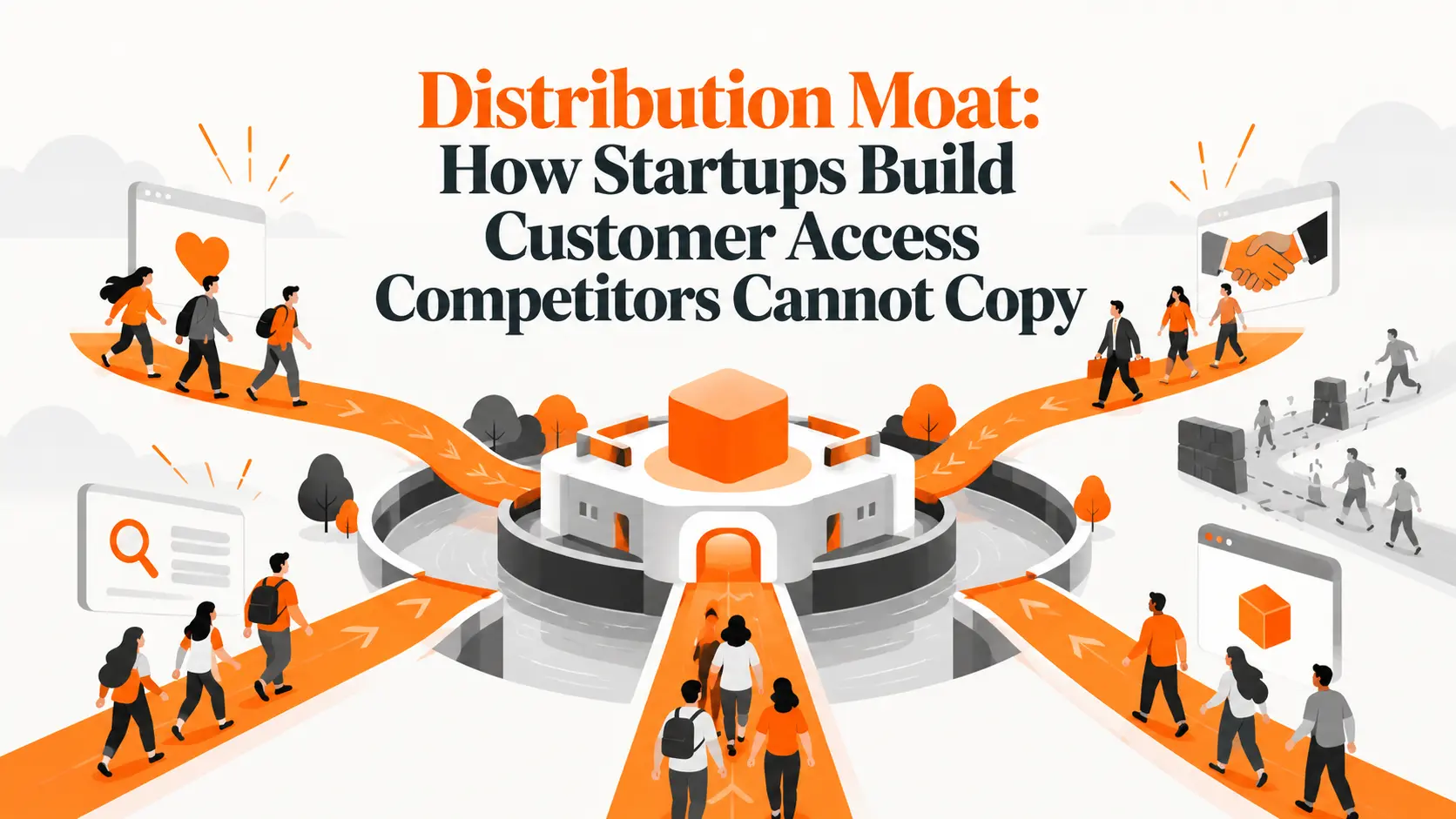
A distribution moat is an enduring advantage in reaching the right customers. It can emerge from an audience that trusts a company, a partner network that repeatedly introduces qualified buyers, or a presence inside the places where purchasing decisions already happen. The advantage is not simply that a startup generates leads. It is that competitors find those customers more expensive, slower, or harder to reach even when they offer a similar product.
The distinction matters within Startup Moats. A startup can have strong sales this quarter because it is spending heavily on advertisements or benefiting from a popular social platform. Neither proves that access to customers is protected. A genuine distribution advantage becomes more useful as relationships, reputation, knowledge, and repeatable routes to market accumulate. It should make the next relevant customer easier to win without requiring the same effort to be purchased again.
For founders, the practical question is not which marketing channel is fashionable. It is which route to customers can become increasingly efficient, trusted, and difficult for a well-funded competitor to reproduce.
What Makes Distribution a Competitive Moat
Every business needs a way to be discovered. Search results, advertisements, trade shows, outbound sales, marketplaces, and recommendations can all create demand. But a channel is only a route. A moat exists when the business develops a structural advantage inside that route. This might be an unusually trusted reputation among a defined buyer group, a difficult to secure agreement with industry partners, or a direct relationship that survives changes to a third party platform.
Consider two software companies targeting independent medical clinics. One rents attention through the same keywords and ad auctions as its rivals. The other has spent years helping a network of clinic advisers explain operational problems, runs useful educational sessions with those advisers, and receives introductions from organisations whose recommendations buyers trust. The second company has not made competition impossible. It has developed a more credible path into a specific purchasing conversation that a newcomer cannot duplicate by raising its ad budget for one month.
That does not mean paid acquisition is bad. Advertising may be the fastest way to discover a message that works, enter a new market, or capture existing demand. The mistake is treating access purchased one impression at a time as though it were an owned advantage. If the acquisition economics vanish when spending stops, the business may have a functioning campaign but not a distribution moat.
The Mechanisms That Make Customer Access Harder to Copy
A direct audience with a reason to return
A newsletter, product community, customer education programme, or subscriber base can create repeat access to people who care about a specific problem. The strength comes from relevant engagement and permission, not the raw size of an audience. Ten thousand disengaged followers may be less useful than a few hundred operations leaders who repeatedly read the company’s research and seek its advice when a problem becomes urgent.
Ownership also needs careful definition. A company can control an email list it has permission to contact, but it does not control inbox placement. It can publish a helpful knowledge library, but it does not own its ranking in search engines. Strong distribution therefore combines a recognizable brand, direct relationships and more than one dependable way for customers to return.
Trusted partners close to the buying decision
Partnerships can be especially valuable when buying is complex. Accountants, implementation consultants, industry associations, and established software vendors may already be involved when a customer chooses a new product. The partnership creates an advantage if it consistently produces introductions that fit the startup’s ideal customer profile, gives the partner a durable reason to recommend the product, and remains economically worthwhile for both sides.
A logo on a partner page is not enough. A founder should know whether the partner actually introduces customers, whether the startup can maintain a direct relationship after introduction, and how exposed the business becomes if that partner changes priorities. A high performing exclusive arrangement may create short term access while also introducing significant concentration risk.
A product that naturally reaches the next buyer
Some products contain their own distribution opportunities. An invoicing tool may be noticed by the recipient of an invoice; a collaboration product may become visible to colleagues invited into a project. That exposure only matters if it reaches a plausible buyer and produces genuine interest. Sending more invitations or placing a brand name on more screens does not automatically make the product viral, and viral sharing does not by itself establish a network effect.
The useful test is whether existing customer activity creates qualified new exposure at a repeatable cost. If referrals persist because the product solves a problem worth discussing, that can help distribution compound. If referral volume depends entirely on rewards that cost as much as ordinary advertising, the advantage is much weaker.
Comparing Distribution Channels by Defensibility
Channels should be compared by the advantage a company can develop within them rather than by an assumed hierarchy in which organic traffic is always good and paid traffic is always bad. The same channel may be highly defensible for one startup and replaceable for another.
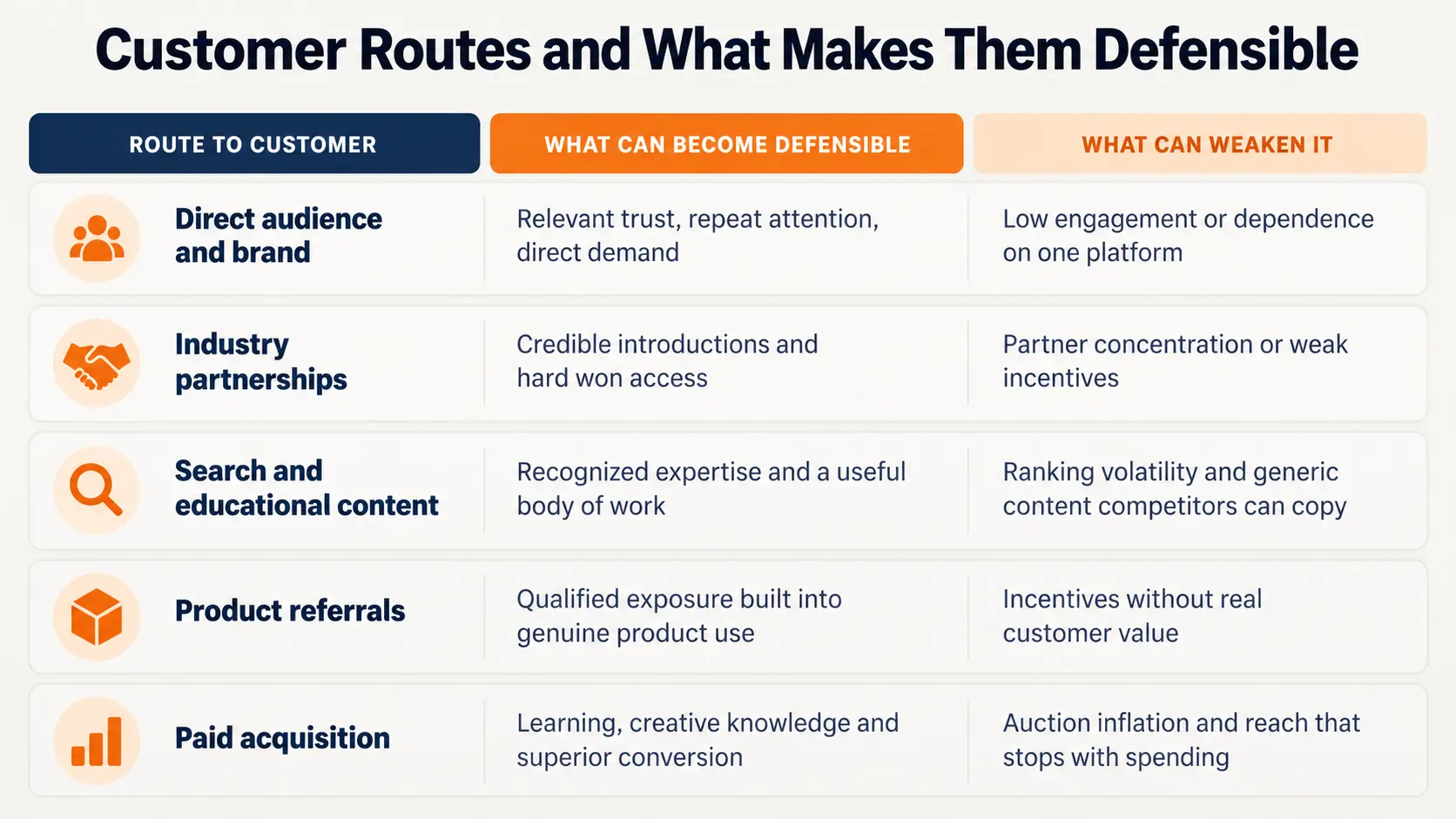
The strongest approach is often a combination. Paid campaigns can identify which buyers respond to a problem, while a deeper educational resource helps those buyers return without another paid click. Partners can introduce the startup, while a credible product experience turns referred customers into direct advocates. The moat is the accumulated customer access and trust across these activities, not the number of channels listed in a marketing plan.
How a Startup Builds Its First Distribution Advantage
A startup rarely begins with a defensible channel. It begins with a narrow segment and an imperfect understanding of how that segment buys. The first decision is to identify the moment when customers search for help, seek a recommendation, or become willing to change vendors. A broad promise to reach small businesses tells the founder very little. Knowing that regional payroll firms advise care providers during annual compliance reviews is far more useful.
Suppose a new SaaS company helps independent care providers manage rota compliance. Broad advertising attracts interest but rarely reaches the person responsible for approving a new system. Interviews reveal that regional payroll advisers are consulted when providers prepare for inspections. Instead of distributing generic growth content, the startup creates practical guidance that helps those advisers answer recurring questions, trains a small group of willing partners and follows the quality of introductions. Over time it could become the company those advisers reliably mention when the relevant problem appears.
The advantage in this hypothetical example is not a secret advertisement or a single successful webinar. It is the combination of specialist understanding, trusted intermediaries, repeat educational value, and a feedback loop from real buyer conversations. The company must still deliver a good product. A distribution moat brings the right buyers into consideration; it cannot compensate indefinitely for poor retention or unsatisfactory outcomes.
Start with one specific route to one specific buyer
Founders should select an initial channel according to the buyer’s behaviour and the product’s complexity. A low cost self serve product may spread through useful content or invitations. A regulated enterprise product may require partners, procurement relationships or industry credibility before a purchase is possible. Trying every channel at once often conceals which activity actually caused demand.
Turn the channel into a repeatable asset
The next step is to document what makes the channel work and reinvest in that capability. For a partner programme, that may mean clear qualification rules, training and a reliable follow up process. For a specialist publication, it means original knowledge that addresses recurring purchase questions, a credible editorial standard and a way for readers to stay in contact. For product referrals, it means a genuinely helpful sharing moment rather than a promotional prompt inserted everywhere.
A moat starts to form when each cycle leaves something behind: a stronger relationship, a larger base of useful material, better knowledge of objections, greater brand recall, or a process that makes customer introductions more reliable. Activity that disappears without a trace after a campaign ends is difficult to defend.
Measuring Whether the Advantage Is Real
Traffic, followers and raw lead counts are useful diagnostics but poor proof of defensibility. The founder needs to measure the economics and durability of customer access. Track qualified opportunities and activated customers by acquisition source, not just signups. Include the labour, partner commissions, creative production and technology costs needed to run each route. A channel with low advertising spend may still be expensive when it consumes the founder’s entire week.
For illustration, suppose a startup spends $12,000 in total to acquire 50 paying customers through advertisements. Its acquisition cost is $240 per customer. Over the same period a partner initiative costs $6,000 including staff time and commissions, and brings 60 paying customers, giving an acquisition cost of $100. The arithmetic makes the partner route appear attractive, but it does not prove a moat. The company must compare the quality, revenue, retention and continued availability of those customers over subsequent periods. If a single partner accounts for nearly all 60 customers, access could disappear after one contract change.
A stronger signal is that the share of qualified customers arriving through repeat referrals, direct interest or established partner relationships rises while acquisition economics remain sound. An equally important countertest is concentration. If one search ranking, marketplace, creator or partner drives most opportunities, the business may have a powerful source of growth and a fragile business at the same time.
A Practical 90 Day Validation Plan
During the first month, choose a clearly defined buyer and map how purchasing decisions happen. Speak with recent customers and lost prospects, identify the intermediaries they trust, and establish a baseline for qualified acquisition costs. Select one candidate mechanism rather than setting a vague target to become better known.
In the second month, run a contained experiment that could leave a lasting asset. A software company might build a partner enablement programme with three relevant advisers; another might publish a small series of evidence based guides around one expensive buyer problem and invite readers into a permission based mailing list. Record which activities generate conversations with people who match the intended buyer, rather than celebrating impression counts.
By the third month, compare conversion quality, total cost, dependence on individual partners or platforms, and signs of repeat demand. Decide whether the mechanism deserves another period of investment, requires a different audience, or should be abandoned. Ninety days cannot establish a mature competitive moat. It can establish whether there is evidence of a channel that may become more valuable and difficult to replicate with sustained work.
When Distribution Stops Being a Moat
Distribution advantages are vulnerable to changes outside the startup. A search platform may alter what it displays, an integration partner may favour its own product, an industry association may change its commercial policy, or an emerging competitor may earn trust with a neglected part of the market. The company can also destroy its advantage from within by pushing low quality offers to a previously trusting audience.
Defensibility therefore depends on maintaining trust and reducing avoidable dependence. Founders should retain appropriate direct customer relationships, track the sources of new demand, review partner incentives, and ensure that useful knowledge and reputation survive the loss of any one channel. Diversification is not a substitute for focus, but concentration should be a conscious risk rather than a surprise discovered after growth stalls.
The Founder’s Decision
A distribution moat is strongest when the company can explain not only how customers arrive today but why that access should become more efficient and reliable with continued execution. The answer should name a specific buyer, a channel tied to that buyer’s behaviour, a compounding asset, and evidence that the route produces customers worth keeping. If all the company has is a campaign that a competitor can reproduce tomorrow, it has found distribution, not yet a moat.
FAQ
What is a distribution moat in a startup?
It is a durable advantage in reaching and winning relevant customers, created through assets such as trusted relationships, a directly engaged audience, strong partner channels or repeatable product referrals. It goes beyond temporary traffic or a successful advertising campaign.
Is an email list enough to create a distribution moat?
Not by itself. The list needs permission, relevant subscribers and evidence of continued engagement or qualified demand. Email also carries deliverability and audience fatigue risks, so durable access usually depends on trust and multiple ways for customers to reconnect.
Can paid advertising become a distribution advantage?
Advertising can produce valuable learning and a more efficient acquisition process, but it rarely creates a moat solely through spending. A stronger position emerges when paid campaigns help build recognizable demand, better conversion economics and direct customer relationships that remain valuable beyond individual auctions.
How long does it take to build a distribution moat?
There is no standard timeline. A founder may validate an initial channel in weeks, while brand trust, partner networks and repeat direct demand can require sustained work. The more useful measure is whether each cycle improves qualified access and customer economics without creating unacceptable channel dependence.

Mohsen Avid
Founder & Editor, PinerookMohsen Avid is the founder of Pinerook, covering entrepreneurship, startup strategy, digital business, and the decisions behind building new ventures.
 Seen first.