A startup has economies of scale when it can deliver more of the same product or service at a lower average cost per unit without lowering quality. That can happen when fixed expenses are spread across more customers, operational processes become more efficient, or better utilization reduces wasted capacity. The important qualification is that higher sales do not automatically produce these savings. A company can double its customer count and still see its cost to serve each customer rise.
For founders building Startup Moats, the question goes beyond efficiency. A declining cost curve becomes a competitive advantage only when rivals cannot easily reproduce it and customers benefit from the result. Lower costs can allow a startup to protect margins, offer a more attractive price, or reinvest in a better service. But the advantage must survive a fair comparison with competitors, including the additional costs that appear as the business grows.
What Are Economies of Scale in a Startup?
Economies of scale describe the reduction in average cost as a business produces more units over a relevant range of output. The unit might be a shipment, a completed transaction, an active software account, or a manufactured product. The company needs to choose a denominator that represents a consistent service, because comparing a basic account with a complex enterprise account can make a cost trend misleading. The simplest calculation is total relevant operating cost divided by the number of comparable units delivered.
Consider a software business with recurring product development, security, and platform expenses. Supporting another customer may not require building another product from scratch, so part of the existing cost can be shared across a growing customer base. Yet the business also pays for hosting, support, payments, and usage, and those expenses may increase with each account. Economies of scale exist only if the combined average cost declines, not simply because one fixed expense is allocated across more accounts.
Two mechanisms are worth separating. Internal economies of scale come from changes inside the company, such as more efficient processes or better use of equipment. External economies of scale emerge when the surrounding industry develops shared suppliers, infrastructure, or specialist talent. An external benefit may make an entire category cheaper to operate, which is useful but less likely to distinguish one startup from its competitors.
Where Cost Advantages Come From
Spreading fixed costs across more output
Some expenses support the whole service rather than one particular sale. Product development, a compliance program, machinery, or a central operations team may handle a larger volume before major new spending is required. When the startup delivers more with essentially the same capacity, its fixed cost per unit falls. This is especially visible in products with substantial upfront development costs and relatively modest costs of serving an extra customer.
That effect has limits. Infrastructure often grows in steps, and a larger customer base may require additional engineering, service levels, or compliance work. Founders should ask how many units the current system can handle reliably, what additional capacity will cost, and whether quality remains stable at the higher volume. Costs deferred into the next quarter are not necessarily costs eliminated through scale.
Learning, utilization, and process design
A logistics startup may reduce rework as teams learn a repeatable route and handling process. A manufacturer may improve output quality so fewer materials are wasted on defective units. A SaaS company may automate routine onboarding, but only after it identifies tasks that recur reliably across accounts. These improvements can lower cost per successful outcome even without a dramatic increase in purchases or customer count.
The essential comparison is cost per completed, quality adjusted unit, not cost per attempt. A factory that makes more items but rejects a larger share has not necessarily become more efficient. The same problem appears in digital products when faster delivery leads to outages or more manual support. Operational learning supports scale when the company can show that it takes fewer resources to deliver the same result.
Purchasing power and shared resources
Higher, predictable volume can sometimes secure more favorable supplier terms, improve utilization of dedicated equipment, or justify a specialized employee whose work benefits many customers. However, a discount that depends on a large minimum commitment can introduce new risk. If demand falls below the contracted amount, the lower nominal unit price may be outweighed by unused inventory or a costly reservation. Scale should make the business more resilient, not merely increase the value of its obligations.
Economies of Scale Across Different Startup Models
The cost curve depends on what the startup sells and how customers use it. Traditional software can distribute a developed product widely, but cloud infrastructure, support, security, and high usage can remain material. AI applications may have substantial inference costs per request, so more activity does not automatically move the cost of each result toward zero. A physical product company may gain from larger production runs while facing inventory, quality control, storage, and working capital constraints.
For marketplaces, more transactions can spread shared platform costs, but payments, dispute handling, incentives, and operations may scale with activity. A services company may struggle to reduce cost per client when each new account requires dedicated expert hours. The useful founder question is therefore not whether the business is called SaaS, AI, or marketplace. It is which costs remain fixed for a meaningful period, which rise with volume, and which new expenses appear when capacity is expanded.
How to Calculate Economies of Scale
A practical analysis starts by specifying the output unit and the cost boundary. For a SaaS business, the unit might be one active paying account per month, with infrastructure, recurring platform overhead, and direct support included. For a fulfillment startup, it might be one correctly completed order with labor, materials, and facility overhead included. Keep the service standard and accounting period comparable across scenarios, and include any extra capacity needed to support growth.
The following numbers are an illustrative example, not the financial results of a real company. Assume a service startup spends $24,000 monthly on shared operations and $4 to fulfill each completed order. At 2,000 orders, its total monthly cost is $32,000 and the average cost is $16 per order. If it can fulfill 6,000 orders with the same shared capacity, total cost rises to $48,000 while average cost falls to $8 per order.
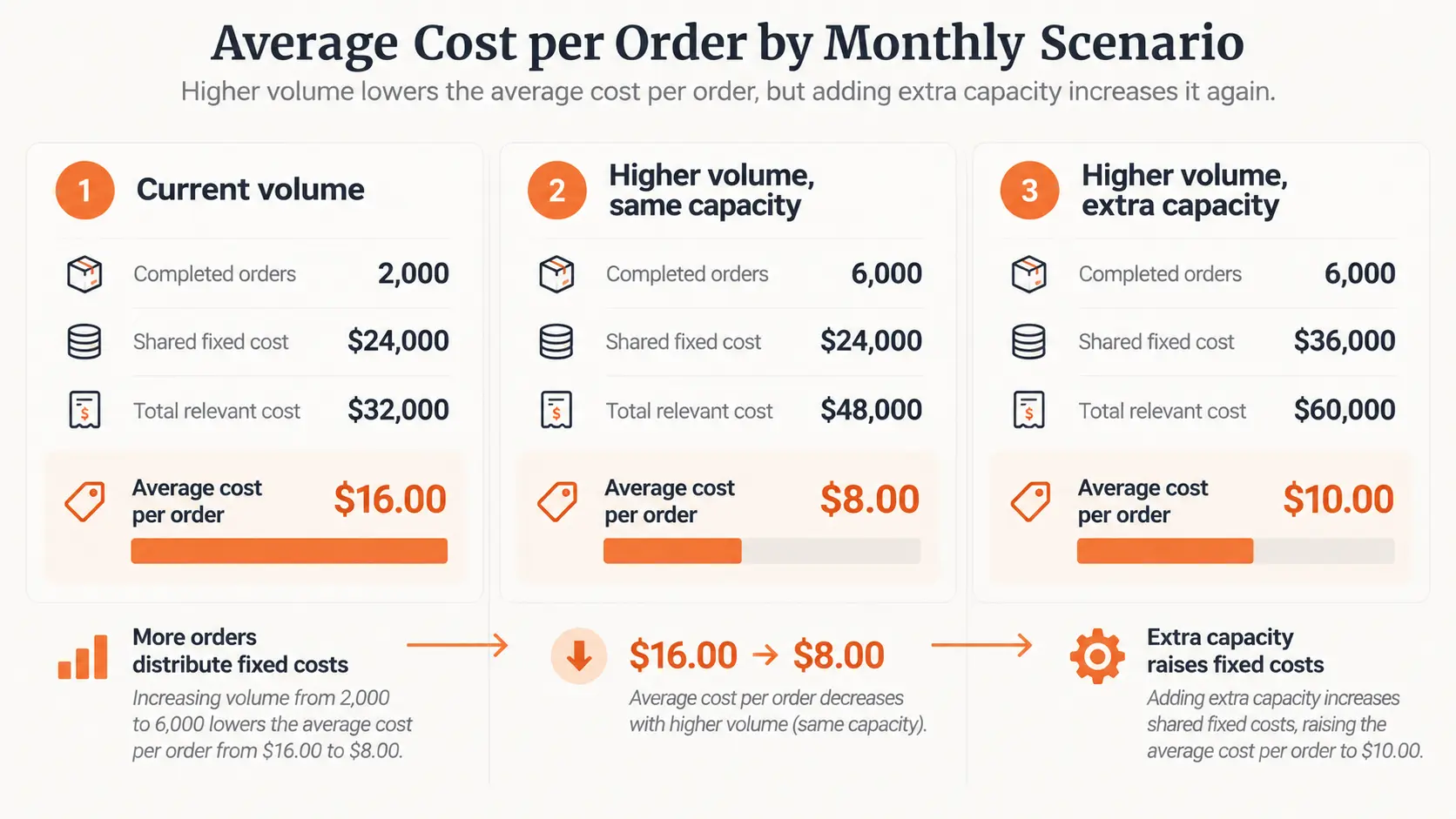
Now suppose serving 6,000 orders actually requires another $12,000 of monthly fixed operating capacity. The average cost is then $10, not $8. Scale still improves economics compared with the original $16, but the advantage is less dramatic than a simple fixed cost allocation suggests. The lesson is to model the next capacity threshold before making claims about long term cost leadership.
Average cost and marginal cost should not be confused. Average cost divides all relevant cost by all units, whereas marginal cost concerns the added cost of producing one more unit, or an additional block of units where capacity comes in steps. A declining average can coexist with a substantial marginal cost, particularly in services and AI products. Founders should examine both before lowering prices or promising unlimited usage.
When Lower Costs Become a Real Startup Moat
A cost improvement is useful internally, but it is not automatically defensible. If every competitor can rent the same cloud resources, purchase the same automation software, or obtain the same supplier discount, the efficiency may become the industry's baseline rather than a lasting edge. A moat is more plausible when the startup has access to scarce capacity, unusual process knowledge, a repeatable quality advantage, or utilization that competitors cannot match without significant time or investment.
One test is to compare the startup with an equally capable new entrant at the same service quality and realistic purchasing terms. Does the company retain a cost advantage after accounting for customer support, failures, compliance, and the next capacity step? Is the advantage large enough to matter for pricing or profit, rather than being a rounding error in the total cost structure? Would it persist if a large rival served a similar volume or if vendors changed their prices?
Founders should also ask whether customers receive any benefit. A company can use its lower costs to offer competitive pricing, reinvest in reliability, or sustain better margins during a difficult market. None of these outcomes is automatic, and the choice depends on the value customers perceive and the intensity of competition. A cost advantage is strongest when it protects an attractive customer proposition rather than hiding weak product demand.
Scale economies and network effects also need different evidence. A product can become cheaper to deliver as more customers join even when customers do not improve the product for one another. Conversely, a network may become more valuable with additional participants while costs also rise. Treating these two mechanisms as interchangeable can cause founders to misread the source of their advantage.
The Risks: Diseconomies of Scale and False Efficiency
Diseconomies of scale arise when the organization becomes more expensive per unit as it expands. Adding management layers, entering unfamiliar markets, increasing customer complexity, or operating multiple incompatible systems may erode earlier savings. The average cost curve does not have to fall forever. After a point, more volume can require disproportionate spending on coordination, quality assurance, and capacity.
There are subtler errors too. A company might report a lower infrastructure cost per account only because inactive accounts are included in the denominator, or it might move expenses from a delivery team into general overhead. A discounted supplier contract may lower unit price while increasing inventory losses. A temporary promotional price can raise order volume without demonstrating a structurally cheaper delivery process. These reporting choices can make growth look efficient even while cash demands intensify.
Lower average cost also does not guarantee profitability. If revenue per unit is below the cost of serving it, the company may lose money on each unit even as that loss becomes smaller. Acquisition spending, fixed corporate overhead, financing requirements, and customer retention still shape the business outcome. This article measures the cost mechanism behind a competitive advantage, not the full financing or valuation picture.
A Practical Scale Test for Founders
Start with one output that the company already delivers consistently. Build a simple cost map that separates committed capacity, costs that vary with activity, and costs that rise only when the business crosses a threshold. Compare at least three volume levels, including one that requires an operational change. Use real supplier quotes and engineering or operations estimates where possible, rather than assuming that a larger customer base will somehow make every cost cheaper.
Next, run a controlled test where demand allows. Increase volume in one product line, region, or customer segment while tracking cost per completed unit, quality, rework, and service time. Watch the marginal cost of the additional activity rather than celebrating only a falling overhead ratio. If a new process reduces both error rates and labor per successful delivery, record what made that improvement possible and whether a competitor could implement it easily.
Finally, translate the result into a competitive hypothesis. Estimate how long a capable rival would need to reach similar efficiency, which resources or learning would be difficult to obtain, and whether the advantage remains after the next capacity expansion. A credible scale moat is supported by observed cost curves, customer outcomes, and constraints on imitation. The goal is not growth for its own sake; it is a business that can deliver increasing value at an increasingly favorable cost structure.
FAQ
What is a simple example of economies of scale for startups?
A startup with fixed product development and security expenses may serve more paying accounts without increasing those costs at the same rate. If the total cost per comparable active account falls while reliability and support quality remain consistent, the company is experiencing economies of scale over that range. Usage based expenses and future capacity upgrades must still be included.
Are economies of scale the same as unit economics?
No. Unit economics describes the revenues and costs associated with a defined unit, such as an account or completed order. Economies of scale describes how the average cost of a comparable unit changes as output increases. A business may understand its unit economics without having a meaningful scale advantage.
Can a small startup benefit from economies of scale?
Yes. A small startup can improve utilization, standardize repeated tasks, or share fixed costs across a modestly larger customer base. The gain may be useful even if it is not yet a competitive moat. What matters is measurable improvement at a relevant level of output, not becoming a large company first.
Do software and AI startups have unlimited economies of scale?
No. Hosting, model inference, monitoring, support, security, and additional capacity can grow with demand. Some software products have low incremental delivery costs, while compute heavy products may retain significant variable expenses. The cost curve must be measured rather than assumed.
When do economies of scale become a competitive advantage?
They become more defensible when the lower cost per quality adjusted unit is material, repeatable, and difficult for rivals to replicate. A startup should test whether the savings survive realistic supplier terms, extra operating capacity, and a like for like competitive comparison. Lower average cost by itself is not proof of a moat.

Mohsen Avid
Founder & Editor, PinerookMohsen Avid is the founder of Pinerook, covering entrepreneurship, startup strategy, digital business, and the decisions behind building new ventures.
 Seen first.