Kalshi and Polymarket both let people trade on the outcomes of real events, but choosing between them takes more than comparing two probability percentages. The central differences are the legal venue you can access, the currency and custody model, the fees on a particular market, and the rules used to settle it. There is no reliable platform wide winner on price or liquidity: the better comparison is the exact contract you intend to trade.
For readers already familiar with Prediction Markets, the first distinction is easy to miss: Polymarket US and Polymarket International are separate products, not two interfaces connected to one account. Kalshi is a US regulated event contract exchange. Polymarket US is also a US regulated exchange, while the international platform uses blockchain based trading and is unavailable for new trading by US residents. That distinction changes nearly every meaningful side by side comparison.
Kalshi vs Polymarket at a glance
This comparison reflects publicly available platform documents reviewed in October 2026. Eligibility, market listings, and fee schedules can change, so any trade requires a fresh check of the specific venue and contract.
The most important distinction: there are two Polymarkets
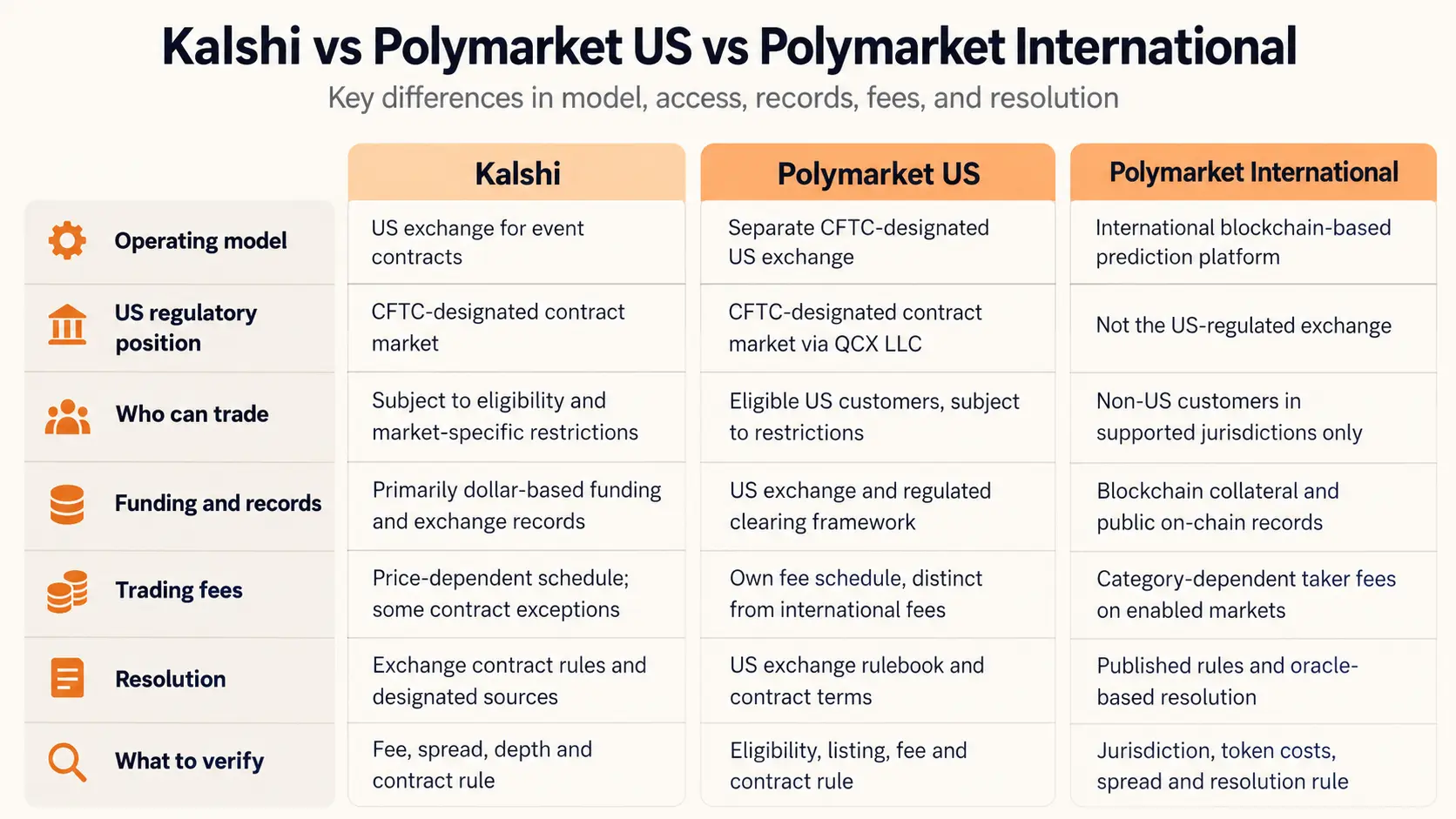
Many comparisons still describe Polymarket solely as a crypto based alternative to a federally regulated Kalshi. That is incomplete in 2026. Polymarket US operates through QCX LLC, which appears on the Commodity Futures Trading Commission’s list of designated contract markets. It is not the same venue as the international website; account access, collateral, oversight, available contracts, and customer support are separate.
Polymarket International, by contrast, is a non custodial blockchain based platform. Its trading history can be examined on chain, and its market outcomes follow published rules with an oracle and dispute process. US residents cannot use the international platform for new trading. Both the international service and the US platform have geographic or product limitations, so users should confirm eligibility rather than assume an app or website is permitted everywhere.
How trading and payouts compare
On both brands, the familiar event contract asks whether a defined outcome will happen. A Yes share priced at 60 cents is often read as an implied probability near 60%. If it settles as a winning one dollar contract, the gross difference is 40 cents per share before trading costs. If it loses, the stake can be lost. Before settlement, the position may be sold to another participant at the available market price, which may differ from the last displayed price.
The mechanism may sound identical, but contract wording matters more than brand familiarity. One venue might resolve a question from the first official data release, while another uses a later revised figure. Even similarly titled election, economic, or sports markets can apply different deadlines, eligibility criteria, cancellation provisions, or authoritative sources. A price gap between those markets is not automatically a risk free opportunity.
Kalshi vs Polymarket fees: what a trade really costs
Kalshi publishes a price dependent fee schedule. Its standard event contract taker calculation uses 0.07 multiplied by the number of contracts, the contract price, and one minus that price, subject to the schedule’s rounding rules and any series specific exceptions. Some Kalshi markets also charge maker fees. The actual fee must be checked on the trade and relevant schedule; “limit order” does not automatically mean “free.”
Polymarket International uses a different category based fee system for eligible markets. Its published taker rates vary across subjects such as crypto, sports, finance, and politics; certain geopolitical markets carry no trading fee. Makers are generally not charged trading fees under that international schedule. These rules should not be copied onto Polymarket US, which has its own fee structure and trading framework.
For a simple illustration, buying 100 contracts at 50 cents under Kalshi’s standard 0.07 formula produces a trading fee of about $1.75, assuming the ordinary multiplier and no contract exception. Under Polymarket International’s published sports taker rate of 0.05, a comparable 100 share, 50 cent trade produces a formula based fee of 1.25 in the platform’s dollar denominated fee units. These examples are deliberately not a claim about two executable offers: the traders may not have access to both venues, the market rules may differ, and the order books may show different bid and ask prices.
The spread is often just as important as the listed fee. A market showing a 52 cent last trade may have a best available purchase price of 55 cents, particularly when the order book is thin. For 100 shares, that three cent difference is three dollars before exchange fees. A nominally cheaper fee schedule cannot make up for consistently worse execution at the size you need.
Funding, custody, and settlement
Kalshi’s interface and ordinary event contract experience are organized around US dollar pricing and a centralized exchange account. Polymarket US similarly operates in a US regulated exchange and clearing framework. Polymarket International uses collateral tokens on Polygon. Following a 2026 exchange upgrade, the international platform introduced pUSD, a token designed to be backed one for one by USDC. Traders entering from a bank or another cryptocurrency may incur conversion, network, or third party processing costs in addition to market trading fees.
For settlement, Kalshi and Polymarket US follow the relevant exchange rulebook and contract terms. On Polymarket International, the UMA optimistic oracle has historically been used to propose and challenge market resolutions, with a final result governed by the particular market’s published rules. Neither approach removes event definition risk. Before entering a position, traders need to know who decides the outcome, when that decision becomes final, and what happens if a source is delayed, revised, or disputed.
Which platform has better markets and liquidity?
The answer depends on the event, the trading window, and the customer’s location. Kalshi offers a broad range of US focused event contracts, including economic and sports related questions. Polymarket International has extensive coverage across politics, world events, cryptocurrency, and culture, while Polymarket US lists markets through its distinct US framework. Listing breadth is not the same as executable liquidity: a long catalog may include thinly traded contracts.
Instead of choosing a platform by total headline trading volume, compare the exact market’s best bid, best ask, available size at those levels, and recent trading activity. A liquid market can support a modest order with little price impact, while a thin one may move sharply as soon as an order is placed. Readers using markets as business signals should also distinguish price discovery from forecasting accuracy: heavy activity is not proof that the crowd has superior information.
A practical example: the same economic event on two venues
Imagine two exchanges show contracts about a forthcoming inflation release. Venue A displays a Yes price of 54 cents, and Venue B displays 51 cents. It is tempting to conclude that Venue B is the cheaper expression of the same forecast. A closer reading may show that A refers to the initially published annual inflation rate, while B settles using a different measure or rounding convention. The dates can also differ. These are not necessarily interchangeable contracts.
Even when the rules match, the prices must be compared on an executable basis. Suppose the best available offer at A is 56 cents with a tight spread and enough size for the entire order. At B, the first 20 shares cost 52 cents but the remaining 80 require paying 57 cents or more. B’s headline price is lower, but the full order may be more expensive before fees. This is why the relevant comparison is total expected entry cost for the intended size, followed by likely exit cost or settlement terms.
How to choose between Kalshi and Polymarket
For US residents
Start with the eligible US products: Kalshi and Polymarket US. Compare the actual available contracts, current fee schedule, payment methods, identity requirements, and trading restrictions. Do not treat Polymarket International as another route to the same market. Federal exchange designation also does not mean every category of event contract is available in every location; state level legal challenges and product restrictions can affect access.
For eligible international users
Check which platform is legally available in your jurisdiction and whether the contract is offered there. Some readers will find Polymarket International relevant, but its blockchain collateral, wallet security, and settlement workflow introduce operational considerations that differ from a dollar based exchange account. Never attempt to bypass location restrictions with a VPN; eligibility is part of the trading decision.
For founders, analysts, and researchers
The objective may be to observe forecasts rather than place trades. In that case, a useful source is the market with clearer resolution terms, active order books, historical records, and better alignment to the business question. Comparing two venues can reveal how different groups price uncertainty, but apparent consensus should still be tested against official data, external forecasts, and the possibility of thin or biased participation.
Common mistakes when comparing the two
A frequent mistake is ranking platforms solely by the percentage on the screen. Another is comparing international Polymarket fees with Kalshi charges as if both accounts were available to the same user. Others ignore exchange specific market wording, assume that all maker orders are free, or use 24 hour volume instead of visible depth to estimate execution costs. A careful comparison begins with permission to trade, continues with an exact contract match, and only then examines price, liquidity, fees, and settlement risk.
Frequently asked questions
Is Polymarket regulated in the United States?
Polymarket US operates through QCX LLC, a CFTC designated contract market. Polymarket International is a separate blockchain based platform and is not the US regulated exchange. The name Polymarket alone does not identify which legal venue a person is using.
Can US residents trade on Polymarket.com?
No. Polymarket’s international website does not permit US residents to deposit or place new trades. Eligible US users must use the separate Polymarket US service and follow its current account and location requirements.
Is Kalshi cheaper than Polymarket?
Not universally. Kalshi’s charges vary with price and certain market rules. Polymarket International uses category dependent fees, while Polymarket US has a separate schedule. The relevant comparison is the full executable cost for a matching contract, including spread and any funding costs.
Why do Kalshi and Polymarket show different probabilities?
Different participants, order book liquidity, trading costs, and contract wording can produce different prices. Prices may also be recorded at different times. A difference is meaningful only after confirming that both contracts define and settle the same event.
Which platform is better for predicting events?
Neither brand guarantees more accurate forecasts across every category. Reliability depends on the specific market’s information quality, liquidity, time to resolution, and the incentives of participants. For analysis, compare the track record of closely matched, resolved questions rather than a few high profile outcomes.

Masoumeh Jahangard
Markets & Economy Writer at PinerookMasoumeh Jahangard covers markets, economic trends, and business conditions for Pinerook, focusing on how they affect startups and growing companies.
 Seen first.