A company receiving stablecoins cannot simply record every token as cash and close the books when a blockchain transaction is confirmed. The finance team must establish what asset it received, the value of that asset at the relevant date, which customer invoice or supplier obligation it settles, and what happens when the token is converted or transferred. The practical accounting begins with the transaction’s economic substance, not the wallet balance displayed by a payment app.
The broader case for using digital dollars in commercial payments is covered in Stablecoins for Business. This guide addresses the next problem: how an accountant turns those payments into a consistent ledger, audit trail, and set of financial statements. It focuses on businesses that accept or hold stablecoins rather than companies that issue them. The exact entries depend on contract terms, the reporting framework, and the facts of the transaction, so a documented accounting policy is essential.
What Stablecoin Accounting Must Capture
A useful starting point is to separate four events that payment software often displays together. First, the business recognizes the underlying sale, purchase, or liability under the usual revenue or expense rules. Second, it receives or transfers the stablecoin. Third, it may continue holding a token whose accounting value can change. Fourth, it may redeem or sell the token for money in a bank account. Each event can have a different accounting date, amount, and supporting record.
For example, a software company might issue a dollar invoice on Monday, receive USDC on Tuesday, and receive bank dollars from its payment provider on Thursday. The invoice, token receipt, and bank settlement should be traceable to one another, but they are not the same event. If the provider converts the payment before the merchant receives it, the merchant may never control the underlying token. The contract and settlement reports determine whether a stablecoin asset belongs on that merchant’s balance sheet at all.
How Are Stablecoins Classified Under US GAAP and IFRS?
The most consequential question is whether a token represents a contractual claim, another financial asset, a qualifying cash equivalent, or an intangible asset. Two dollar linked stablecoins can look identical in a wallet while giving their holders different enforceable rights. A token’s name or intended one dollar price does not settle its financial reporting classification. The same company can also hold an instrument under different circumstances, such as direct issuer redemption versus access only through a secondary exchange.
Under US GAAP, FASB Accounting Standards Update 2023 08 introduced fair value guidance for crypto assets that meet the criteria in ASC 350 60. The scope excludes, among other assets, tokens that give holders enforceable rights to or claims on underlying goods, services, or other assets. As a result, it is incorrect to assume that every stablecoin automatically follows that crypto asset model. Depending on the terms, some stablecoins may fall under other financial asset or intangible asset guidance. Certain arrangements may qualify as cash equivalents if the applicable requirements are met, but classification is fact specific and should not be inferred from the peg alone.
This issue remains active rather than completely settled in practice. During 2026, FASB continued work on the classification and disclosure of certain digital assets as cash equivalents. Finance leaders should check the final guidance and their reporting date, instead of treating a proposed clarification as an issued standard. An accounting memorandum should explain the token’s redemption rights, liquidity, restrictions, issuer obligations, and the standards supporting the selected classification.
For an entity reporting under IFRS, contractual rights are equally central. A stablecoin with an enforceable right to receive cash may require assessment under IFRS 9 and the definition of a financial asset. When those rights are absent or insufficient, IAS 38 or, for qualifying holdings held for sale in the ordinary course of business, IAS 2 may be relevant. The IFRS Interpretations Committee’s older guidance about cryptocurrencies did not establish that every redeemable stablecoin is an intangible asset. Accountants should therefore examine the particular instrument rather than mechanically applying cryptocurrency examples to all stablecoins.
Recording Stablecoin Payments From Customers
Start with the customer contract. A merchant that has earned revenue records the sale and related receivable according to its ordinary revenue recognition policy; receiving tokens does not itself create a second sale. When the customer settles the receivable with an asset the merchant controls, the business generally derecognizes the receivable to the extent that the payment satisfies the contractual obligation and recognizes the asset received using its applicable accounting policy. The invoice currency and the token’s fair value may differ, even when each token is designed to be worth one dollar.
A business should distinguish direct token receipt from processor managed settlement. With direct receipt, the company holds a token and needs a policy for classification, measurement, and eventual disposal. With processor managed fiat settlement, the company may have only a receivable from the service provider followed by a bank deposit, depending on the arrangement. Payment interface labels such as “paid” or “settled” are not sufficient evidence of who owned the token between those events.
The recognition date also matters. A transaction broadcast to a blockchain may be pending, reversible through a custodian’s internal process, or subject to network confirmation criteria. The finance team should adopt a consistent control based definition of when the asset is received and when a payable is discharged. That policy should reflect actual enforceable rights and settlement terms, not a generic number of blockchain confirmations.
A Practical Journal Entry Example
Assume a US based design agency uses dollars as its functional currency. It previously recognized a $10,000 invoice for completed services. The customer pays 10,000 tokens of a dollar linked stablecoin, and the tokens have an observable total value of $10,000 when the agency obtains control. Two days later, the agency sells the tokens through a provider and receives $9,950 in its bank account after a separately identifiable $50 conversion fee. For simplicity, this illustration assumes no intervening remeasurement difference and a policy under which the asset is recorded at the stated amount.
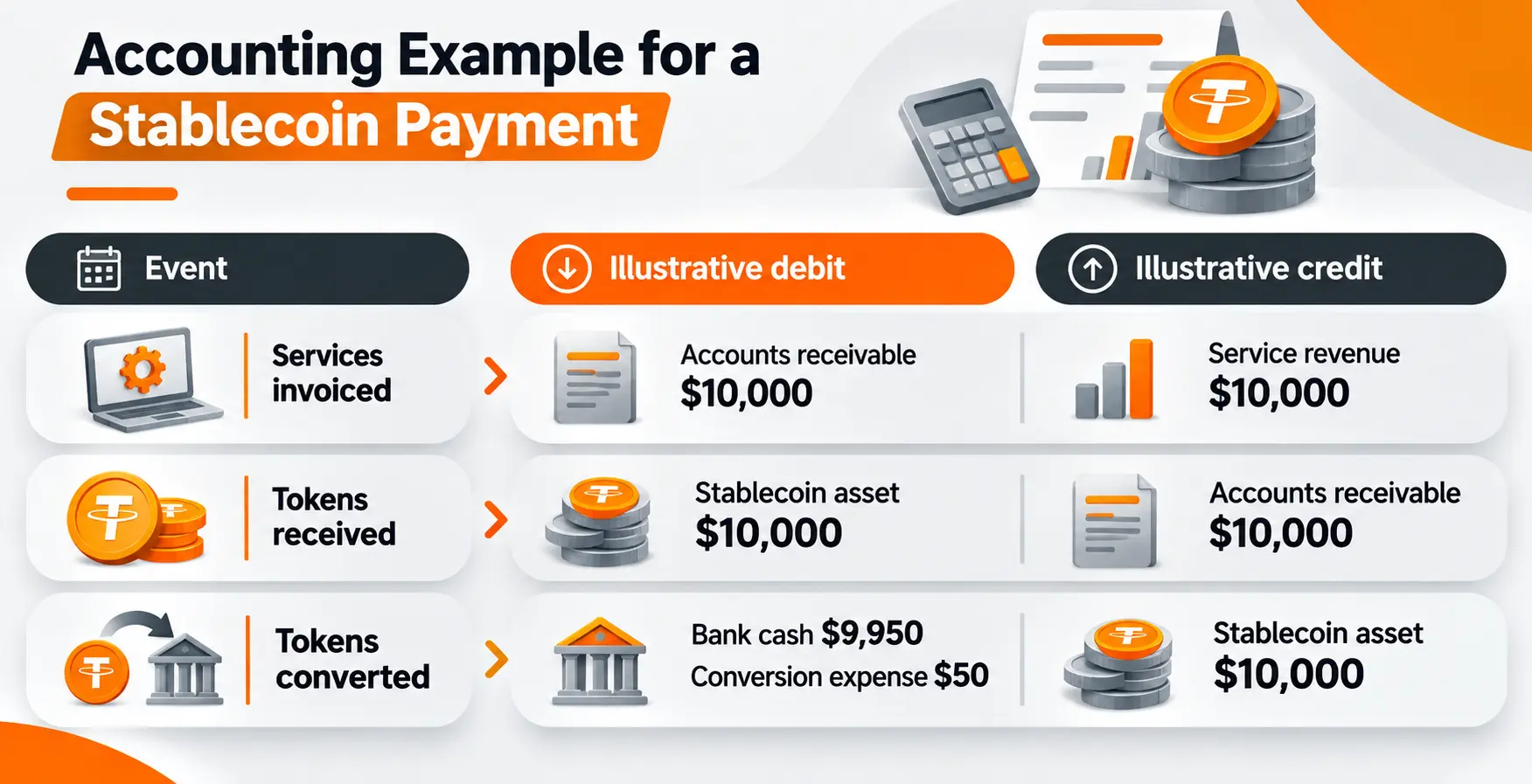
These entries illustrate the flow of value rather than prescribing a universal chart of accounts. A company using a qualifying cash equivalent classification would label and present the asset differently. If a market price movement occurs before conversion, additional measurement or disposal entries may be required under the relevant standard. Likewise, the $50 might require different presentation if it is embedded in a conversion price rather than identified as a service charge. The accountant should reconcile the gross token amount, any recognized gain or loss, the fee, and the net deposit so that no part of the transaction disappears.
Now consider a less comfortable variation: the invoice is $10,000, but the stablecoin received is worth only $9,980 on the settlement date. The business should not automatically value it at $10,000 because the token normally trades near its peg. It must decide whether the original debtor still owes $20, whether the payment contract defines the token quantity as full settlement, or whether another contractual adjustment applies. That distinction is an accounting judgment about the transaction and customer rights, not merely a crypto price calculation.
How to Account for Value Changes and Depegging
The word stable can make financial reporting errors look harmless. A token that falls from $1.00 to $0.97 represents a three percent change in market value before fees. On a holding of 80,000 units, the change would be $2,400 if the accounting model measures the asset on that basis. Whether and where the change is recognized depends on the applicable classification and measurement requirements. The finance team cannot choose a convenient valuation approach only when market prices move against the business.
At each reporting date, determine which price or measurement basis the chosen standard requires, whether reliable observable prices exist, and whether the company has a direct redemption right distinct from a secondary market quote. Consider any restrictions on selling, redemption delays, counterparty exposure, and events after the reporting date. A separate report should track the amount available for immediate operating use. A book value or displayed token balance does not by itself establish how much cash payroll can access tomorrow.
For a depeg or redemption suspension, the company may need to evaluate impairment, fair value changes, credit loss requirements, or disclosures, depending on its model. It should document when management learned of the event, which market data it used, and why the selected estimate reflects the applicable standard. This accounting work is distinct from choosing how much stablecoin risk the treasury should accept in the first place.
Reconcile Wallets, Invoices, Providers, and Bank Accounts
Stablecoin bookkeeping becomes unreliable when the finance team relies on only a blockchain explorer. The blockchain may show a transfer but not the customer invoice, the legal owner of a custodial wallet, the processing fee, or the funds that finally arrived in the bank. An audit ready process links each invoice and accounting entry to a token identifier, blockchain network, wallet or custody account, transaction reference, timestamp, gross and net token amounts, conversion rate, and provider settlement record.
The first reconciliation should match expected customer collections with payment receipts. A second should match the token subledger with supported wallet and custodian balances. A third should match conversions and withdrawals with provider reports and bank statement deposits. Fees, rejected transfers, transfers between company controlled wallets, and assets still in transit need separate treatment. In particular, moving tokens between two wallets controlled by the same entity is normally a transfer of location, not new revenue.
The controls should also make responsibility clear. Someone other than the payment initiator should review material transactions and unresolved exceptions. Access to private keys, custody dashboards, and settlement exports should follow role based permissions with approval limits. A monthly close that depends on one employee manually remembering what a wallet address represents will not scale as transaction volume increases.
Taxes and Supporting Records Are a Separate Question
Financial statement accounting and tax reporting are related, but they are not identical. For US federal income tax purposes, the IRS generally treats digital assets, including stablecoins, as property and requires adequate records of receipts, exchanges, and dispositions. A business receiving a digital asset as payment for services needs evidence of its US dollar fair market value when received, as well as the transaction date and relevant cost basis records. Subsequent conversion or disposal can have additional tax consequences even if the coin was intended to track the dollar.
The tax character of any gain or loss depends on the circumstances, including the business’s activity and how it holds the asset; it is not safe to assume every difference is a capital gain or that every $1 stablecoin transaction has zero tax impact. Businesses operating across borders also need to determine whether local indirect taxes, payroll obligations, withholding, or electronic reporting rules apply. Accountants should retain pricing sources and transaction evidence that support both financial reporting and tax filings without pretending the two systems always use the same values.
Financial Statement Presentation and Disclosures
A balance sheet should communicate what the company owns and how readily it can use that value. If a token qualifies for cash equivalent treatment, the company still needs to consider restrictions, concentration, materiality, and relevant disclosure requirements. If it is accounted for as a financial or intangible asset, financial statement presentation and subsequent measurement may be different. Netting all token holdings against bank cash can therefore hide material differences in rights and risks.
Users of the financial statements may need to understand which stablecoins are held, which entities issue or safeguard them, whether direct redemption is available, and how significant valuation or liquidity risks are assessed. Material accounting judgments and concentrations should be explained consistently. The cash flow statement can also require analysis of whether a particular movement is a cash flow, a transfer among cash equivalents, or a noncash transaction. The answer follows the classification and actual transaction structure, not the stablecoin label.
Build a Repeatable Monthly Close Process
Before accepting meaningful volumes, agree a written policy covering the supported tokens, approved providers, transaction recognition points, functional currency, valuation evidence, fees, accounting classification, and cut off controls. Map the provider’s transaction export to the general ledger and decide what exceptions trigger manual review. A small pilot should use actual transactions and at least one period end close, not just screenshots of successful payments.
During the close, confirm wallet ownership and balances, reconcile unsettled invoices, investigate unmatched transfers, verify conversion rates, and review any significant movements in token prices. Check whether the company holds assets for which direct redemption is unavailable or restricted. Finally, review financial statement classification, disclosures, and tax records with the accounting team. A process that can be explained and repeated by someone other than its designer is more valuable than an automated dashboard that nobody can audit.
The Practical Bottom Line
Businesses can accept a dollar linked token without having dollar cash, and they can settle a customer invoice before the proceeds reach a bank. Accurate stablecoin accounting makes those distinctions visible. The essentials are a defensible asset classification, complete recognition of every business transaction, reliable valuation evidence, reconciled custody records, and consistent reporting at period end.
The best implementation is deliberately ordinary: begin with the invoice, follow the asset as it changes hands, document fees and valuation, and connect the ending balance to independent evidence. If an accountant cannot explain exactly where the recorded amount came from and who can redeem it, the payment process is not yet ready to scale. The objective is not crypto specific complexity. It is the same clarity that reliable business accounting should provide for any asset or payment method.
FAQ
Are stablecoins recorded as cash on a balance sheet?
Not automatically. Classification depends on the token’s contractual rights, liquidity, regulatory structure, and the applicable accounting framework. Certain arrangements may qualify as cash equivalents, while others are treated as financial or intangible assets. An intended one dollar peg does not establish the classification by itself.
Does receiving USDC create business revenue?
Receiving USDC can settle a sale or service invoice, but the revenue event is determined by the underlying customer contract and revenue recognition rules. If the business already recognized the revenue, receiving the token usually settles a receivable rather than producing a second revenue entry.
Do businesses need to record stablecoin conversion fees?
Yes. A finance team should account for the difference between the gross amount received and the funds delivered after conversion. Whether the difference is a separately identified fee, spread, or gain or loss depends on the transaction and applicable accounting policy.
Can a blockchain transaction hash replace an invoice?
No. A transaction reference can support evidence that a transfer occurred, but it generally does not establish the customer, contractual purpose, valuation, tax documentation, or legal ownership required for complete accounting records.
Does a stablecoin payment create tax reporting obligations?
It may. In the United States, the IRS generally treats stablecoins as digital assets and expects records of receipt and disposal, including relevant dollar values. The exact tax result depends on the transaction and taxpayer circumstances, so it should be reviewed separately from the financial statement entry.

Masoumeh Jahangard
Markets & Economy Writer at PinerookMasoumeh Jahangard covers markets, economic trends, and business conditions for Pinerook, focusing on how they affect startups and growing companies.
 Seen first.