Stablecoins are becoming a practical option for certain business payments, but their value depends on what happens before and after a blockchain transfer. A fast transaction does not guarantee that the recipient can obtain local currency cheaply, that the issuer can redeem tokens under stress, or that the business can reconcile the payment correctly. For founders and finance teams, the relevant question is not whether stablecoins are innovative. It is whether they solve a measurable financial problem more reliably than existing payment methods.
A business should consider stablecoins when traditional rails create material delays, unpredictable foreign exchange costs, restricted payment windows, or excessive dependence on intermediary banks. It should avoid treating them as an automatic replacement for bank accounts, working capital controls, or regulated payment providers. This guide explains how the system works, where it may help, what it actually costs, and how to run a small pilot without exposing the entire treasury operation to a new kind of risk.
What Are Stablecoins in a Business Context?
A stablecoin is a digital token intended to maintain a reference value, commonly one US dollar or one euro. Many payment oriented stablecoins are issued by companies that hold reserves and provide a defined redemption process. Others use different collateral structures or mechanisms. The word stable describes the intended price behavior, not a promise that all stablecoins have identical protections or that their price can never move.
For a company, the distinction between holding a token and holding a bank deposit matters. The token exists on a blockchain or related ledger, while the financial rights attached to it depend on the issuer, applicable law, custody arrangement, and redemption terms. A stablecoin is not automatically an insured deposit or legal tender simply because it targets a currency's value. The finance team must establish who owes the holder money, under what conditions, and how the holder can actually recover that value.
Stablecoins can also be confused with ordinary cryptocurrencies and central bank digital currencies. An unpegged cryptocurrency typically has a market driven price; a stablecoin aims to track a reference asset; a central bank digital currency, where issued, represents a different legal and institutional arrangement. These differences are more important to a business than whether the payment interface looks like a familiar online wallet.
Why Businesses Are Paying Attention in 2026
The strongest argument for stablecoins is not that blockchains move enormous headline transaction volumes. Much of that activity includes trading, internal transfers, and automated financial transactions rather than purchases of goods and services. A February 2026 analysis by McKinsey and Artemis estimated approximately $390 billion of actual stablecoin payments at an annualized rate based on activity in December 2025. The researchers emphasized that this was a small fraction of global payment value, even as certain business uses were growing.
More recent evidence points to increasing commercial experimentation. In October 2026, Visa reported that approximately 17 percent of stablecoin linked card volume across the period it measured came from business and commercial card programs. This measures activity within Visa's relevant programs, not the share of all business payments made with stablecoins. Neither figure, by itself, proves that a particular founder should adopt the technology. They instead demonstrate why a careful business case is worth examining.
Cross border commerce is a particularly important setting. A startup may have customers in one region, suppliers in another, and contractors working across multiple time zones. A traditional wire can involve several providers, foreign exchange conversion, and banking cutoffs. A stablecoin transfer may shorten one portion of that process, but exchanging money into and out of the token can still introduce delays, cost, and compliance requirements.
How a Business Stablecoin Payment Actually Works
Imagine a software company in the United States needs to pay a supplier whose expenses are in euros. The company could arrange to buy a dollar denominated stablecoin through an authorized service, send the token over a supported network, and have a provider convert it into euros for the supplier. Alternatively, a regulated payment platform might handle the token movement behind the scenes so neither business directly manages a wallet. Those two approaches can deliver a similar user experience while creating very different operational responsibilities.
The full route matters more than the blockchain step alone. First, funds enter through a bank account or other authorized source. Second, the payment provider converts them to the chosen stablecoin or routes value through its own settlement arrangements. Third, the token is transferred or settled. Finally, the recipient holds the token, spends it, or converts it into an account balance in the currency it needs. A finance team should verify each stage, especially the last one, before declaring that a payment was successfully completed.
In Stablecoin Payment Processing, providers may supply checkout tools, invoicing, wallet infrastructure, identity verification, sanctions screening, conversion, and reporting. A merchant accepting a stablecoin but receiving ordinary fiat currency can have a much simpler accounting and custody experience than a business holding token balances directly. Yet an integrated service can also add fees, jurisdictional restrictions, and counterparty dependencies that need to be understood before launch.
Where Stablecoins Can Solve Real Business Problems
Not every transaction needs a new rail. Domestic payments between bank accounts may already be inexpensive and fast, especially where real time systems are available. Stablecoins become more interesting when a specific combination of payment timing, geography, currency conversion, or customer access creates friction that ordinary solutions cannot resolve economically.
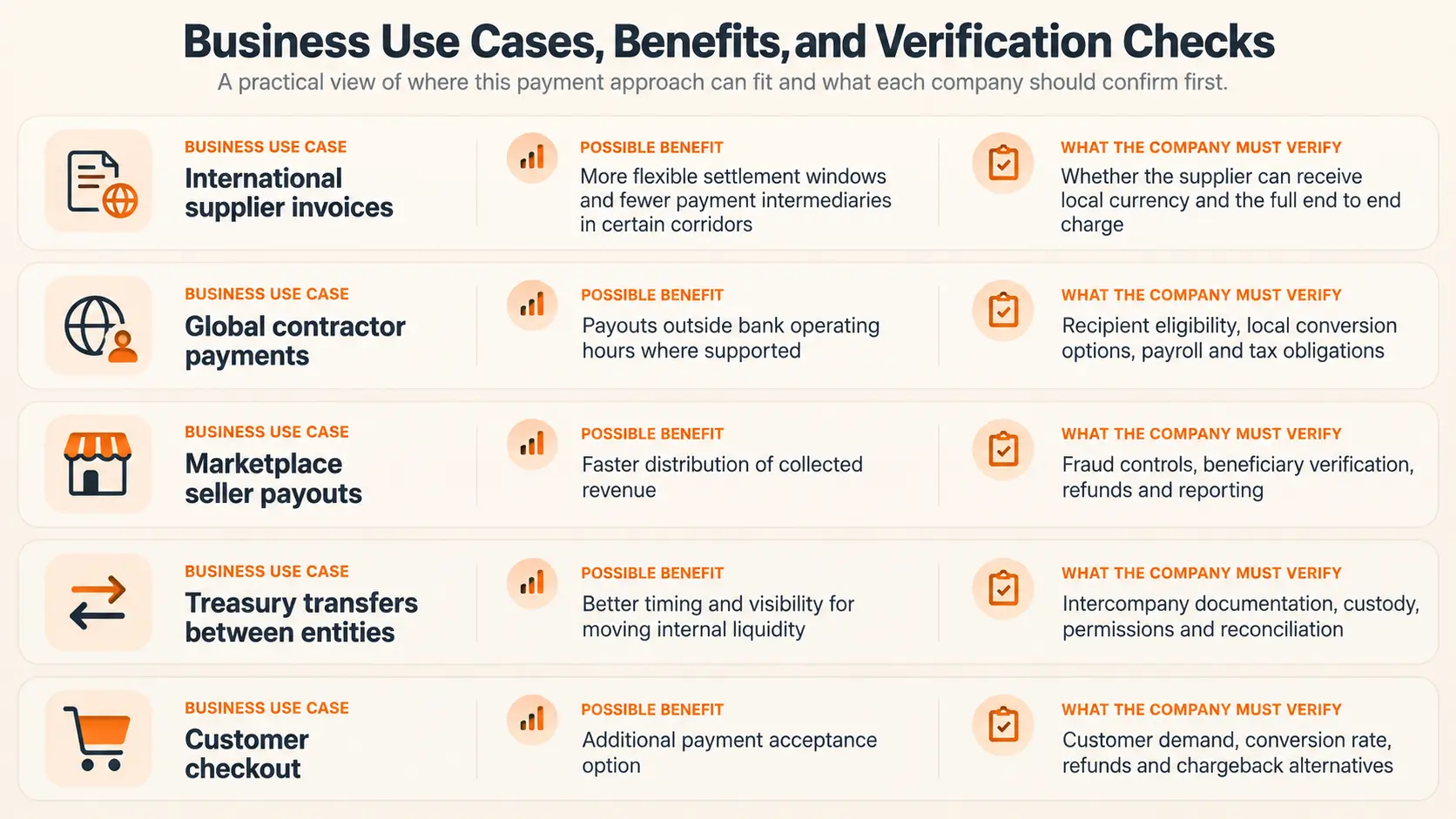
The main attraction of Cross Border Stablecoin Payments is that a company may reduce friction along selected international routes. But benefits are corridor specific. A payment between two countries with modern banking connections may not improve meaningfully, while a transfer involving limited correspondent banking can be quite different. The right comparison is between complete payment journeys for the same beneficiary and invoice, not between a blockchain confirmation time and a bank's advertised transfer time.
A second application is Stablecoin Treasury Management, especially for companies with cash movement needs across entities, time zones, or markets. Treasury teams may be able to move funds during evenings and weekends, reducing some timing constraints and prefunding requirements. That is not the same as increasing the amount of safe cash available to the company. A token balance introduces issuer exposure, custody exposure, and liquidity questions that a board or finance lead should approve explicitly.
What Does a Stablecoin Payment Really Cost?
A stablecoin transaction can have a very small network fee and still be an expensive business payment. The cost can include access charges, the spread when acquiring the token, the network charge, an intermediary's processing fee, the spread when selling the token, and the amount deducted by a receiving provider. If a company needs extra accounting work or has to maintain a funded balance with several providers, those costs also belong in the analysis.
The search for Stablecoin Payment Fees should begin with an end to end quote from the sender's original currency to the recipient's spendable currency. Consider a purely hypothetical $20,000 supplier invoice. A conventional route might charge $35 in bank fees, $240 in conversion costs, and $10 at the receiving bank, a total of $285. A token based route might instead charge $25 to enter, $70 for conversion, $2 for network movement, and $18 for withdrawal, a total of $115. The illustrative difference is $170, but these are not market price quotes and cannot be generalized to every provider or country.
The real comparison should also record the time until the beneficiary can use the funds, the probability of manual review, the consequences of sending money to the wrong address, and the cost of fixing a disputed transaction. A cheaper transfer with an unreliable off ramp may have a higher operational cost than a slightly more expensive bank payment. A founder should require evidence across repeated transactions before updating the company's payment policy.
Stablecoins or Traditional Banking: Which Rail Fits?
A comparison of Stablecoin vs Bank Transfers works best when the business defines its priorities first. For a domestic salary payment, a supported bank payroll system may already offer familiar legal protections, controls, and a clean accounting trail. For a time sensitive supplier transfer across a difficult international corridor, a carefully selected stablecoin provider might be faster and less costly. The answer will change by provider, jurisdiction, amount, currency, and the type of payment being made.
Businesses do not have to choose one system for everything. A sensible design can keep bank deposits as the main operating balance, use established domestic payment systems wherever they work well, and enable a stablecoin route only for transactions with demonstrated benefits. This approach limits concentration risk and makes it easier to switch back if a token issuer, network, or intermediary fails a required control.
The business also needs to distinguish three operating models. A fully managed provider may accept a conventional bank or card payment on one side and settle through stablecoins behind the scenes. A platform may allow customers to pay with a token while the company receives fiat. A self managed system may require the company to hold tokens and maintain private key controls. Similar payment speed does not mean those models carry comparable levels of responsibility.
The Risks That Do Not Disappear When Prices Look Stable
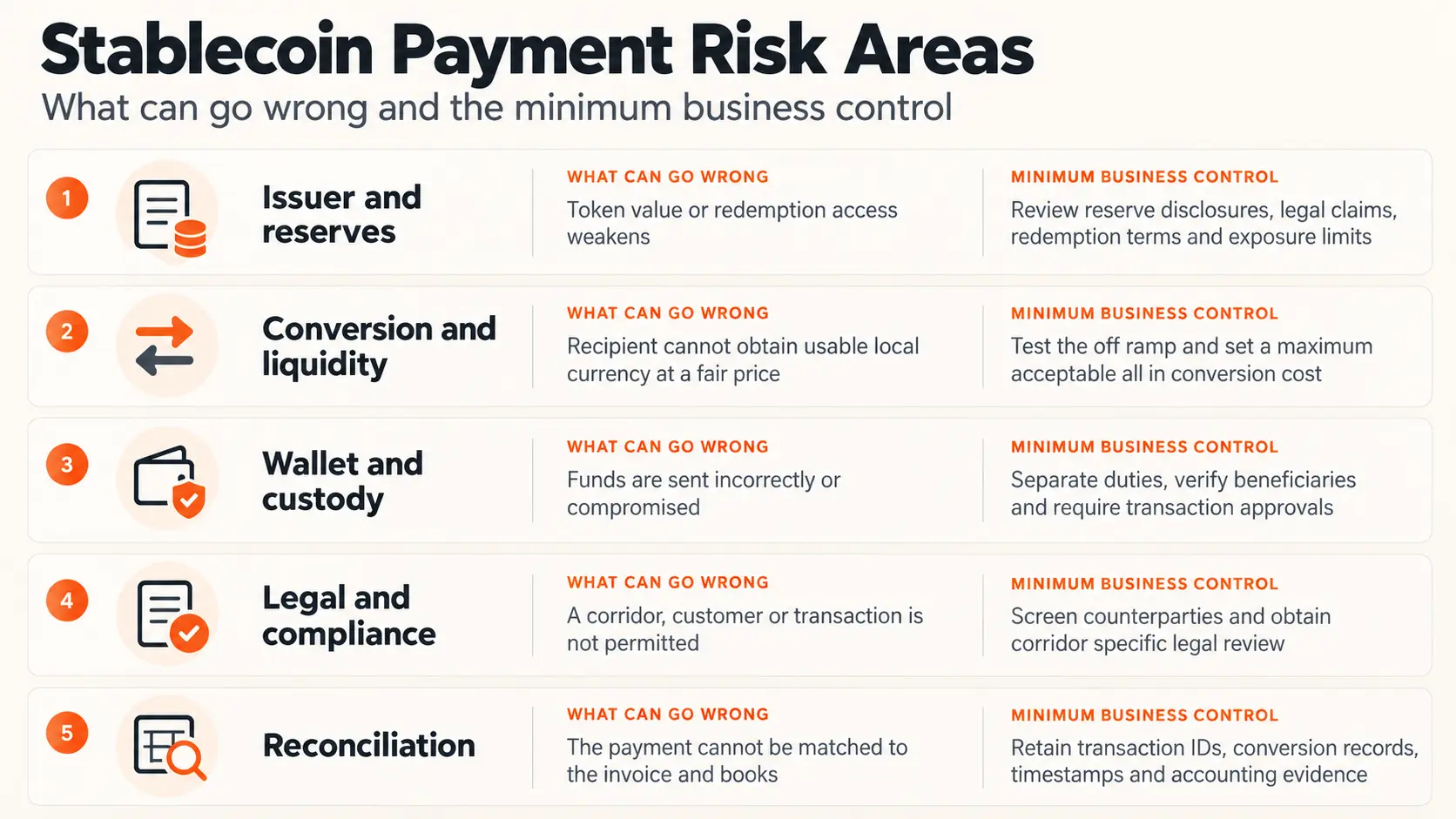
Stablecoin Depegging Risk is the possibility that a token no longer trades close to its reference value. This may follow concerns about reserves, access to redemption, market liquidity, or broader stress. Even a token backed by apparently sound assets can create short term conversion problems if major exchanges or service providers cannot process exits. For any balance held for business operations, the question is how quickly the company can obtain spendable funds during a disruption, not only what the token was worth on a normal day.
Issuer and redemption risk are separate from network risk. A blockchain might continue functioning while an issuer freezes accounts or delays redemptions. The token could be redeemable in theory but unavailable to the particular business because it lacks a direct issuer relationship. A provider might have the correct licenses yet be unable to offer a usable off ramp in the destination country. Each failure point deserves its own contingency plan.
Custody risk matters as much as the coin itself. When a company controls private keys, stolen credentials or an incorrect destination address may lead to irreversible loss. Even businesses using outsourced custodians should know who can authorize transfers, whether approvals require more than one person, what transaction limits apply, and what happens when an employee leaves. Finance and security leaders should rehearse those controls before transferring meaningful balances.
Regulation, Tax, and the Limits of a Global Payment Network
Stablecoin Regulation for Businesses is not a single universal rulebook. Issuers, exchanges, custodians, payment firms, and ordinary commercial users may fall under different obligations. A business operating across jurisdictions must consider financial services laws, sanctions, anti money laundering measures, consumer protection, tax treatment, and any rules governing who may use a particular token or provider. Being able to transmit a token technically does not establish that the payment is lawful or compliant for the parties involved
In the United States, the GENIUS Act was enacted in 2025, and on October 21, 2026 the Office of the Comptroller of the Currency announced a final rule covering categories of payment stablecoin issuers and relevant custody activities under its supervision. The agency stated that the rule and the Act take effect on January 18, 2027, and that certain anti money laundering and sanctions details will be addressed separately. A business should not interpret the announcement as blanket approval for all tokens or as proof that every commercial payment receives deposit insurance or banking protections.
In the European Union, the MiCA framework addresses relevant categories of crypto assets and services, with separate implications for issuers and service providers. Other markets impose different restrictions on access, conversion, transfers, or promotion. Regulatory checks therefore need to cover the sender, recipient, stablecoin issuer, network service, and settlement provider. For an international startup, legal review should be tied to the specific payment corridor rather than a generic statement that stablecoins are regulated.
Tax and bookkeeping requirements remain relevant even when a token aims to equal one dollar. Stablecoin Accounting for Businesses requires a documented approach to recording the initial payment, any asset held, conversion fees, possible gains or losses, and the invoice being settled. Accounting classification can depend on the governing standards, the legal rights associated with the token, and the company's role in the transaction. A merchant receiving immediate fiat may face a very different workflow from a company that maintains sizeable token balances on its books.
How to Evaluate a Stablecoin Provider Before a Pilot
Selection should begin with the business process, not the coin's popularity. Finance teams should identify where the current payment process fails, what measurable improvement is required, and which parts of the new flow a vendor will actually perform. A provider promising instant settlement should explain whether that refers to blockchain finality, arrival in the recipient's wallet, or availability of spendable local currency. Those are different milestones.
A practical due diligence review covers the issuer and redemption arrangement, supported regions, customer verification, custody structure, access permissions, transaction monitoring, fraud procedures, pricing, operational resilience, and exportable records. It should also document what happens when a payment is delayed, recalled by a service provider, or mistakenly directed. A company that cannot identify who owns each failure case is not ready to scale the route, however attractive its transaction fee may appear.
Where possible, use a small pilot with a willing counterparty rather than moving all supplier payments at once. Run transactions of differing sizes and at different times, including when traditional banks are closed. Record the total sender cost, delivered amount, settlement completion, receipt confirmation, exception rate, and the finance team's time needed to reconcile each payment. Retest if the provider, coin, or jurisdiction changes materially.
A Practical Decision Framework for Founders
Start with the operational constraint. Is the problem the cost of international supplier payments, unavailable banking hours, delayed marketplace payouts, or trapped liquidity across subsidiaries? If the problem has already been solved by a reliable bank or established payment processor, adding a token may create work without improving the outcome. The business case should specify the existing baseline before a stablecoin pilot begins.
Next, evaluate the entire corridor. Check that the origin provider can obtain the token, that the chosen route supports the transaction, and that the recipient can access usable value. Establish what currency the recipient needs and who will absorb fees or exchange differences. A business is not solving the problem if it shifts the burden to a supplier or contractor who must navigate an unfamiliar wallet and expensive conversion service.
Then set clear financial limits. Choose a modest pilot amount, cap token balances and provider exposure, require authorized counterparties, and document a fallback route. Designate one person accountable for finance operations and another for technical or security controls. Approval processes, reconciliation evidence, incident escalation, and support responsibilities should be agreed before the first live transaction.
Finally, compare actual outcomes with the baseline across several payments. The decision is not simply whether the pilot was faster. A useful route must improve total landed cost, timing, operational predictability, or customer access without creating disproportionate risks. If the provider cannot deliver repeated evidence of improvement, preserve the conventional route and revisit the case only when conditions change.
Metrics That Show Whether the Business Case Works
The clearest metric is total delivered cost: the sender's original currency amount minus the spendable amount the recipient ultimately receives, adjusted for the invoice value. Track median and worst case settlement times, not only average blockchain confirmation. A business should also record payout failures, manual intervention, days of money held before conversion, and any payments that required compliance review. These measures reveal whether the process is reliable at normal and difficult moments.
Cash and risk metrics matter too. Monitor peak stablecoin balance, exposure by issuer, amounts held with each intermediary, and the time required to convert those assets during a disruption. Account for vendor fees and staff effort in the savings calculation. One successful transaction can demonstrate that a corridor works; it cannot establish that the route is appropriate for an entire finance operation.
For customer facing payments, compare checkout completion, refund handling, support inquiries, and the number of buyers who actually want to pay with a token. A new method adds value only if it solves an observed need. Novelty may generate interest, but it does not automatically justify new onboarding steps or a parallel reconciliation process.
What Stablecoins Mean for the Future of Business Payments
Stablecoins are best understood as an additional settlement option within a broader financial system, not as a universal replacement for banks. They may offer real advantages for selected international payments, digital commerce and treasury movement, but those benefits coexist with new issuer, operational, legal and conversion risks. The next phase of adoption will depend as much on familiar controls, reliable local currency access and clear regulation as on blockchain performance.
For startups, the most useful approach is deliberately narrow. Identify a costly payment problem, test one corridor with known counterparties, and assess results using the whole transaction rather than an isolated network fee. When the evidence supports an improvement, expand carefully with controls that finance teams can understand and auditors can verify. When it does not, existing payment infrastructure remains the sensible choice.
FAQ
Are stablecoins safe for business payments?
Some stablecoin arrangements have stronger reserve disclosures, legal protections and supervision than others, but no token is risk free. Businesses should assess the issuer, redemption terms, custody provider, supported jurisdiction and recipient conversion options. A limited, well controlled payment pilot is safer than holding large balances before those questions have been answered.
Can a company use stablecoins without holding cryptocurrency?
Yes. Some payment providers let customers pay in stablecoins while the merchant receives a conventional fiat balance, or they use stablecoins for settlement behind the scenes. The exact service, eligible countries and operational responsibilities depend on the provider.
Are stablecoin payments always cheaper than international bank transfers?
No. Network charges are only one part of the total cost. Token acquisition, conversion spreads, withdrawal charges, vendor fees and reconciliation work can eliminate an apparent saving. Compare the amount that reaches the recipient in usable currency for the same invoice.
Do stablecoin transfers settle instantly?
Blockchain confirmation may be fast, depending on the network, but usable business settlement can take longer. Conversions, compliance checks, off ramps and receiving bank processing can all extend the process. Businesses should measure the moment the recipient can spend the funds, not merely the transaction confirmation time.
Does US regulation make every stablecoin equivalent to a bank deposit?
No. The US GENIUS Act and implementing rules address specified stablecoin issuance and related activities; they do not automatically make all tokens insured deposits or permit every payment in every jurisdiction. Legal rights and protections depend on the relevant instrument, entity and governing rules.
When should a startup avoid stablecoins?
A startup should be cautious when existing payment rails are already cheap and reliable, when the recipient lacks a practical conversion service, when the payment's legality is uncertain, or when the company cannot maintain custody and accounting controls. The strongest reason to adopt a new rail is a demonstrated business improvement, not pressure to follow a market trend.

Masoumeh Jahangard
Markets & Economy Writer at PinerookMasoumeh Jahangard covers markets, economic trends, and business conditions for Pinerook, focusing on how they affect startups and growing companies.
 Seen first.