Stablecoin regulation determines which tokens and payment services a business can use, who is allowed to issue or hold them, and what controls apply when money moves between companies and customers. There is no universal stablecoin license that automatically covers every business activity or country. A merchant accepting an invoice payment, a processor moving funds for clients, and an issuer promising redemption may face very different obligations. For founders and finance teams, the practical starting point is to identify their exact role in the transaction before selecting a stablecoin or provider.
For businesses exploring Stablecoins for Business, regulatory analysis should be part of payment design rather than a last minute legal review. A token may be available in a wallet but unavailable through a compliant payment provider in a particular market. Similarly, an issuer may be supervised while a business's custody arrangement, sanctions exposure, or local currency conversion remains unsuitable. The goal is to establish a repeatable way to determine whether a proposed payment route can be operated legally, documented properly, and maintained if the rules change.
What Stablecoin Rules Actually Cover
Stablecoin laws typically address several separate layers of financial activity. Issuer rules concern who creates tokens, what backs their value, how holders can redeem them, and what disclosures or supervisory reporting are required. Service provider rules address businesses that exchange, custody, transfer, broker, or otherwise handle crypto assets for customers. Ordinary commercial payments may also raise sanctions, consumer protection, contract, tax, and financial crime questions even if the merchant itself is not a regulated crypto asset service provider.
Compliance does not travel automatically with the token. A regulated issuer cannot guarantee that every checkout service, custodian, or international payment corridor is permitted. Regulators assess the entity, activity, customers, and jurisdiction, not only the asset name.
The same payment can involve different regulated roles
A subscription business may use separate firms for token issuance, hosted checkout, custody, and conversion. Whether the merchant receives tokens or only a bank payout changes its operational and legal exposure.
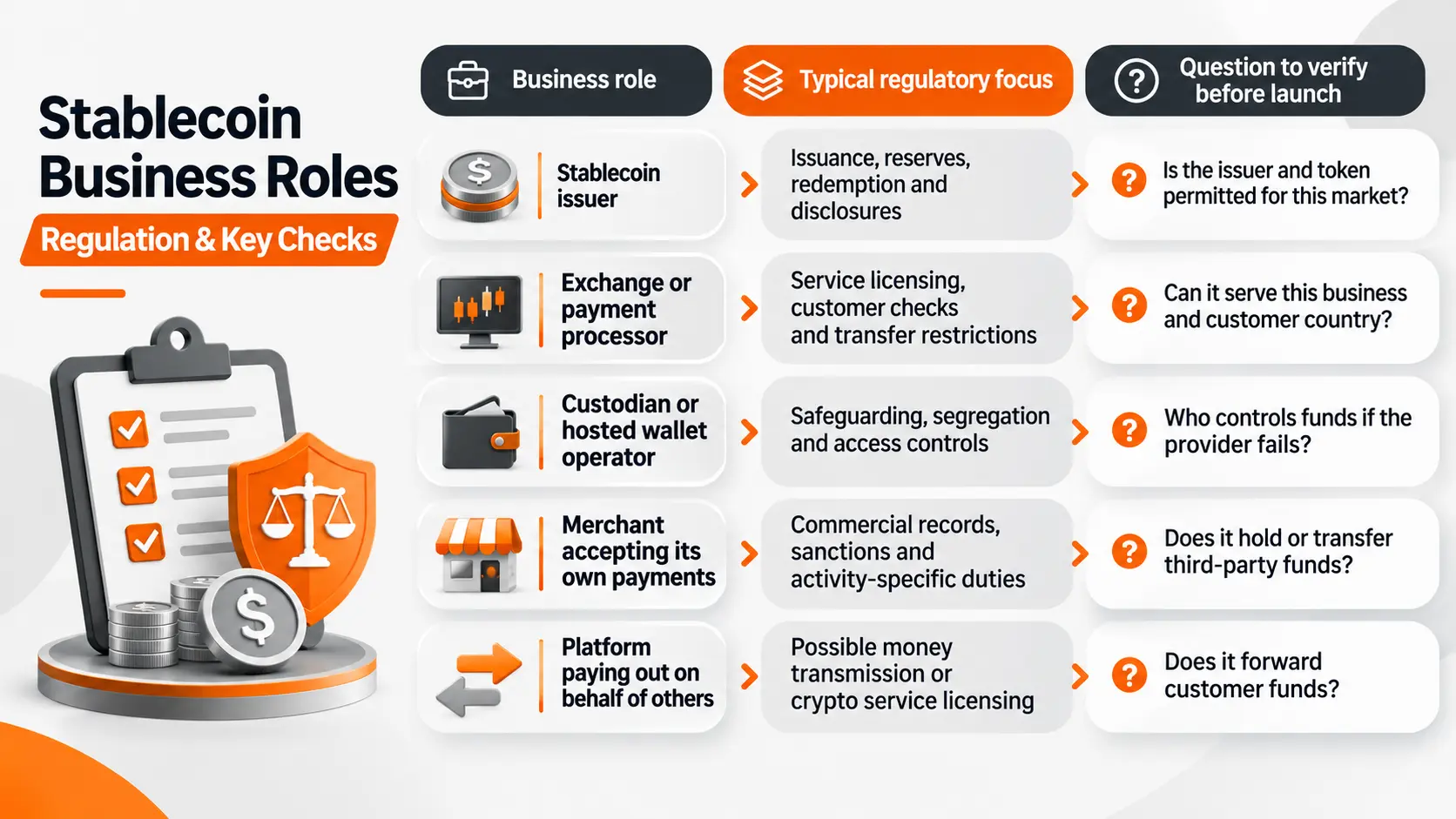
This table is a screening tool, not a license determination. The same company can occupy multiple roles, and local legal definitions differ. In particular, a marketplace holding customer funds can have a different regulatory profile from a merchant collecting payment for its own product. The business model should be reviewed before anyone assumes the term “merchant” removes the need for authorization.
Stablecoin Regulation in the United States
The United States enacted the GENIUS Act on July 18, 2025 to establish a federal framework for payment stablecoins. On October 21, 2026, the Office of the Comptroller of the Currency announced its final rule for issuance and certain related activities within its jurisdiction. Crucially, both the Act and the OCC final rule take effect on January 18, 2027. A rule that has been finalized is not necessarily already operative, and businesses reviewing requirements in November 2026 need to distinguish future obligations from rules currently in force.
The framework focuses primarily on permitted payment stablecoin issuers, including specified bank related entities, nonbank issuers, relevant state supervised issuers, and qualifying foreign issuers. The OCC rule addresses reserve assets, redemption, risk management, audits, oversight, and certain custody arrangements. It does not mean that all stablecoins have the same legal status or that any company can launch a dollar token without issuer approval once the framework takes effect. The legal treatment of a particular asset depends on its structure and the applicable law.
The OCC also states that Bank Secrecy Act, anti money laundering, and sanctions provisions are being addressed through separate rulemaking with the Treasury. That is an important limit on the October final rule, not evidence that financial crime requirements can be ignored in the meantime. Existing laws and obligations can still apply depending on the activity, provider, and counterparties. A business should therefore separate the issuer's regulatory authorization from the processor's existing licenses and its own compliance responsibilities.
A company receiving payment for its own products primarily needs to verify that its provider can serve the payment flow and customer locations. Marketplaces, payout platforms, and firms holding client balances require additional review because their activities may fall under financial service regulation.
MiCA Stablecoin Rules in the European Union
The European Union's Markets in Crypto Assets Regulation, known as MiCA, operates under a different system. MiCA distinguishes e money tokens, which refer to one official currency, from asset referenced tokens, which reference other values or combinations of assets. Issuer conditions and redemption provisions vary by category. Crypto asset service providers also face authorization and operating obligations, so checking only an issuer's reputation does not establish whether a service can legally reach EU customers.
The transition period for certain EU crypto asset service providers ended on July 1, 2026. Firms providing covered services after the applicable deadline generally need MiCA authorization. ESMA maintains a register of authorized providers and relevant issuer categories; vendor checks should use the legal entity, not just its brand.
On October 8, 2026, ESMA clarified expectations for services involving asset referenced tokens and e money tokens that do not comply with MiCA. Authorized crypto asset service providers are expected to stop offering relevant services involving noncompliant stablecoins to EU clients, subject to limited arrangements for dealing with remaining holdings. The scope covers services such as transfers, exchanges, custody, and trading activity. Consequently, the mere existence of a liquid token market outside the EU does not prove that an EU facing payment flow is supported lawfully.
A US startup selling into the EU should verify which party serves the European customer, whether the selected token and service remain available through an authorized provider, and who handles the conversion into euros if required. Compliance is a chain of activities and counterparties. Changing a token, provider, customer location, or custody model can change the analysis even if the underlying invoice amount stays the same.
The UK and Other International Payment Markets
The United Kingdom is developing its own approach, and businesses should not mistake proposals for final permissions. In June 2026, the Bank of England published a policy statement and draft rules for sterling denominated systemic stablecoins. It indicated an intention to finalize the relevant code toward the end of 2026, working alongside the Financial Conduct Authority. The UK framework distinguishes systemic payment arrangements from other crypto asset activity; the applicable legal route must be confirmed against the current rules when a product launches.
Other jurisdictions may restrict tokens, exchanges, payment services, or local currency conversion. A transfer can involve laws governing the sender, merchant, provider, beneficiary, and final payout bank. Blockchain access does not override those restrictions; review the entire corridor rather than claiming that a token is “legal worldwide.”
Compliance Responsibilities for Commercial Payments
Using a licensed partner does not transfer every responsibility away from the merchant. The processor may handle customer verification and monitoring, while the business supplies ownership information, keeps commercial records, and follows applicable restrictions. Contracts should assign these tasks explicitly rather than rely on a universal checklist.
Know your customer, know your business, and financial crime controls
Know Your Customer and Know Your Business procedures help regulated providers understand who uses their services and how funds are expected to move. Businesses should ask a payment partner which checks it conducts, what data it requires, whether high risk transactions are reviewed, and what happens if funds are delayed. These controls can affect customer experience as directly as network speed. A business promising instant payouts should not promise a timetable that ignores lawful screening or manual review.
FATF standards and national laws also affect virtual asset service providers, including transaction information requirements often referred to as the Travel Rule. The obligations generally attach to relevant regulated activities, not automatically to every customer holding a token in a wallet. A startup should determine whether it or its service partners are acting as regulated providers before designing data collection or assuming that wallet to wallet movement is always outside financial regulation.
Sanctions screening and blocked transactions
Sanctions requirements remain relevant regardless of how quickly a blockchain transaction settles. US Treasury guidance for the virtual currency industry discusses risk based screening of customer information, wallet addresses, and transactions, alongside controls for restricted jurisdictions and persons. Companies should define how the processor handles flagged payments, who reviews exceptions, and whether the merchant can receive or return a suspicious transaction. Bypassing a geographic or provider restriction using another wallet or network does not resolve the underlying legal problem.
Redemption, custody, and customer expectations
Regulated issuance does not automatically turn a stablecoin into a bank deposit. Businesses should examine the issuer's redemption terms, who has a contractual claim, whether the merchant can redeem directly, and what role an intermediary plays. A customer may think a payment is final when the blockchain confirms it, while the merchant's processor may still need to screen, accept, convert, or settle the funds. Payment terms should explain what counts as completed payment and how refunds, failed payouts, and disputed transfers are handled.
A Practical Regulatory Review Before Launch
Start with a specific transaction. Map the sender, token, network, service providers, custody steps, and final payout. Review those roles against the applicable jurisdictions; a vendor license is useful only if it covers the service being purchased.
First, define the product and payment corridor
Document the legal merchant entity, country of sale, customer types, sender and beneficiary locations, token, network, custody method, and final settlement currency. Note whether the company holds assets for itself or for others. If the company offers a marketplace or third party payouts, highlight this feature separately, because it can change whether financial service authorizations are needed. A compliance review cannot be reliably completed when these operational details remain unspecified.
Next, confirm the token and every service provider
Match each provider's registered legal name with its relevant authorization and product scope. In the EU, check the ESMA register and investigate whether the particular stablecoin and service are supported under MiCA. In the US, distinguish the issuer related GENIUS framework, including its January 2027 effective date, from existing state and federal obligations that may cover payment and custody services. Obtain written confirmation of allowed countries, prohibited industries, settlement methods, and the process for changes to supported assets.
Then, allocate responsibility and document exceptions
Vendor contracts should identify who completes onboarding checks, screens transactions, safeguards funds, retains relevant records, handles refunds, and responds to a legal freeze. Identify which party bears costs if a payment is blocked after the customer has sent the token. Define an escalation route for the merchant's finance, compliance, and support teams. A clear exception process is more useful than a claim that every stablecoin transfer settles instantly.
Finally, test a controlled payment before scaling
Use a limited pilot with counterparties the company is permitted to serve and with providers that have passed legal and operational review. Record the sender's debit, transaction reference, provider status, final credited amount, and time until the proceeds are usable. Test what happens when a transaction is held for review or a refund is requested. Approval to scale should depend on reliable compliance records and successful settlements, not just a low network fee.
Example: A US Software Company Billing an EU Customer
Imagine a US software company issues a €5,000 invoice to an EU business and wants to offer stablecoin checkout. The amount and currency here are hypothetical. If the US vendor uses a checkout provider that accepts the customer's supported asset and settles euros into the vendor's bank account, the provider may handle much of the crypto asset activity. The company still needs to confirm that its provider is authorized for the EU facing service, that the stablecoin can be offered under MiCA, and that any sanctions or contractual restrictions are satisfied.
Now suppose the same company changes its arrangement and starts receiving tokens directly into a corporate wallet, converting them itself, or forwarding some receipts to contractors. That can create new custody, counterparty, and potentially service provider questions. The company should not assume the legal review for its old hosted checkout covers its new operational model. A short mapping exercise before the change may prevent a costly interruption after customers begin paying.
A confirmed blockchain transfer can still face processor rejection, an unavailable off ramp, or extra bank checks. The pilot should measure final receipt and exceptions, not merely network confirmation.
Mistakes That Lead to Avoidable Regulatory Exposure
One mistake is assuming that a well known dollar linked token is approved everywhere. Another is confusing a vendor's general corporate registration with permission to provide the specific financial service being purchased. A third is treating the absence of a visible bank intermediary as proof that sanctions, anti money laundering, or transfer data rules do not apply. None of these shortcuts follows from the technology being used.
Operating changes can require a new review. Expanding to another country, changing exchanges, holding customer funds, or changing payout currency may alter the legal requirements. Track material changes and identify the governing legal entity for every payment route.
Building a Payment Model That Can Withstand Regulatory Change
The strongest approach is to design payments that can be explained, audited, and redirected if a provider or token is no longer supported. That means identifying the actual legal and operational roles, choosing authorized providers for the intended markets, retaining records, and maintaining a conventional payment fallback. It also means assigning responsibility for monitoring material changes in law instead of treating regulatory approval as a one time task.
As of November 2026, the US GENIUS Act framework has a future effective date, while the EU MiCA service provider regime is already operative. Different implementation timelines make jurisdiction specific verification essential. Stablecoins may offer useful commercial payment routes, but lawful and durable adoption depends on the full transaction, not on the name or technology of the asset alone.
FAQ
Does a business need a license just to accept stablecoin payments?
Not automatically. A company receiving payment for its own goods or services may have different obligations from a company issuing stablecoins, holding customer assets, or transferring money on behalf of third parties. The answer depends on the activities performed and the jurisdictions involved. Businesses should have their specific flow reviewed before concluding that a license is or is not required.
Is the GENIUS Act already in effect in the United States?
The GENIUS Act was enacted in July 2025, and the OCC finalized major implementing rules in October 2026. According to the OCC, the Act and its final rule take effect on January 18, 2027. Other existing legal requirements may apply before that date, so businesses should not interpret the future effective date as a general compliance exemption.
Can a US business accept any stablecoin from an EU customer?
Not necessarily. The token, the service provider, the payment activity, and the relevant countries all matter. MiCA restricts covered services involving noncompliant stablecoins, and sanctions or other local rules can create further limitations. The business should verify the specific payment route rather than rely on the token's availability on a blockchain.
Does using a regulated stablecoin mean the money is insured?
No. Regulatory requirements for issuers, reserves, and redemption do not automatically provide the same protections as an insured bank deposit. Businesses should examine the issuer's terms, the legal rights of holders, the custody arrangement, and the circumstances in which redemption could be delayed or restricted.
What compliance records should a company keep for stablecoin payments?
The relevant records depend on its role and local laws, but a sensible business process captures the invoice, counterparties, provider, token, network, transaction reference, approval trail, fees, and final settlement confirmation. Where regulated services are involved, additional verification or reporting records may be required. The recordkeeping policy should be approved against the applicable legal obligations.

Masoumeh Jahangard
Markets & Economy Writer at PinerookMasoumeh Jahangard covers markets, economic trends, and business conditions for Pinerook, focusing on how they affect startups and growing companies.
 Seen first.