
Prediction markets are growing into businesses with several ways to earn revenue, but the basic economics are easy to misunderstand. A platform may facilitate millions of dollars in event contract trades without keeping anything close to that amount. Its actual income depends on which fees it charges, who receives those fees, what it pays for liquidity, and how much it costs to operate a trustworthy market.
The broader guide to Prediction Markets explains why event contracts produce prices that reflect collective expectations. Here, the business question is different: who earns money when those contracts trade, what costs stand behind the transaction, and which commercial models can remain viable as competition increases?
How do prediction market companies make money?
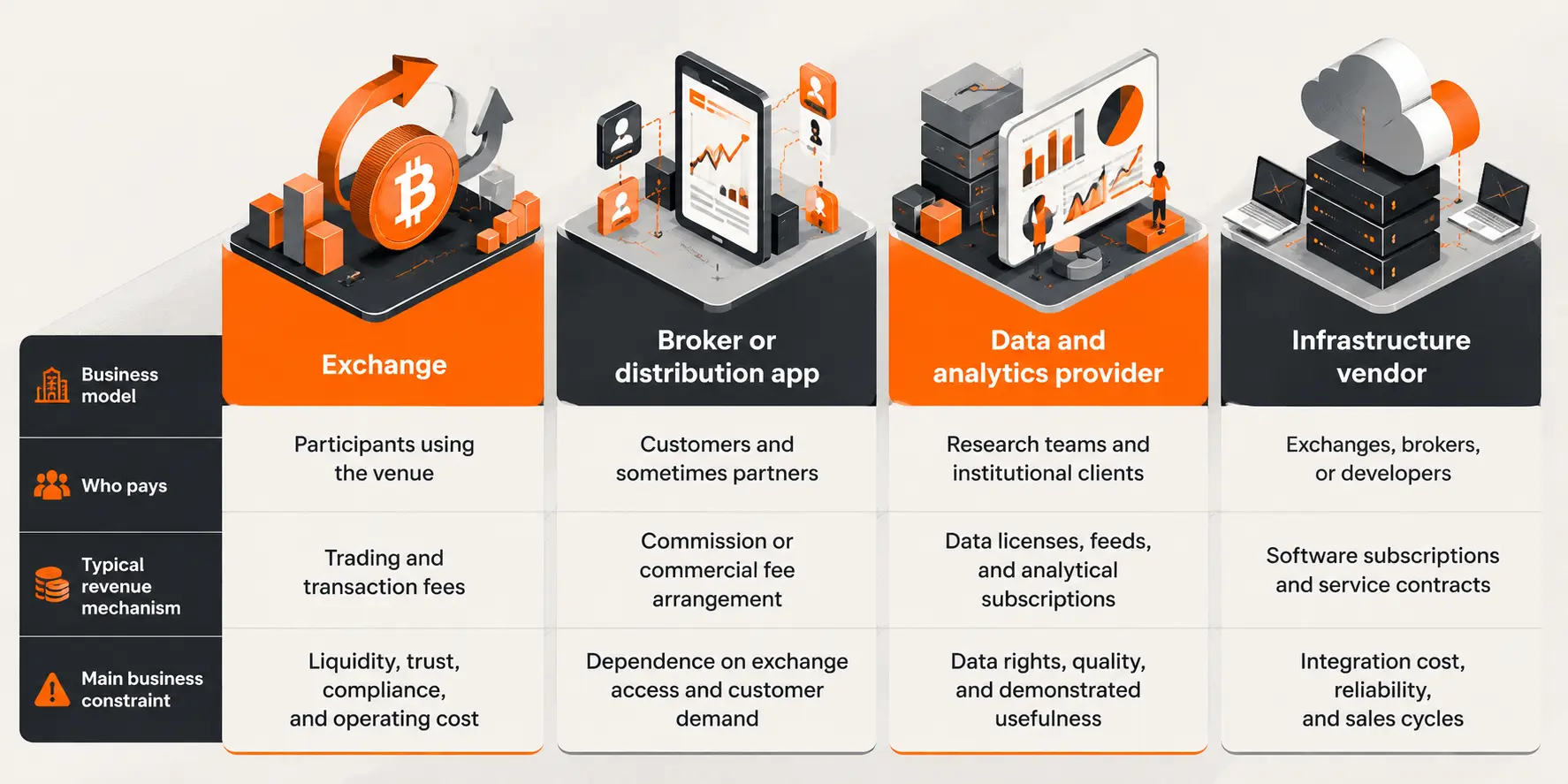
The most direct answer is transaction fees. An exchange matches orders from traders and may charge for completed trades rather than taking the losing side of each prediction. Other companies earn commissions for bringing customers to an exchange, sell processed market data to professional users, or provide the infrastructure that makes trading and settlement possible. A company may operate across several of these layers, but each comes with different licensing, capital, technology, and customer acquisition requirements.
The distinction matters because a successful trading app is not necessarily an exchange. A broker can build the customer experience on top of another company’s market, while a data vendor can serve clients who never trade a contract at all.
The four main prediction market business models
1. Exchange fees: getting paid when contracts trade
An exchange brings buyers and sellers together, maintains order matching, publishes market rules, and organizes the steps leading to settlement. Its clearest revenue source is the transaction fee. The amount may depend on the contract price, quantity, order type, or market category. Some exchanges charge the trader who removes an existing order from the book, while other fee schedules also apply to certain resting orders.
Kalshi describes transaction fees as its core revenue model and states that it does not take a financial position in which event outcome wins. That is the key distinction between a matching venue and a business that directly bets against its customers. The exchange earns from activity, although the precise fee collected can change with the contract and fee schedule.
A trading fee is not pure margin. An exchange may return some of it to market makers, spend on incentives to keep order books usable, and absorb the ongoing expense of surveillance, compliance, dispute handling, and settlement operations. A fee formula therefore reveals the pricing mechanism, not the company’s profit.
2. Brokerage and embedded distribution
A second approach is to distribute contracts through a brokerage, investing app, or financial platform that already has customers. The distributor can charge an additional commission or negotiate a commercial arrangement with the venue, subject to the applicable regulatory structure. Its advantage is an established audience and familiar account experience, rather than the need to build an exchange from scratch.
For example, Public offers access to Kalshi event contracts through its existing investing experience. Its published information distinguishes an exchange charge from its own commission. The broader lesson is that the customer facing app and the underlying trading venue can earn separate fees on the same transaction. Contract availability, fee treatment, and permitted distribution models still vary across partners and jurisdictions.
This business model can scale distribution efficiently, but the distributor may depend on the exchange for available markets, uptime, settlement, and product terms. It also needs to weigh how many existing customers will actually trade instead of merely browsing the probabilities.
3. Market data and analytics
Every active event market generates a stream of prices, changes in expectations, order book information, and final outcomes. Traders create that information through their activity, while research teams, media companies, and financial institutions may find value in clean, consistent datasets. A data business can charge for specialized feeds, historical coverage, analytics, service guarantees, or integration into professional systems where licenses permit.
Intercontinental Exchange has described plans to distribute Polymarket event driven data to institutional capital market participants. This illustrates a model in which the commercial product is not another trading screen. It is a structured signal that can fit into research, risk management, or portfolio workflows. Publicly available market prices should not be confused with paid, licensed, quality controlled datasets; neither the existence of a partnership nor the announcement of a data feed establishes how much revenue either partner ultimately receives.
For a young company, this layer is attractive because customers do not have to place bets to purchase analytics. It is also competitive: data quality, licensing rights, latency, consistency, and the usefulness of the resulting decisions determine whether someone will pay.
4. Technology and infrastructure services
A fourth model serves the companies operating around the market. Software providers can offer market interfaces, data normalization, compliance monitoring, risk tools, order routing, or operational systems under subscription, usage based, or contracted service fees. Some services are purchased by exchanges; others target brokerages, institutional users, or developers creating specialized applications.
This is a different proposition from building an internal employee forecasting market, where the main goal may be better decisions rather than transaction revenue. Infrastructure vendors sell a repeatable service to the ecosystem. Their challenge is proving that customers need a specialized tool enough to pay for it rather than building the feature internally.
Why trading volume is not the same as revenue
Reported trading volume often dominates prediction market headlines because it is large and easy to compare. It is not a measure of sales revenue, and two providers may report volume using different conventions. A platform offering fee free markets, large rebates, or promotional pricing can show substantial activity with much less retained revenue than its gross volume suggests.
Consider a purely illustrative exchange that processes $12 million in matched trading volume during a month and collects an average fee equal to 0.5% of that volume. Gross transaction fees would be $60,000. If it spends $18,000 of that amount on maker rebates and other trading incentives, $42,000 remains before ordinary operating expenses. If variable processing and market servicing costs are another $12,000, the contribution would be $30,000 before salaries, engineering, legal costs, and other fixed overhead.
Those figures are hypothetical, not a description of Kalshi, Polymarket, or any specific venue. The point is that gross fees, fees retained after incentives, contribution margin, and actual profit are four different numbers. Founders evaluating this industry should ask for each one, not treat volume as proof of a healthy business.
Why would a platform make some markets free?
Waiving fees can be a deliberate business decision. Lower costs may attract traders, encourage the first orders in a new category, and help a market develop more competitive prices. A venue might make money elsewhere in its product mix or decide that building participation now is more valuable than collecting a small amount per trade today.
Polymarket’s published documentation shows that fee treatment can differ by market category and that some fees help fund maker rebates. The details can change, and its international marketplace should not be treated as identical to its separate US exchange. The important commercial tension is straightforward: charging more can lift revenue per trade but may discourage activity, while charging less can help adoption without guaranteeing a path to profitability.
Liquidity incentives are similarly a cost of maintaining the product, not evidence of platform earnings. A deeper order book may make the market more useful, but paying for that depth only creates durable value if demand eventually supports the expense.
What makes a prediction market business sustainable?
Useful markets and repeat participation
A marketplace with frequent activity across well defined questions has more opportunities to earn transaction fees. But repeat trading must be genuine and economically valuable. Short lived promotions, automated churn, and unusually high gross volumes can obscure weak retention or costly customer acquisition. The better test is whether participants return when promotional incentives decline.
Trust in the rules and final outcome
A prediction contract only works if customers understand what resolves it and trust that the venue will apply those terms. Reliable settlement sources, effective surveillance, clear dispute procedures, and transparent customer communications are core operating capabilities. Failure here can erase a distribution advantage faster than a lower fee can restore it.
Cost of acquiring and serving customers
Distribution can be expensive. Advertising, referral rewards, identity checks, support requests, and regulatory obligations all affect the economics of an active account. A company should track contribution per retained trader alongside acquisition cost, rather than celebrating signups that never become useful recurring activity.
Diversification without losing focus
A venue may pursue transaction fees, brokerage partnerships, and data products at the same time. That can reduce reliance on one source of income, but each new line requires sales effort, product quality, and sometimes different permissions. The most credible expansion builds on an existing strength: reliable markets that generate data, a trusted audience that needs access, or an infrastructure capability other businesses cannot easily reproduce.
What should founders examine before entering this market?
Start with the role the business will play. Running an exchange, distributing access, selling analytics, and supplying infrastructure are not interchangeable strategies. A founder with strong developer distribution may be better positioned to build tools than a heavily regulated venue. A firm with established financial customers may be better suited to distribution than to building order books from zero.
Then test the numbers in the right sequence. Identify who actually pays, when a fee is earned, and which costs rise with every additional transaction or account. Estimate customer acquisition, retained activity, payment or settlement costs, and the cost of maintaining reliable market information. Review legal and contractual permissions before investing in an integration; the rules for intermediaries and specific event contracts may change.
Finally, challenge the growth story. If fees were reduced, would the market still attract useful participation? If incentives ended, would liquidity providers remain? If publicly available prices were free, would professional clients still pay for the data product? Clear answers expose a real business model more effectively than a chart showing headline volume growth.
FAQ
Do prediction market platforms make money when traders lose?
Exchange style venues generally earn by facilitating transactions, not by automatically taking the opposite side of every customer position. A market maker or another participant may profit or lose from the trade. Always distinguish the role of the exchange from the roles of traders and liquidity providers.
Are prediction markets profitable businesses?
Some can generate substantial fee income, but revenue does not establish profitability. Market incentives, legal and compliance work, settlement infrastructure, staffing, and customer acquisition all matter. Public information is often insufficient to calculate a particular private platform’s net profit.
Can prediction markets earn money without charging trading fees?
Yes. Depending on permissions and contracts, a company may earn from licensed data, analytics, infrastructure software, or distribution relationships. Free trading can also be a temporary strategy to attract users, although it does not itself create a sustainable revenue stream.
Do market makers pay the exchange or get paid by it?
Both arrangements are possible across venues and contract types. Some orders incur fees, while eligible liquidity providers may receive rebates or rewards. The net economics depend on the current fee schedule and the risk of quoting prices that informed traders may trade against.
What is the biggest business risk for a prediction market startup?
There is no single risk across all models. For an exchange it may be the combination of regulation, liquidity, trust, and operating cost. For a distribution app, it may be partner dependence and weak customer retention. For a data company, it may be uncertain willingness to pay for information users can access elsewhere.

Masoumeh Jahangard
Markets & Economy Writer at PinerookMasoumeh Jahangard covers markets, economic trends, and business conditions for Pinerook, focusing on how they affect startups and growing companies.
 Seen first.