A startup can be busy, shipping and attracting attention while its business model quietly stops making sense. Prospects praise the demo but will not pay. Customers use one overlooked feature and ignore the main product. A new technology makes the original proposition less valuable. None of these signals automatically means the company should abandon its idea. They mean the founders need to identify which assumption has failed and whether a more promising one can be tested.
A startup pivot strategy is a structured way to make that decision. It connects what the company has learned about customers, demand, distribution and economics to a material change in direction. A pivot is not a fresh brand name, a cosmetic redesign or the addition of a feature. It changes a central element of how the business intends to create, deliver or capture value.
The essential distinction is between changing direction to pursue better evidence and changing direction to escape discomfort. Good founders are willing to question their plan, but they also give a promising hypothesis enough time and focused effort to be tested properly.
What Is a Startup Pivot Strategy?
A startup pivot is a deliberate change to an important business hypothesis while retaining useful learning, capabilities or relationships. The change could involve who the company serves, which problem it solves, what product it offers or how it makes money. The word strategy matters because the shift needs a reason, a choice about what to keep and a test that could show whether the new direction deserves more investment.
Consider a fictional startup selling a generic reporting dashboard to small logistics companies. Customers rarely sign in, but they repeatedly ask the team to resolve exceptions in their shipment data. Building another dashboard widget would be an iteration. Changing the offer to an exception resolution service, supported by the same data connections, would be a potential pivot. The company would retain an advantage in domain knowledge while changing the outcome customers buy.
A pivot does not guarantee success. It creates a new hypothesis that must earn its place through evidence. Likewise, persistence is not a mistake when the startup has a credible problem, a promising customer response and a fixable execution gap.
Start With the Decision, Not the Drama
Before deciding to change course, founders should write down four things: the original hypothesis, the evidence collected, the most important contradiction and the proposed replacement hypothesis. An honest diagnosis may reveal that the business has a distribution problem, not a product problem. It may show that customers value the outcome but need a different buying process. It may also show that the underlying problem is not urgent enough to support a business.
A useful one page decision statement can be expressed in plain language: We believed these buyers would pay for this outcome. After these specific tests, the evidence is weaker than our agreed threshold. We now believe this adjacent buyer or outcome has stronger demand, and we will test it before committing the company.
This approach protects the team against two opposite errors. The first is continuing because the founders have already invested time. The second is pivoting every time results are disappointing, without ever testing one coherent direction deeply enough.
When the Evidence Points Toward a Pivot
The question of When to Pivot a Startup should be answered through patterns, not a single bad week. One weak launch, a competitor announcement or three rejected sales calls is rarely sufficient evidence. Look for repeated signals within a well defined customer segment and a genuine attempt to solve the problem.
Three signals deserve particular attention. First, customers consistently understand the proposition but do not consider the problem worth solving or paying for. Second, a different use case or customer segment demonstrates stronger behavior without heavy persuasion. Third, the economics or external conditions have changed so much that reasonable execution improvements cannot restore the original case.
Founders should distinguish these from problems they can repair. A confusing onboarding process may hide genuine demand. A poor sales channel may make a good product look unwanted. Inadequate reliability may suppress repeat use. Investigate those explanations before concluding that the strategy itself is wrong.
A Diagnostic Table for Founders
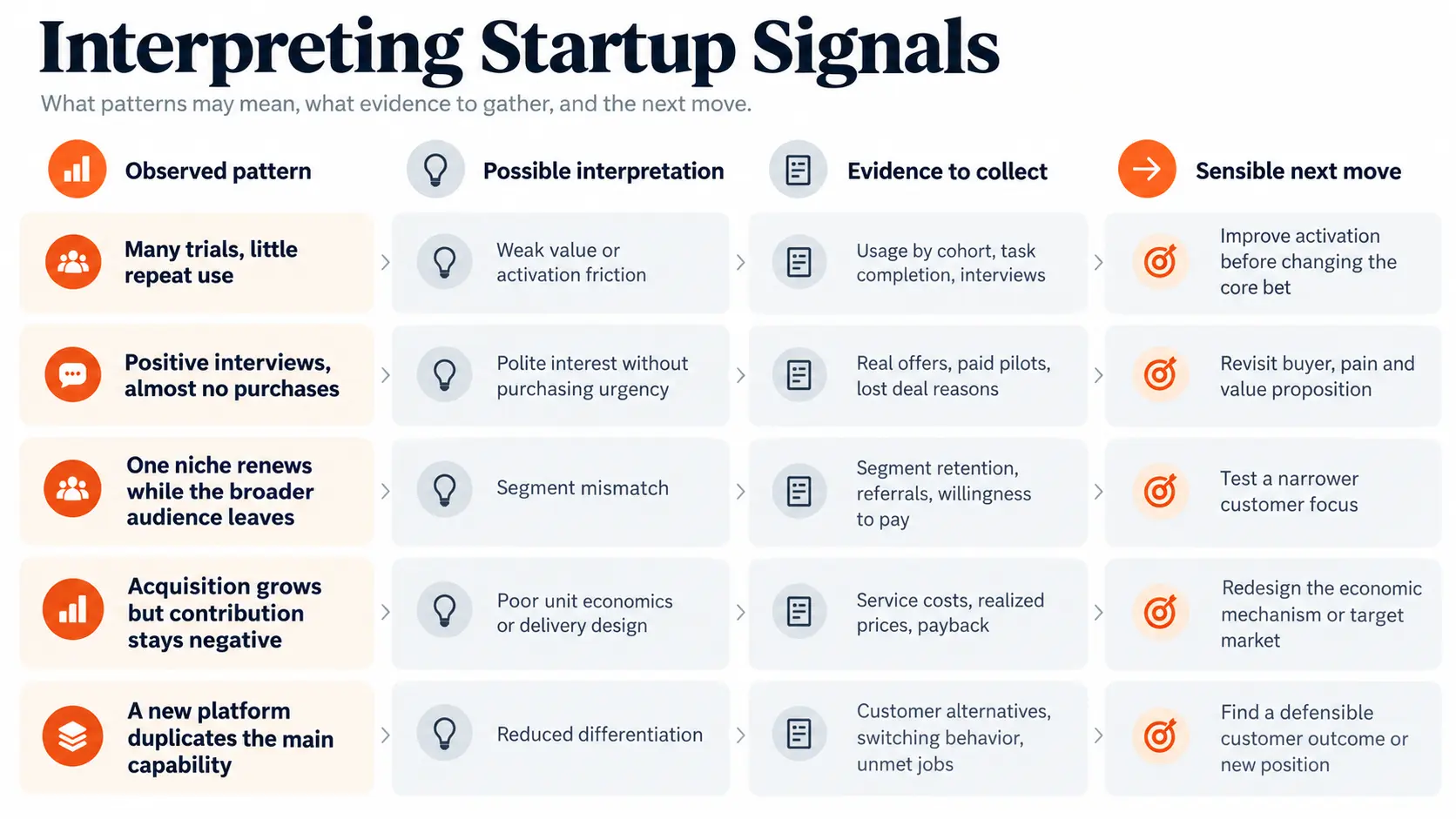
This table is a diagnostic aid rather than an automatic rule. The meaning of a metric changes with industry, stage and buying cycle. Enterprise software cannot be evaluated on the same timetable as a consumer app, and a product with long implementation cycles needs more patience than a simple self service tool.
Decide Whether to Pivot or Persevere
Pivot vs Persevere is not a choice between courage and stubbornness. It is a comparison of two expected paths using the same evidence and constraints. Founders should ask what would have to become true for the current approach to work, how plausible that improvement is and whether the alternative has stronger evidence rather than merely a more exciting story.
Perseverance is reasonable when the problem is painful, a defined customer group is returning or paying, the remaining friction is specific and the team can afford another focused test. A pivot becomes more credible when repeated tests undermine the central assumption, improved execution has not changed the result and a nearby opportunity shows more promising behavior.
A third option deserves equal attention: stop. Not every business can be rescued with a fresh customer segment. A pivot that needs resources the startup does not have, expertise it cannot obtain or a regulatory path it cannot satisfy is not automatically preferable to an orderly shutdown.
The decision should be dated and revisited only when the agreed evidence is available. Constantly reopening it consumes attention and makes every team member less confident about what matters this week.
Which Part of the Business Should Change?
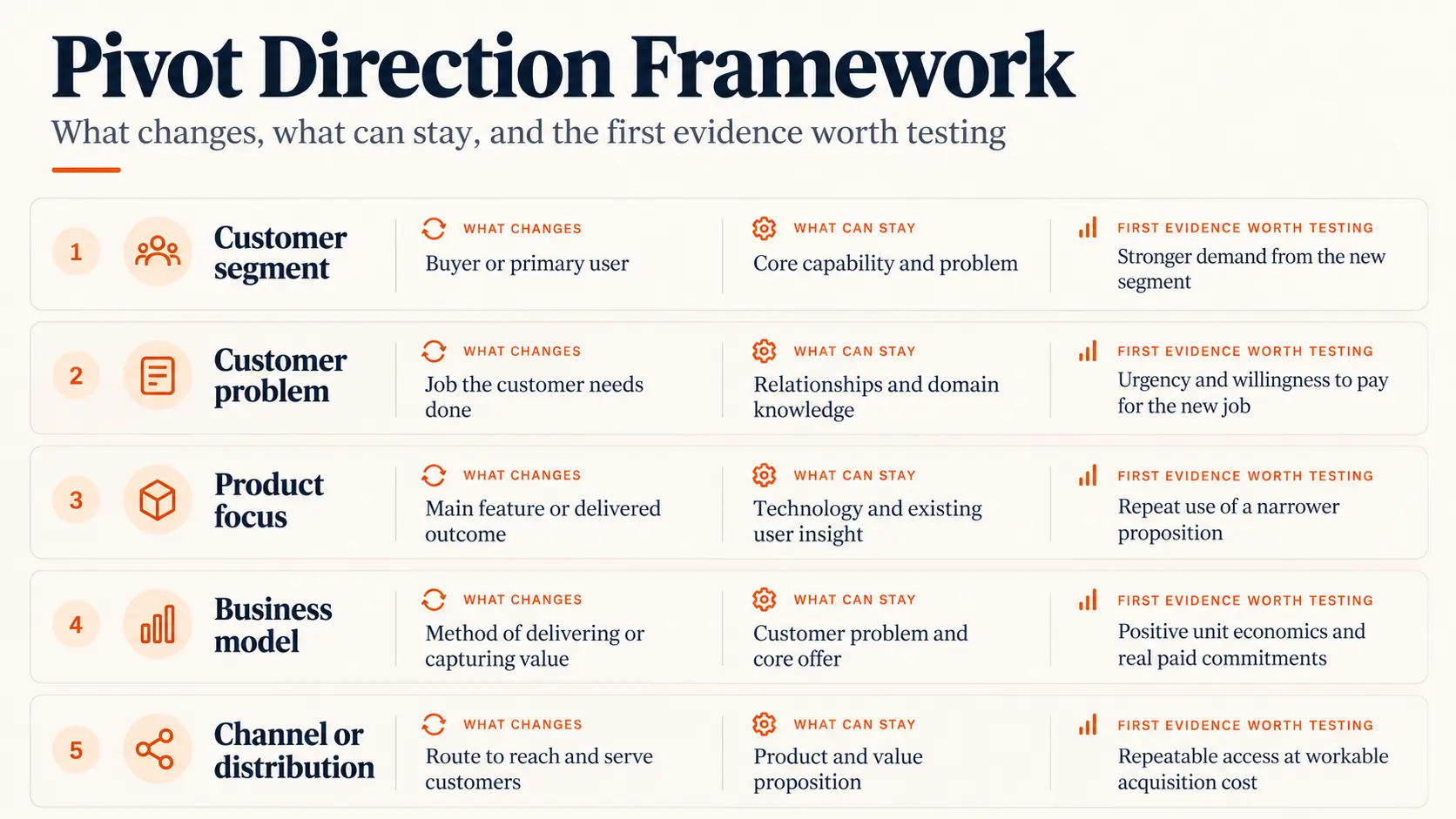
Types of Startup Pivots differ according to the assumption being replaced. Some preserve the product and find a different buyer. Others preserve the customer and solve a different job. More substantial changes may affect the product architecture, delivery model, revenue mechanism or market altogether.
The useful question is not which label sounds impressive. It is which assumption has been disproven. If a team changes its customer, product, pricing and channel simultaneously, it may never know which change caused the result. A focused pivot preserves as many validated elements as possible and changes the element most responsible for the weak outcome.
Choosing the Scope of the Pivot
Change the Customer Before Rebuilding the Product
A Customer Segment Pivot can be appropriate when one group experiences the problem much more intensely than the audience originally targeted. A workflow tool intended for freelancers might prove much more valuable to small agencies coordinating several clients. The underlying capability stays, but purchasing authority, onboarding, messaging and support expectations change.
Founders should not interpret one enthusiastic enterprise prospect as a market. Interview several comparable buyers, identify a repeatable buying trigger and test whether the product can be delivered profitably to that group. The difference between a new segment and an expensive custom project matters.
Change How the Company Captures Value
A Business Model Pivot changes the commercial logic, not merely the price on a landing page. A company may shift from selling a tool to selling a managed outcome, or from one time licenses to a recurring service. Such changes affect service obligations, gross margins, cash timing and customer expectations.
This question is distinct from a financial forecast or a general list of revenue models. The founder is evaluating whether a different economic relationship solves a proven weakness in the current business. A promising new fee structure still requires paid evidence, not just a spreadsheet that looks better.
Test the New Direction Before a Full Commitment
The practical answer to How to Validate a Startup Pivot is to make the smallest credible offer that tests the largest uncertainty. A new landing page may reveal interest, but it cannot prove willingness to pay. An interview may reveal pain, but it cannot show whether the new workflow works reliably. Match each experiment to the claim it is supposed to support.
For a customer change, talk with qualified buyers and present a specific purchase offer. For a new product outcome, observe customers completing the important task. For a changed business model, measure both customer commitment and delivery cost. Where regulations, integrations or security requirements are central, test those constraints before celebrating early demand.
A disciplined test plan has five elements: a named target segment, one risky assumption, a concrete offer, an evidence threshold and a decision date. It also records the source of prospects so the team does not mistake warm introductions for broad market demand.
A Simple Example With Clear Limits
Suppose a startup has sold three paid pilots after pitching its original offer to 40 qualified prospects. That is a 7.5 percent observed pilot conversion rate. The founders test a narrower use case and sell eight pilots to 20 qualified prospects, an observed rate of 40 percent. This would justify further investigation, not an immediate conclusion that the new strategy is more than five times better.
The leads may differ in urgency, referral source, company size or price. The pilots might not renew. A responsible next step is to compare more similar prospects, assess how much work each pilot requires and measure whether the new customers reach the promised outcome. Numbers become useful when the company understands what they do and do not prove.
Protect Runway While Running the Experiment
A pivot carries opportunity cost. The company may have existing obligations, employees attached to the original product and customers who still depend on it. Turning every resource toward an unverified direction can destroy the very time needed to learn.
A practical approach is to establish a short exploration budget. For illustration, a startup with six months of cash runway might reserve a defined four week period and a limited amount of engineering and founder time to test the new offer. That is not a universal recommendation: an enterprise business with longer cycles may need a different design, and a company with immediate solvency problems may have no safe testing window.
Map three costs before approving the change: cash required to test the new model, costs of keeping existing customers supported and costs that cannot be recovered. Protect contractual commitments and identify decisions that would be difficult to reverse, such as deleting customer data, ending a critical partner relationship or hiring specialists for an unproven market.
A pivot should have a stopping rule. If the critical evidence fails to appear by the decision date, the team should revisit the hypothesis instead of quietly extending the experiment until the budget is gone.
What Real Startup Pivots Can Teach Us
Startup Pivot Examples are useful when founders study what changed and what remained rather than treating famous outcomes as recipes. Two widely documented cases show why retaining an existing asset matters.
Instagram developed out of Burbn, a more complicated location oriented application. Its founders recognized that photo sharing offered a clearer experience and focused the product around it. The transferable lesson is not that every app should remove features. It is that observed behavior can reveal a more valuable job than the original product description.
Slack emerged after the team behind the online game Glitch ended the game and developed the communication tools the team had used internally. The transferable lesson is not that failed products hide billion dollar opportunities. It is that capabilities and lived problems inside an unsuccessful venture may support a new, testable proposition.
Both stories are affected by survivorship bias. Countless changes of direction did not produce famous businesses. A founder should be more interested in the decision process, evidence and constraints than in copying the final outcome.
How to Execute a Pivot Without Losing the Team
A credible pivot has an owner and a sequence. First, identify which assumption is changing and which evidence remains valid. Second, put the new direction into one sentence that customers and staff can understand. Third, decide which commitments to preserve, which work to stop and what must be tested next. Fourth, assign a named person to each experiment and set a date to review results.
Engineering should know which work is frozen and which is essential. Sales should know whether they are still offering the old product and to whom. Support should have a plan for existing customers. Finance should see the costs and cash consequences. Founders should distinguish a provisional test from an approved permanent strategy.
Communicate the Change With Specifics
Communicating a Startup Pivot means giving employees, customers and investors a coherent explanation of what the company learned and what it will do next. Different audiences need different detail, but no audience benefits from language that pretends nothing has changed.
An internal explanation should name the evidence, new hypothesis, work being stopped, near term milestones and unresolved risks. Customers deserve clarity about product support, contracts, data and migration. Investors need a candid account of remaining runway, proof already obtained and the conditions for further commitment.
Avoid announcing the new market as a guaranteed win. Clear uncertainty can strengthen credibility when paired with an observable plan. If the new direction does not improve the chosen signals, say what decision follows.
Measure Whether the New Direction Is Working
Early excitement is not sufficient evidence. A useful measurement plan covers demand, repeated value and business sustainability. The exact metrics depend on the model, but the company should compare like with like and keep a record of its previous baseline.
Demand evidence might include qualified requests, paid pilot conversion or committed purchase orders. Value evidence might include task completion, repeat usage, renewal intent supported by actual behavior and customer references. Economic evidence might include delivery cost per account, contribution margin, sales cycle and cash collection.
Choose one primary decision metric and a few guardrails rather than building a new dashboard for every pivot. For example, a business selling a managed compliance outcome may prioritize completed customer cases at the promised accuracy and service cost. Signups alone would be a poor proxy for that value.
A useful review cadence may include an initial test review, a follow through check on customer behavior and a later economic assessment. Those periods should be adapted to actual sales and delivery cycles. A short test that cannot possibly observe a renewal should not claim to prove retention.
A Founder Decision Framework
Before committing to a new direction, answer these questions in writing.
1. Which core assumption failed, and what direct evidence supports that conclusion?
2. Have we tested plausible execution fixes to the current approach?
3. What valuable knowledge, technology or relationships can we carry forward?
4. What is the single most uncertain belief in the proposed direction?
5. Which test could disprove that belief at acceptable cost?
6. What results would justify continuing, changing again or stopping?
7. How much runway remains after honoring existing commitments?
8. Who owns the decision and when will it be revisited?
A good decision record does not make uncertainty disappear. It makes the reasoning inspectable and prevents the team from rewriting history after the result is known.
Common Mistakes to Avoid
The most damaging mistakes tend to come from confusing emotion, activity and evidence. Founders pivot because a trend is fashionable, move after too little testing, describe a pricing change as a whole new business or preserve all of the old roadmap while adding the new one. Each creates the appearance of progress without making a clear commitment.
Another mistake is ignoring a narrow but promising market because its first customers look smaller than the original vision. Starting with a sharply defined problem may produce stronger learning than pursuing a large audience whose needs have little in common.
Finally, do not turn the pivot into a heroic origin story before customers validate it. The objective is not to prove that the founders were flexible. It is to find a business customers repeatedly choose and one the company can sustainably deliver.
A startup pivot strategy turns uncertainty into a testable decision. Change direction when repeated evidence challenges a central assumption and a credible alternative deserves investigation. Persevere when the underlying demand is real and the main obstacle can be addressed through execution. Stop when neither path is commercially or operationally plausible.
The strongest pivot is often not the largest change. It is the smallest decisive change that puts the startup closer to a valuable customer problem, with clear proof required before the next major commitment.
FAQ
What is a pivot in a startup?
A pivot is a substantial change in a startup's customer, problem, product or business model based on learning. It differs from a normal iteration because it replaces an important assumption about how the business will work.
When should a startup consider pivoting?
Consider a pivot when repeated, relevant tests undermine a central hypothesis, reasonable improvements do not solve the issue and an alternative shows promising evidence. One disappointing launch is not enough by itself.
Is changing pricing considered a pivot?
Not necessarily. Adjusting a price point is usually an iteration. Changing from selling a software product to selling a managed result, with different responsibilities and economics, may represent a material business model change.
Can a startup pivot after raising funding?
Yes, but it should consider investor agreements, governance requirements, remaining cash and customer obligations. Founders should communicate material strategy changes transparently and follow applicable contractual duties.
How long should a pivot experiment take?
There is no universal duration. A simple paid offer may be tested quickly, while enterprise adoption or regulated services require longer cycles. Define the evidence needed and a budgeted review date before beginning.
What is the difference between pivoting and starting over?
A pivot intentionally carries forward useful assets, evidence or capabilities while replacing a key hypothesis. Starting over may mean abandoning most of the previous customer, product and operational learning.

Mohsen Avid
Founder & Editor, PinerookMohsen Avid is the founder of Pinerook, covering entrepreneurship, startup strategy, digital business, and the decisions behind building new ventures.
 Seen first.