A startup may have customers who like its product and still struggle to build a viable business. Revenue comes in, but supporting each account costs too much. Buyers want the result, yet the proposed contract does not match how they budget. In these situations, adding features or cutting prices may leave the underlying problem untouched. A business model pivot changes an important part of how the company creates, delivers or captures value, using evidence from customers rather than an attractive new spreadsheet.
The broader Startup Pivot Strategy explains how founders decide whether a strategic change is warranted. This guide concentrates on one specific decision: when the product or customer problem has promise, but the commercial system around it does not. The goal is to replace a weak business assumption with a model that customers will buy and the company can operate sustainably.
A Business Model Pivot Changes More Than a Price
A business model describes the connected decisions behind a company: the customer served, the value delivered, the activities required to deliver it, the partners involved, the costs incurred and the way the company earns money. A business model pivot substantially changes one or more of those relationships while preserving useful evidence or capabilities.
Consider a startup that provides software to help clinics resolve billing exceptions. If it lowers the monthly subscription from $150 to $125, that is usually a pricing experiment. If it stops selling software access and begins selling verified, completed exception resolutions, it has changed what customers purchase, how employees deliver the work, what constitutes a successful transaction and how revenue relates to cost. That is a credible business model pivot.
Eric Ries describes value capture as part of the product hypothesis, not an optional feature to add later. Steve Blank similarly treats a pivot as a substantive change to a business model component. The practical implication is simple: changing a number on the price page is not automatically a new model, and a new billing unit can have consequences far beyond billing.
A founder should be able to finish this sentence before beginning: “We currently believe customers will pay for this offer under these conditions, but observed behavior suggests a different economic relationship will work better.” If the new belief cannot be stated clearly, the proposed pivot is probably too vague to test.
Signs the Current Commercial Logic Is Failing
The first signal is a mismatch between the value customers receive and the unit they are asked to buy. A business may value completed tasks while the startup charges for user seats. Customers with fluctuating demand may reject a fixed commitment even when they acknowledge the product's usefulness. Repeated objections from qualified buyers matter more than one prospect asking for a discount.
A second signal appears when apparently healthy revenue hides weak contribution. A company can add paying accounts while each additional account requires more expensive onboarding, support or specialist labor than expected. This can be a delivery model problem, not necessarily a failure of the product. Before replacing the model, founders need to separate costs that will decline with experience from costs that are structurally tied to each sale.
A third signal is a persistent difference between users and economic buyers. Employees might use the product daily but lack purchasing authority. A department may need an outcome, while procurement will only approve a defined service or a contract with measurable performance obligations. The company may need to change the buyer relationship or commercial promise, not abandon the user problem.
Finally, cash timing can make an otherwise plausible model hard to sustain. A startup might pay suppliers immediately while collecting fees months later, or invest heavily in implementations before recognizing revenue. A pivot that improves customer demand but worsens working capital could make the business less resilient.
None of these signals proves a pivot is necessary. First test whether more focused onboarding, narrower scope, a better sales process or disciplined pricing within the current model could solve the problem. The point is to identify the failing assumption, not to make every difficult quarter an argument for reinvention.
The Commercial Changes Founders Can Test
Several business model changes recur in young companies. The most useful way to compare them is by the assumption being replaced and the evidence needed before committing.
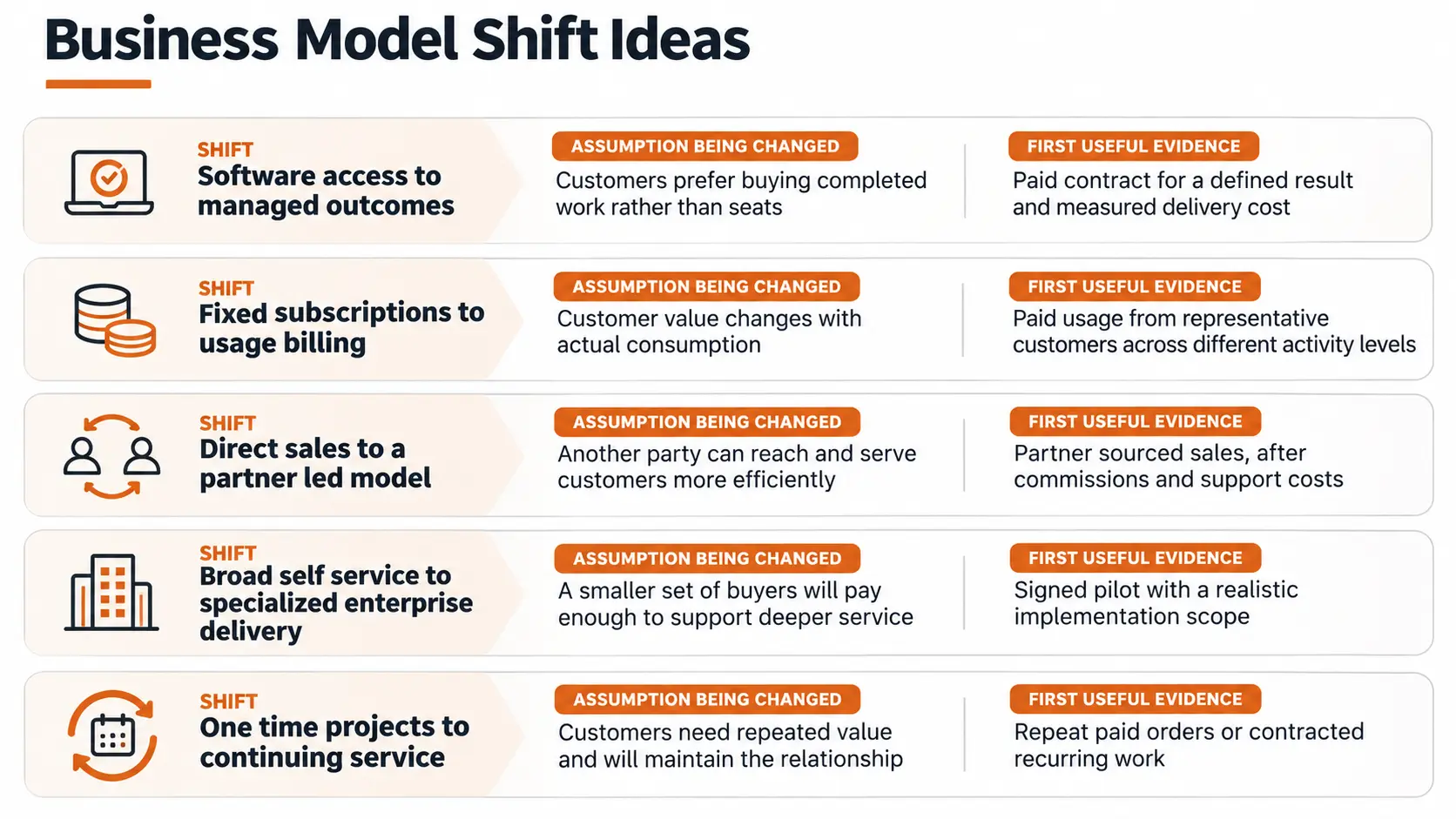
These are alternatives to investigate, not a menu of upgrades. Moving to enterprise customers can increase contract value while lengthening sales cycles. Charging for usage can align price with value while making monthly revenue less predictable. Providing managed outcomes can appeal to buyers yet create operating burdens that a software company has never handled.
A business model pivot should solve a diagnosed contradiction. Choosing a fashionable monetization structure because similar companies use it adds uncertainty without addressing the original failure.
Diagnose the Weak Link Before Redesigning the Business
Separate customer demand from payment friction
Begin with customers who have actually used the product. Ask what they relied on it to accomplish, which department benefits, how they currently pay for alternatives and what approval prevented a purchase or renewal. Then review actual events: paid orders, renewal decisions, support work, utilization and reasons deals were lost.
Suppose most prospects say the product is useful but cannot justify another monthly software contract. If they repeatedly purchase manual help to achieve the same outcome, there may be evidence for a managed service model. If they simply do not consider the problem urgent, changing billing may do little. The test must distinguish these cases.
Separate sales efficiency from delivery economics
A long sales cycle is not proof that pricing is wrong. Some products require trust, integration and procurement review regardless of their commercial model. Conversely, fast signup does not prove the business works when customers require more support than their payments cover.
Map the value chain from qualified lead to collected cash. Identify the buying decision, contract obligation, implementation step, recurring delivery work, payment event and cost attached to each. A pivot that changes the billing unit but leaves an expensive process untouched may merely conceal the same weakness.
Identify what can remain unchanged
An effective pivot preserves validated assets. These may include customer relationships, a trusted dataset, integrations, operational knowledge or a product capability that already works. The new model should specify which assets still create value, which obligations need redesign and which assumptions must be tested again.
Changing everything simultaneously may make the result impossible to interpret. A startup that changes its customer, product, channel and payment structure at once cannot easily identify why a pilot succeeds or fails.
An Illustrative Business Model Pivot With Numbers
Imagine a fictional startup called ClearCase that helps small clinics handle billing exceptions. It currently sells access to workflow software to 40 clinics at $150 per month. That produces $6,000 in monthly subscription revenue. Assume the direct costs attributable to serving those accounts, including cloud services and customer support, total $2,200. The resulting contribution before common overhead is $3,800.
Interviews and account records reveal that clinics care most about exceptions resolved, not software seats. The team proposes a managed service charging $28 for each completed, accepted case. During a limited trial, assume it completes 300 accepted cases for $8,400 in revenue. At an estimated $15 direct delivery cost per case, direct costs are $4,500 and contribution is $3,900.
At first glance, the new model earns $2,400 more revenue and $100 more contribution. That is not enough to declare victory. The new service requires quality checks, trained operators, client specific procedures and a contractual definition of an accepted result. Volume may fluctuate. The trial may have used unusually cooperative customers. If the service resolves only 200 cases at the same unit economics, contribution falls to $2,600. At 400 cases, it increases to $5,200, assuming capacity and cost per case stay unchanged.
The numbers are hypothetical and compare different operating designs, not a controlled experiment. They deliberately exclude shared overhead, taxes, acquisition cost, financing needs and the possibility of delayed collection. A founder should use actual cohort data, realistic capacity limits and cash collection information before replacing the original model.
The useful insight is that changing the unit sold changes the work required to earn each dollar. Revenue can grow while profitability, cash conversion or reliability deteriorates. Commercial validation must therefore measure purchasing behavior and delivery performance together.
How to Validate the New Model Before Committing
A controlled trial is more useful than announcing a companywide pivot. Start by naming the single assumption that has failed. ClearCase's hypothesis might be: “Clinics will purchase verified exception resolutions at a price that leaves a viable contribution after the labor and quality costs needed to complete them.”
Next, design a real offer. Specify who is eligible, what is delivered, how completion is verified, which work is excluded, when payment is due and what happens if the outcome is disputed. A customer who agrees in a conversation has not validated the model. A paid pilot or enforceable purchase commitment with observable delivery creates stronger evidence, although a single deal still does not establish repeatable demand.
Recruit a small but relevant set of buyers. Avoid selecting only existing champions who have already promised to support the team. Track how prospects were sourced, who approved the purchase, what price and terms they accepted, and whether the team had to offer costly exceptions. If the old and new offers are compared, keep the customer and workload differences visible rather than assuming the groups are identical.
Before the first trial begins, write down the outcome needed to continue. That may include a target share of qualified buyers accepting the offer, acceptable direct cost per completed unit, a service quality threshold and a cash collection deadline. Thresholds should come from the startup's actual cost base and runway, not generic internet benchmarks. Record what would cause a revision or an orderly stop.
Observe the complete economic cycle. Test the sale, delivery, acceptance, invoicing, collection and a repeat order when the natural buying cycle permits it. A deposit is useful but does not prove that customers will renew. A positive pilot margin is useful but does not prove the team can maintain quality at scale.
At the review date, compare three realistic choices: keep the existing model and repair execution, expand the new model in a bounded way, or stop the experiment. The decision should follow evidence that was defined in advance, with exceptions explained openly.
Protect Customers and Runway During the Transition
A commercial pivot affects people who already bought the original promise. Existing customers may expect software access, service levels, support windows or data portability. A startup cannot assume it may simply replace those commitments with a different paid offer. Review contracts and give customers a clear choice when terms allow it.
A practical transition often involves maintaining the old service for a limited group while testing the new model with separately defined capacity. That creates costs, so the founder should set a budget and owner for each stream. Teams need clarity about which product commitments continue, which sales messages change and which workflows remain provisional.
Payment terms deserve as much attention as booked revenue. Managed services may require wages before invoices are collected. Usage pricing may expose the company to sudden swings in volume. Partner sales may add commissions, slower payment and less control over the customer relationship. Finance needs a simple picture of cash outflows, collected receipts and worst plausible demand before the new model becomes the default.
Do not scale operations based only on trial demand. Hire or commit to large contracts after the startup has tested repeatability, quality and the costs of handling less favorable customers. Preserving the ability to reverse or narrow the pivot is often more valuable than an ambitious launch announcement.
Measures That Show Whether the Pivot Is Working
The right scorecard connects the promised customer outcome to the cost of delivering it. A company selling completed work should measure accepted outcomes, not merely tasks started. A usage model should distinguish activity that generates billable value from activity that consumes resources without producing income.
Paid conversion shows whether buyers accept the new offer. Repeat purchase or renewal reveals whether the value persists. Direct contribution indicates how much remains after costs attributable to the service. Cash collection shows whether the model can support real operations. Quality failures, refunds and disputed outcomes are essential guardrails, because an apparently strong contribution figure can depend on underdelivering the promise.
Use comparable groups and observation windows where possible. For example, comparing a mature subscription base with a new trial of highly engaged customers may give the new model an unfair advantage. Track prospect source, customer size, implementation effort and volume alongside financial results. If sufficient time has not passed to observe renewal, say so rather than reporting assumed retention.
The central question is not whether the new model produces more impressive top line growth. It is whether a representative customer continues to purchase a clearly defined outcome at a price the company can deliver, collect and sustain.
A Founder Decision After the Pilot
At the end of the experiment, the founder should be able to explain five things without a presentation full of optimistic forecasts: which original assumption failed, what customers actually purchased under the new model, how much it cost to fulfill the promise, what obligations and cash demands remain, and what evidence is still missing.
A sensible next step may be limited expansion rather than an immediate companywide pivot. If paid demand is real but margins depend on a few exceptional customers, improve delivery before scaling. If the economics work but purchase decisions take too long, investigate the buying process. If neither demand nor viable delivery appears, end the test rather than extending it quietly.
A business model pivot succeeds only when the commercial relationship makes sense for both sides. Founders should change the model because evidence points to a better way of serving and earning from a real need, not because a different billing structure sounds more sophisticated.
FAQ
What is a business model pivot in a startup?
A business model pivot is a substantive change to how a startup creates, delivers or captures value. It may change what the customer buys, who pays, the delivery obligations or the mechanism through which the business earns revenue, while retaining useful learning from the original company.
Is changing subscription pricing a business model pivot?
A small adjustment to a monthly price is generally a pricing experiment. Moving from subscriptions to a meaningfully different contract, such as payments for completed outcomes, may qualify as a pivot if it changes the customer promise and operating economics.
How is a business model pivot different from a revenue model change?
A revenue model change focuses on how money is earned. A business model pivot can be broader, affecting delivery, buyer roles, distribution, resources and costs as well as revenue. Some substantial revenue changes also amount to business model pivots.
How can a startup test a business model pivot cheaply?
Offer a narrowly scoped paid pilot to representative buyers, measure the real cost and quality of delivery, and track cash collection. Define success and stopping conditions before the trial rather than treating interest or signup activity as proof.
Can a business model pivot improve revenue but hurt the company?
Yes. The new model can increase sales while lowering contribution, increasing cash needs, extending collection times or creating service obligations the team cannot meet. Founders need to evaluate the whole commercial cycle, not revenue alone.

Mohsen Avid
Founder & Editor, PinerookMohsen Avid is the founder of Pinerook, covering entrepreneurship, startup strategy, digital business, and the decisions behind building new ventures.
 Seen first.