
A startup pivot changes more than a product roadmap. It can change what employees work on, what customers can expect, how investors assess the company, and what partners have agreed to support. The safest way to communicate it is to explain the evidence behind the decision, distinguish confirmed changes from plans still being tested, and tell each affected group exactly what happens next. A convincing announcement is not the one that sounds most optimistic. It is the one people can act on without having to guess what the founder meant.
Communication is the operational step that follows a decision made through a broader Startup Pivot Strategy. The strategy explains why the startup is changing direction; the communication plan explains who needs to know, when they need to know, and what they must be able to do with the information. Those are different jobs. A team may understand the new market thesis yet still ship the old roadmap, while a customer may support the new vision yet be unable to use the product next month. Founders need a single factual narrative supported by separate, practical instructions for each audience.
Communicate the Decision, Not Just the New Vision
A pivot announcement should answer five questions: what the company originally believed, what it learned, what is changing, what is staying in place, and what will happen next. Without those elements, employees hear a new slogan and customers hear an uncertain promise. The message should identify the specific assumption being replaced, rather than describe every disappointing result as proof the previous strategy was wrong. It should also make clear whether leadership has approved the change or is still running a limited experiment.
Consider a startup that sold a general reporting dashboard but found stronger customer demand for resolving urgent inventory exceptions. The useful explanation is not, “We are becoming an AI operations company.” It is that customers rarely used the reporting screens, several paid pilots relied on the exception alerts, and the next product cycle will concentrate on that workflow. Leadership should say which dashboard features will remain supported and which will stop receiving new development. Such detail makes the pivot understandable to the people whose time, budgets, and processes are affected.
Separate Evidence, Decisions, and Open Questions
Founders often weaken a message by combining observations with predictions. “Five customers paid for the new pilot” is an observed result. “The new product will double revenue” is a forecast that may never materialize. “We will fund one more test before making the permanent switch” is a decision with a boundary. Labeling these correctly allows the startup to communicate confidence in its process without pretending the outcome is certain.
Before speaking publicly, prepare a short decision record that lists the evidence, the approved change, the commitments that remain, unresolved risks, and the next review date. The record is primarily an internal source of truth, not a polished investor presentation. Product, sales, support, finance, and leadership should all work from the same version. If a claim is too uncertain or commercially sensitive to share, the company should say what can be confirmed instead of filling the gap with speculation.
atch the Message to the People Affected
Every audience should hear the same underlying reason for the pivot, but not an identical announcement. Employees need new priorities and decision rights. Investors need the rationale, capital implications, and proof still required. Customers need continuity, service dates, and choices. Partners need to understand whether an agreement or integration will change. A broad public statement is often the least urgent item on this list.
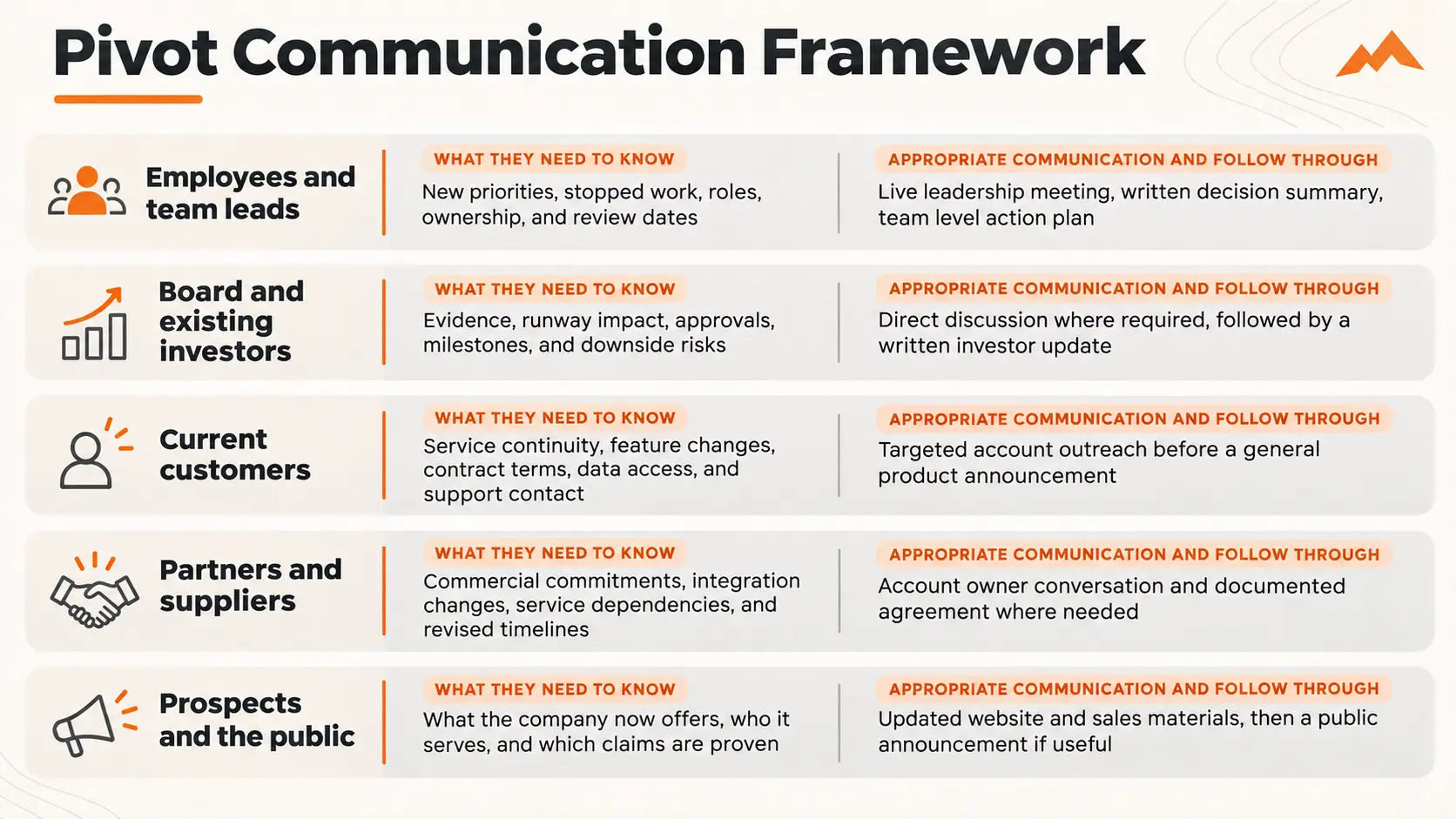
The order is a default, not a substitute for governance or legal review. A board may need to approve the decision before it is communicated broadly. A customer whose service will be discontinued may need formal notice under a contract, regardless of the company's preferred launch date. Investors with specific information rights may also have reporting requirements. The governing question is who needs time to act on a material change, not who should hear the most exciting version first.
Explain the Pivot to Employees Before Priorities Drift
Employees can tolerate uncertainty more easily than contradictory instructions. If leadership announces a new market while existing teams are still judged against the old roadmap, the pivot becomes a source of avoidable conflict. The first internal communication should explain the decision in a live setting where people can ask questions. A written follow up should name the work to continue, the work to pause, and who can authorize exceptions.
Translate the new direction into decisions that people will face that week. Engineering may need to freeze a reporting feature while protecting security fixes and existing service commitments. Sales may need to stop selling an offering that cannot be delivered as previously described. Customer success may need account specific guidance rather than generic talking points. Finance may need to update forecasts, payment timing, and the cost of supporting the old product during the transition. No team should discover its new responsibilities through a social post.
A founder should also acknowledge the human cost of changing direction. Employees may have spent months advocating for the original vision, and a new strategy can alter their roles or professional expectations. Explain what is known about team structure, what remains undecided, and when personnel questions will be answered. Avoid promising that no roles will change unless leadership has enough information to honor that promise. Private employment matters require direct, appropriate conversations rather than hints in a companywide announcement.
Give Managers One Source of Truth
A useful internal communication package can be short. It needs the core narrative, current priorities, decisions that require escalation, customer commitments that cannot be broken, and a living question log. Nominate an owner who corrects contradictory information quickly. Otherwise one manager may tell customers that the old service will remain indefinitely while another promises it will close at the end of the month.
Tell Investors What Has Changed in the Investment Case
Investors do not need a cheerful rebranding exercise. They need an honest account of why the previous thesis weakened, what evidence supports the alternative, and how the decision affects cash, risk, and the company's funding needs. A clear update should distinguish historical results from hypotheses being tested and show the next decision gate. If the startup is pre revenue or operating with a short runway, that context matters more than an attractive market size estimate.
A credible investor communication includes the main lesson from the original strategy, validated assets the company is retaining, the cost of winding down or supporting old commitments, the runway after the proposed change, and the milestones that would justify more investment. The founder should also describe what could invalidate the new direction. Where board consent, financing covenants, or investor information rights apply, those obligations must be addressed before a public launch. Not every investor has the same legal role, so founders should check their actual agreements rather than assume one update meets every requirement.
For example, a founder might explain that the new offer has secured four paid pilots, but those pilots have not established renewal or sustainable delivery economics. The next milestone could be successful completion of the promised workflow at an agreed cost per account. This message is less dramatic than claiming that product market fit has been found, but it gives investors a testable basis for evaluating the pivot. Share the next reporting date and the metrics that will be used, even when the eventual decision may be to stop.
Protect Existing Customers With Specific Commitments
For customers, the word pivot matters less than its consequences. Will the product keep working? Will support still answer requests? Are prices, features, integrations, or data access changing? Founders should answer those questions before explaining why the new market is attractive. Customers who will experience a material change deserve direct notice through an appropriate account contact, not a surprise discovered on the website.
Segment customers by actual impact. One group may see no change and need only reassurance. Another may have a feature retired, a contract revised, or a migration to a different offering. A third may rely on the old product for business critical operations and require a longer transition. Those groups should not receive the same vague email. The notice should identify confirmed changes, effective dates, customer actions, the support channel, and any available options for export, migration, refund, or termination where applicable.
Do not promise uninterrupted service if engineering has not assessed the transition. Do not describe an upcoming retirement as a minor improvement. If contractual service levels, privacy notices, data retention commitments, or consumer protection rules apply, review them before issuing the message. Treat affected customers as parties with existing rights and workflows, not as an audience for a product launch campaign.
A Useful Customer Notice Describes the Impact First
An effective customer explanation might say that the company is narrowing its product around inventory exception handling after observing stronger demand for that workflow. It should then say whether the customer's existing reporting access will remain available, the date on which any change takes effect, and where the customer can request help or export data. The reason for the strategy change can follow. This order respects the practical question the recipient is trying to answer: what do I need to do now?
Coordinate Partners, Suppliers, and Public Messaging
A pivot can affect payment providers, integration partners, resellers, data suppliers, and contractors even when the customer interface appears largely unchanged. A company that changes its target market may also change volumes, required security controls, geographic reach, or the scope of an integration. The responsible account owner should check which arrangements need renegotiation or renewed approval. An informal announcement cannot replace a contract amendment where one is required.
Public communication deserves restraint. A pivot does not automatically justify a press release, a new brand, or a long social media thread. If the new offer is still being validated, a precise product description may be more useful than a dramatic declaration about reinventing the industry. Update the website and sales material when they need to reflect a real change, but avoid publishing claims the team cannot support. Existing customers and committed partners should not learn of a change that affects them from the company's marketing campaign.
A Worked Example of a Pivot Communication Plan
Imagine a fictional software startup called Northfield Reports. It originally sold a reporting dashboard to small retailers. Customer research and paid pilots now suggest a more urgent need for inventory exception alerts, and the company decides to test a narrower service before permanently retiring the dashboard. The pivot itself has been discussed and conditionally approved, but the new service is not yet proven at scale. Communication must preserve that distinction.
On the first day, leadership records the approved test, confirms that existing customer contracts will be honored, and reviews any board or investor consent requirements. Next, the team hears the evidence and the temporary operating plan. Engineering learns which reporting work is frozen, while support receives an account list and specific answers about service continuity. Sales receives new language for the pilot offer and a rule against selling unapproved capabilities.
Within the following working days, the account team speaks directly with customers whose future features may change. Those customers receive a written summary of what stays available during the test and who to contact if their workflow is affected. Investors receive a concise update explaining the new hypothesis, the limited test budget, the customer evidence already available, and the next evaluation date. Only after those commitments are addressed does the company update public product messaging to describe its current offer accurately.
This is an illustrative sequence, not a universal legal timetable. If a contract requires earlier notice, or a company must obtain board approval before taking action, that requirement determines the schedule. The useful principle is consistency: no one should be asked to act on a change before the company has given them enough reliable information to do so.
Measure Whether the Communication Worked
A pivot announcement is not successful merely because it was sent. Founders should check whether employees understand their responsibilities, whether affected customers received and acknowledged critical notices, whether partners accepted revised commitments, and whether investor questions were answered. Track unresolved issues in one place and assign owners rather than treating silence as consent. For significant customer changes, a direct confirmation or support follow up may matter more than an email open rate.
The communication plan also needs a correction process. If the company discovers that a promised transition date is unrealistic, it should update affected people promptly, explain the new expectation, and document any actions they need to take. Recurring contradictions between sales, support, and leadership indicate a broken operating process rather than simply poor writing. Review what people actually understood through questions, tickets, account conversations, and team check ins.
Do not confuse these measures with validation of the pivot itself. A clear announcement can earn trust while the proposed business model still fails. Likewise, strong initial customer interest does not excuse missed obligations to existing users. Track communication execution separately from demand, delivery quality, and financial outcomes, then report both at the next decision point.
Common Communication Mistakes During a Pivot
The first mistake is presenting uncertainty as certainty. Founders sometimes call a promising pilot a proven strategy because they want the team to feel confident. That can create commitments the business cannot meet. Explain the evidence and the next test without asking people to believe the outcome is guaranteed.
The second mistake is treating every audience as a prospective buyer. Employees need clear decisions about their work, not a pitch. Existing customers need continuity information, not a celebration of a new market. Investors need the commercial consequences, not only a revised mission statement. The core narrative can remain consistent while the practical emphasis changes.
The third mistake is announcing a pivot without updating day to day operations. If the old website, sales deck, support scripts, and product roadmap contradict the new strategy, people will trust the artifacts they use rather than the announcement they heard. Another mistake is waiting for perfect certainty before informing those whose contracts or workflows will be affected. The right approach is to communicate confirmed facts at the right time, explicitly name unresolved decisions, and follow through when answers become available.
The Standard Is Clarity People Can Use
Communicating a startup pivot is the process of turning a strategic decision into a set of accurate expectations. The founder should tell the same factual story to everyone, then adapt the details to each group's responsibilities and exposure. Start with evidence, name what changes and what remains, protect existing commitments, and identify the person and date for the next update. The aim is not to persuade every stakeholder that the new strategy will succeed. It is to make sure nobody has to guess what the company has decided or what they need to do next.
FAQ
Should founders announce a startup pivot before validating it?
Not as a completed strategic success. Founders can communicate that they are testing a new direction, describe the reasons for the test, and state what remains uncertain. A permanent announcement should reflect the decision actually made, while affected customers and relevant investors must still receive any notices or approvals required during the test.
Who should hear about a startup pivot first?
Start with any people or governing bodies whose approval is legally or contractually required, then brief the teams responsible for delivering the change before broad public messaging. Customers and partners facing material changes should receive direct, timely notice. The exact order depends on obligations and operational impact, not a universal announcement formula.
What should a startup tell investors about a pivot?
Explain which original assumption changed, the evidence supporting the alternative, the expected cash impact, remaining runway, and milestones required before more resources are committed. Separate results already observed from forecasts and disclose material risks. Follow board, financing, and information rights obligations where applicable.
How should a startup inform existing customers about a pivot?
Lead with what happens to their product, service, pricing, support, data, and contract. Provide dates, required actions, available options, and a named contact. Customers who are materially affected need more specific outreach than those whose service remains unchanged.
Is a public announcement always necessary after a pivot?
No. Some pivots are limited tests or changes in the company's operating focus that do not affect the wider public. The priority is accurate communication with people who must act on the change. Public messaging becomes useful when the offer, positioning, or expectations of prospective customers have genuinely changed.

Mohsen Avid
Founder & Editor, PinerookMohsen Avid is the founder of Pinerook, covering entrepreneurship, startup strategy, digital business, and the decisions behind building new ventures.
 Seen first.