Cross border stablecoin payments let a business move value between countries using a digital token designed to track a currency such as the US dollar. They can shorten the part of a transfer that normally depends on several banks and their operating hours. But a fast blockchain transaction is not automatically a fast international payment. The payment is only useful when the recipient receives the agreed amount in a currency and account they can actually use.
For a company evaluating Stablecoins for Business, the relevant decision is therefore narrower than whether blockchain is faster than a wire. It is whether a particular payment corridor can deliver funds more predictably, at a lower total cost, without introducing unacceptable legal or operating risk. The same stablecoin and network can work well for one destination and poorly for another because the local conversion partner, available liquidity, and beneficiary requirements are different.
The Complete Payment Journey From Invoice to Local Funds
Most business transfers involve more than sending a token to a wallet. The sender may start with a bank balance, while the supplier expects money in a local bank account. A stablecoin route connects those two endpoints through conversion services and a blockchain transfer. Evaluating the whole journey prevents finance teams from mistaking a technical confirmation for successful delivery.
Agree on the Invoice and Receiving Method
First, the sender and beneficiary need to agree on the invoice currency, due date, who absorbs fees, and the actual form of receipt. A supplier may accept USDC directly, but another may require pesos, euros, or another local currency in a conventional bank account. Those choices determine whether the business needs one conversion, two conversions, or no conversion at the receiving end. They also determine who carries exchange rate risk while the payment is being processed.
A written payment instruction should identify the beneficiary, currency, supported network, wallet or bank details, and the evidence needed to mark the invoice paid. When a payment provider handles the route, it should confirm that both jurisdictions and the intended use are supported before the sender commits funds. An available blockchain network does not, by itself, mean a compliant payment service operates in that corridor.
Convert, Transfer, and Confirm
The sender or its provider converts the funding currency into a suitable stablecoin through an on ramp. The provider then sends the token across the selected network and records a transaction reference. Network confirmation can occur quickly, depending on congestion and the network used. Yet that reference shows that a token transfer happened, not necessarily that a supplier has received spendable money.
A recipient that accepts the stablecoin may keep it in a wallet, subject to company policy and custody controls. If the recipient requires local currency, an off ramp must exchange the token and release a domestic payout. This final banking step can be constrained by identity checks, operating hours, liquidity, transaction limits, or a compliance review. In practice, the last mile often determines the beneficiary's real settlement time.
The True Cost of a Cross Border Stablecoin Payment
A claim that a transfer costs only a few cents usually refers to its network charge. An international business payment can also include the sender's funding fee, a spread on stablecoin acquisition, provider charges, a second conversion into local currency, and a withdrawal or bank payout fee. Businesses should compare the recipient's final amount using the same starting currency and a consistent exchange rate benchmark. Comparing a network fee with a bank's all inclusive transfer quote is not a fair test.
Consider a hypothetical $20,000 supplier payment where both methods deliver the same local currency to the recipient. The figures below are illustrative planning assumptions, not quotes from a bank or stablecoin provider. They demonstrate how the parts of the cost change even when the blockchain charge is almost negligible.
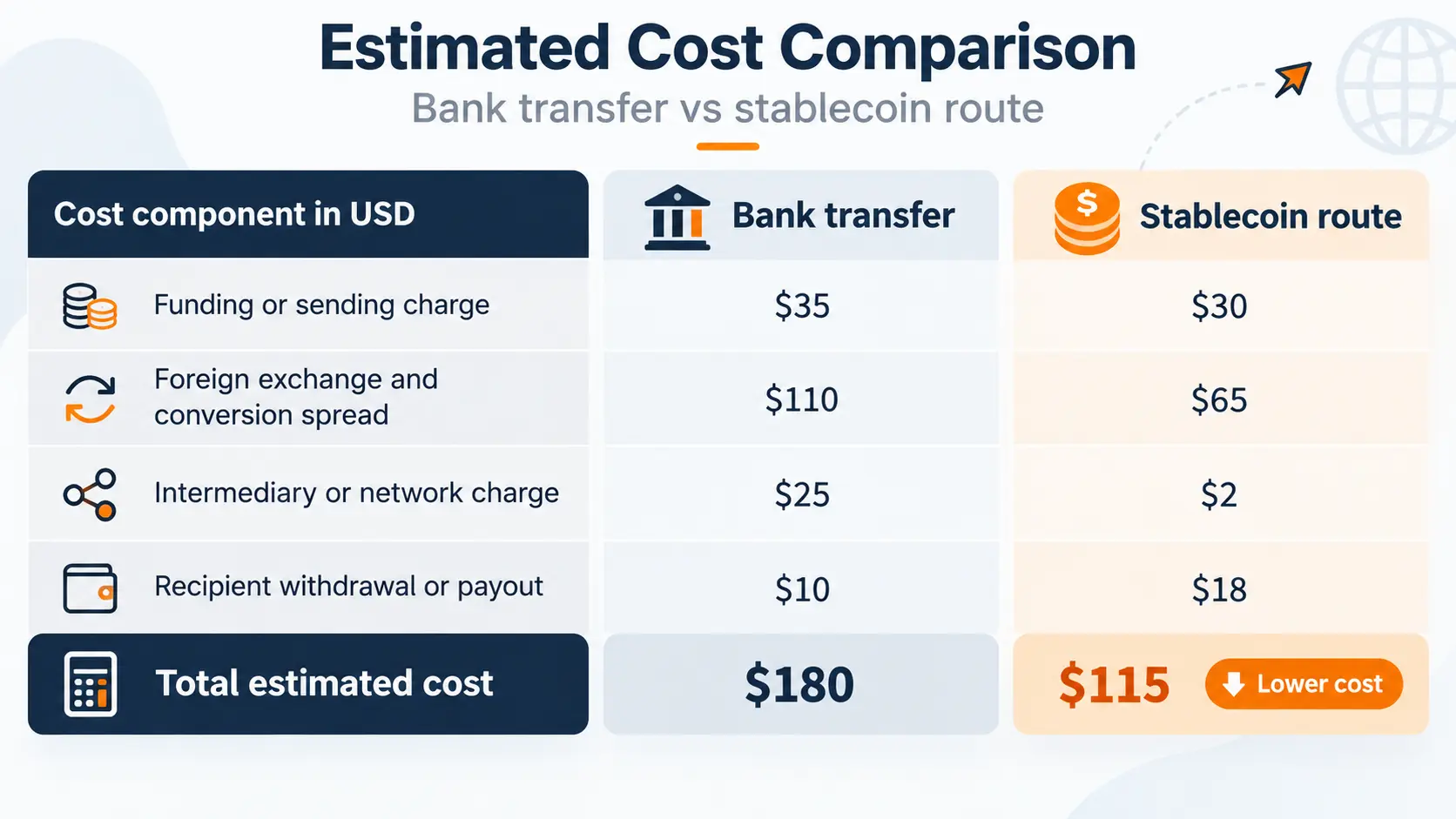
In this example, the stablecoin route costs $65 less, or about 0.33 percent of the transfer amount. That difference could disappear if the off ramp widens its spread or the recipient cannot withdraw promptly. It could also increase if an expensive correspondent banking route is replaced by an efficient local payout partner. An actual decision needs firm quotes and a record of the net amount received over several comparable transfers.
The timing comparison needs the same discipline. Measure the interval from funds leaving the sender's usable balance until the beneficiary can spend or withdraw the proceeds. Record conversion delays and compliance holds, not just the timestamp of the token transfer. A provider advertising near instant network settlement may still rely on local banking rails to complete the payment.
Where Stablecoins Can Improve International Business Transfers
The clearest use cases are repetitive payment routes with expensive intermediaries, inconvenient bank cutoffs, or inconsistent access to foreign currency. For example, a software company paying contractors in several countries may benefit from one funding relationship that supports multiple local payout partners. A marketplace operating across borders may gain from the ability to make payouts outside ordinary banking hours. A manufacturer may value more predictable supplier funding if delayed transfers frequently interrupt orders.
These benefits should not be generalized across every country. A major currency corridor already served by efficient bank or fintech transfers may offer little improvement. A less connected destination may have higher stablecoin conversion charges, scarce local liquidity, or restrictions that outweigh any settlement advantage. The relevant unit of analysis is the corridor and payment type, not the token itself.
For large suppliers, the contract terms matter as much as infrastructure. A buyer that promises a fixed local currency amount must cover any difference between the quoted payout and the supplier's invoice. A recipient paid in a dollar stablecoin may instead accept an exposure to the dollar relative to its domestic currency. Clear responsibility for these differences prevents an apparently cheaper payment from becoming a commercial dispute.
The Operational Risks Behind a Successful Blockchain Transfer
The first risk is a weak off ramp. A payment can appear settled on chain while the receiving provider delays or rejects conversion into local currency. Businesses should examine payout limits, supported banks, service hours, refund arrangements, and the circumstances in which funds can be frozen. A backup payout method matters most when the supplier depends on a deadline rather than merely preferring a faster transfer.
A second concern is the stablecoin and its issuer. Dollar linked tokens are not identical to insured bank deposits, and redemption rights vary by issuer, holder, and jurisdiction. Reserve quality, legal claims, custody arrangements, and market liquidity can affect the ability to convert at the expected value. A business should not hold a larger stablecoin balance than the payment process requires without a separate treasury decision.
The transfer itself also introduces controls that ordinary accounts may handle differently. A wrong address, unsupported network, compromised signing key, or mistaken token selection can make recovery difficult or impossible. Operational controls should include verified beneficiary details, limited wallet permissions, transaction approvals, a second person for material payments, and a documented incident response process. A provider's automated interface does not remove the sender's responsibility to verify instructions.
Finally, legal eligibility is route specific. Applicable obligations may include identity verification, sanctions screening, anti money laundering measures, payment services licensing, foreign exchange controls, and record retention. Different jurisdictions can treat issuers, custodians, payment firms, and commercial users differently. Businesses should verify current requirements with qualified advisers and regulated providers rather than assuming that a transfer is permitted simply because a wallet can receive it.
Selecting a Payment Corridor That Actually Works
A useful provider review begins with the destination, not a list of tokens or blockchains. Ask whether the service supports the sender's entity, the beneficiary's country, the invoice currency, and the actual receiving bank or wallet. Then request an end to end quote that shows the exchange rate, every fee, the beneficiary's expected proceeds, and the conditions under which the quote may change. Any promise of guaranteed delivery should be checked against the service agreement.
The next consideration is operational resilience. Finance teams need to know who holds customer funds at each stage, what happens during a network outage, how long manual review may take, and whether a payout can be returned if the recipient account rejects it. They should also know which party is responsible for customer support and how disputes are resolved. These questions matter more for recurring payroll or critical supplier payments than the number of networks listed on a provider's website.
Reporting capabilities are equally important. The company should be able to reconcile an invoice to a bank debit, token transfer, conversion record, payout confirmation, and accounting entry. Because transaction IDs alone do not establish who received usable funds, the final payout receipt is part of the audit trail. Without consistent records, small savings in transfer fees can be consumed by manual finance work.
A Practical Pilot Before Moving Routine Payments
A sensible pilot uses one supported corridor, a known beneficiary, and a small number of routine invoices. Document the existing route first: total cost, quoted and realized exchange rate, hours to usable funds, rejected payments, and internal time spent on reconciliation. Then run the same measurements through a stablecoin service under comparable conditions. The goal is not to prove a technology preference but to identify a repeatable operational improvement.
Choose a limited payment size consistent with your company's risk policy, verify recipient details out of band, and agree on a backup payment method. Before each test, define the minimum acceptable net payout and the latest useful arrival time. Afterward, compare provider records with bank statements and the beneficiary's confirmation. If the payment is delayed, capture which stage created the delay rather than labelling the whole route slow.
Expand only after several payments show an improvement in delivered amount, usable funds timing, and reconciliation effort. If a provider changes its pricing, a local payout partner loses access, or a regulatory restriction changes, reassess the corridor. What works this quarter may not remain superior indefinitely, particularly in markets where off ramp liquidity is thin.
When Bank Transfers Remain the Better Choice
Traditional rails can remain attractive when the recipient requires a familiar regulated account, the currency pair is highly liquid, and a bank or fintech already provides transparent low cost payouts. They may also offer established dispute procedures, clearer contractual protections, or operational processes that a particular stablecoin route lacks. A startup with only occasional overseas invoices may not justify the effort of adding wallet controls and a second payment provider.
The decision should be treated as a comparison between two complete services, not a contest between blockchains and banks. The strongest outcome may be a mixed payment policy: conventional transfers for straightforward destinations and a carefully approved stablecoin route for corridors where evidence shows an advantage. A payment is successful when the right beneficiary receives the right amount, on time, with a record the business can defend.
Cross border stablecoin payments can create value where international transfers remain costly or operationally unreliable. Their advantage comes from a working chain of funding, token movement, local conversion, compliance, and beneficiary delivery rather than from the blockchain step in isolation. Start with one real payment corridor, measure the result against conventional alternatives, and keep the route only when the full process is demonstrably better.
FAQ
Are cross border stablecoin payments always cheaper than bank transfers?
No. Network charges may be low, but funding fees, conversion spreads, local payout costs, and operational work can change the final price. The cheaper route depends on the countries, currencies, amount, and providers involved. Compare the beneficiary's net proceeds and the full end to end cost.
How long does a cross border stablecoin payment take?
The blockchain portion may settle in seconds or minutes on some networks, but an international payment can take longer to finish. On ramp processing, compliance checks, off ramp conversion, and local bank availability affect when the recipient can use the money. Measure completion at the beneficiary's account rather than at the blockchain confirmation.
Can a business pay foreign suppliers directly in USDC?
Potentially, if the supplier agrees to receive USDC, the parties and their providers are permitted to use it, and the chosen network is supported. The contract should define the currency obligation, valuation point, fee responsibility, and proof of payment. A supplier that needs local currency will still require conversion or a payment provider that performs it.
What happens if a stablecoin transfer goes to the wrong network or address?
Recovery may be difficult or impossible depending on the network, wallet, and recipient control. Businesses should verify beneficiary instructions independently, use supported networks, and apply approval controls and small test transfers where appropriate. A blockchain transaction generally cannot be reversed by simply requesting a bank style chargeback.

Masoumeh Jahangard
Markets & Economy Writer at PinerookMasoumeh Jahangard covers markets, economic trends, and business conditions for Pinerook, focusing on how they affect startups and growing companies.
 Seen first.