A startup can solve a real problem and still struggle to grow because it is selling to the wrong people. A customer segment pivot keeps the core problem and much of the product intact but changes the group the company is built to serve. The difficult part is not discovering that another audience likes the product. It is proving that this audience has an urgent problem, a repeatable buying process, and economics the startup can support.
Within a broader Startup Pivot Strategy, changing customer segments is a specific decision. It should follow evidence that the original segment has received a fair test and a different segment demonstrates stronger commercial demand. Founders need to test both sides of that claim before reallocating the company.
What a Customer Segment Pivot Actually Changes
In the Lean Startup framework, a customer segment pivot happens when the product addresses a genuine problem, but for customers different from those originally expected. The product hypothesis is partly correct. The customer hypothesis is not. This distinction matters because it encourages the team to preserve what works rather than reflexively rebuild everything.
Imagine a startup that makes an approval tool for independent graphic designers. Freelancers use it occasionally, but small design agencies repeatedly invite clients, coordinate revisions, and ask for team permissions. The approval workflow may already solve the right problem. What changes is the economic buyer, the intensity of usage, and the context in which the software becomes valuable.
Changing the headline on a landing page to attract agencies would be a marketing test. Reorienting product decisions, pricing, distribution, and customer success around agencies after validating demand would be a customer segment pivot. The difference is a strategic commitment supported by evidence, not the wording of a campaign.
The Signals That Another Segment May Be a Better Fit
A different segment often becomes visible in ordinary customer activity before it appears in the founders' strategy documents. The company receives unusual inbound requests from one type of buyer, sees heavier use among a small customer subgroup, or finds that a particular organization uses the product for a business critical task rather than an occasional convenience.
Stronger Behavior Matters More Than Enthusiasm
A prospect who says a product is interesting has offered feedback, not proof of demand. Stronger signals include an organization returning to the product without reminders, inviting coworkers, moving an existing workflow into the system, paying for a pilot, or assigning someone to evaluate procurement. None of these signals is conclusive alone. Together, repeated across comparable customers, they support a more serious test.
Founders should compare customers who had a reasonable chance to understand and use the offer. If one group was acquired from a trusted referral and another saw a cold advertisement, a higher conversion rate may reflect the channel rather than customer fit. Likewise, an enterprise trial supported by extensive personal service is not directly comparable to a self service product trial.
The Buyer, User, and Decision Maker May Differ
A segment is not simply an industry label. A project manager may use the tool, an operations director may own its performance, and a finance leader may approve the budget. A promising new segment becomes more credible when the company can identify the operational problem, the person who experiences it, the person who controls spending, and the event that triggers a purchase.
This is especially important when moving from individuals to companies. The underlying feature may stay almost unchanged while expectations around invoices, permissions, security reviews, training, and support increase. If the product is valuable to users but no one has authority or budget to buy it, the pivot remains unproven.
A Worked Example of a Customer Segment Pivot
Consider an illustrative startup with a scheduling and approval tool. The founding team originally targets independent consultants who manage client work. During its early trials, small agencies begin using the same tool to coordinate several consultants and clients at once. Rather than assume agencies are the answer, the team tests comparable offers with both groups over a defined period.
The numbers below are hypothetical and show how to structure evidence. They are not market benchmarks or results from an actual company.
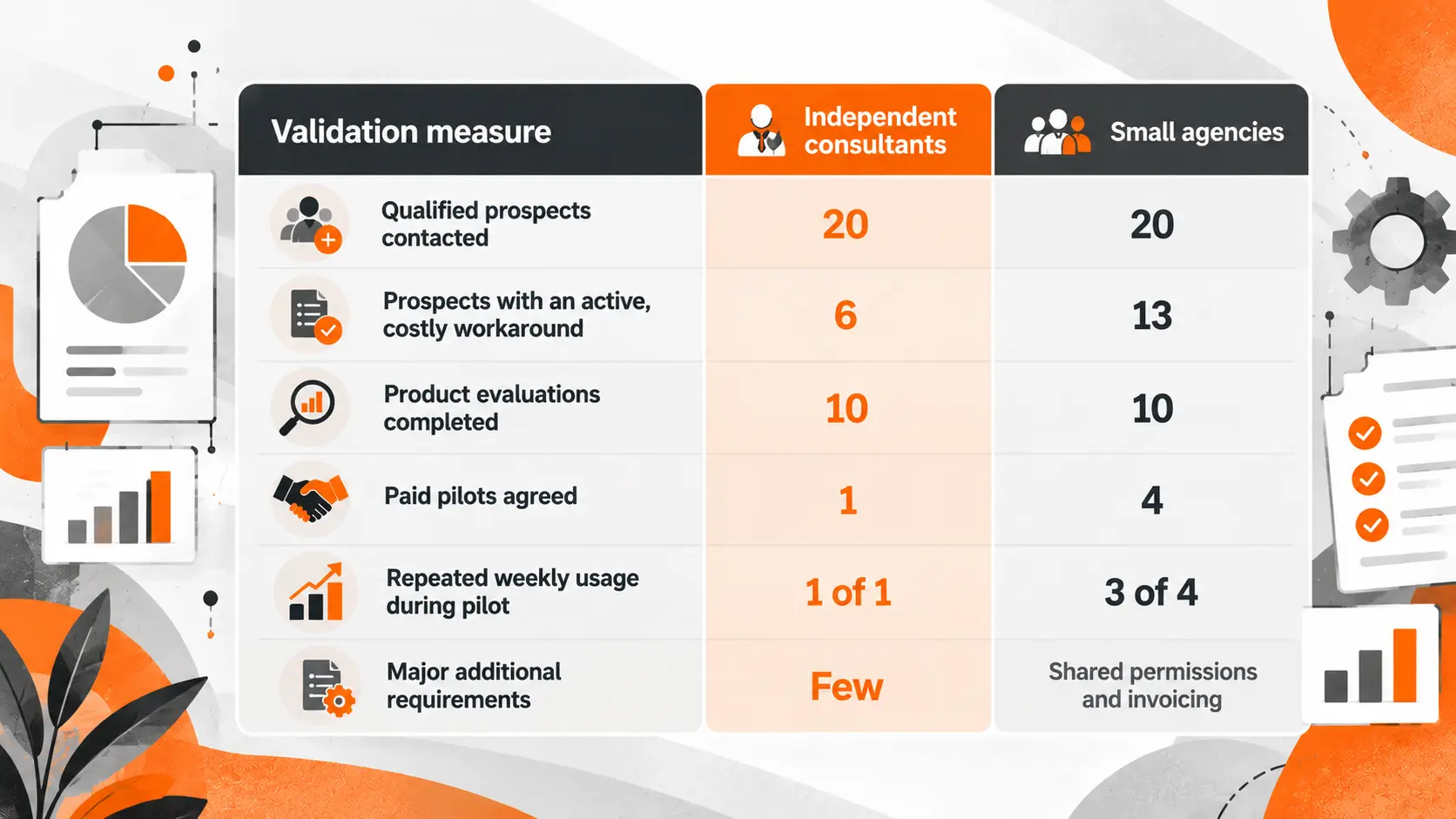
Four paid pilots from ten agency evaluations are encouraging relative to one from ten consultant evaluations, but a sample this small does not establish a dependable conversion rate. The founder should inspect how the pilots were sold, whether the same problem appeared repeatedly, and whether implementation work could be reused across customers. It may be easier to close four unusually well connected agency contacts than four representative customers.
The commercial calculation can also reverse an apparently attractive signal. Suppose an agency pilot yields $300 in monthly revenue but needs twelve hours of custom onboarding and ongoing manual support. A $35 consultant subscription may look weaker yet be cheaper to deliver. Before deciding, estimate gross margin, implementation effort, sales cycle, and expected retention for each segment. The best buyer is not automatically the one willing to pay the highest invoice.
A Practical Method for Validating the New Customer Segment
A useful validation process tests one clear hypothesis with evidence the team can compare. It does not require a complete rebrand, an enterprise feature backlog, or a large market research budget.
Define the Segment Narrowly Enough to Test
Replace vague descriptions such as “small businesses” with a customer profile tied to a specific job and buying trigger. For example: agencies with five to twenty employees that deliver recurring client projects and currently manage approvals through email. That definition tells the founder whom to contact, which workflow to observe, and what alternative the product must beat.
Write down the original segment as carefully as the new one. Record its typical buyer, current workaround, purchase trigger, accessible channels, and expected implementation burden. Without a comparable baseline, the team may mistake any new attention for progress.
Separate the Problem Interview From the Sales Test
First ask prospects to describe recent work, the last time the problem appeared, its consequences, and what they currently do about it. Useful questions focus on observable behavior: who was involved, how much time was spent, what failed, and whether the team had already budgeted for a solution. Avoid leading questions that present the proposed product as an obvious improvement.
Then test a concrete offer. A paid pilot, a limited contract, or a purchase process with a named budget owner is more informative than a survey of hypothetical willingness to pay. If enterprise procurement takes months, a formally approved evaluation with specific success criteria may be a meaningful intermediate step, but it should not be reported as revenue.
Test the Repeated Buying Pattern
One large customer can create a misleading impression of demand. Seek several unrelated customers with similar problems, buying triggers, and implementation needs. Observe whether the same message works, whether decision makers can be reached through a repeatable channel, and whether the product creates value without a founder personally operating it every day.
The initial goal is not statistical proof of the entire market. It is to establish whether a repeatable pattern exists strongly enough to justify the next, larger test. A founder should preserve uncertainty in the decision memo rather than presenting early interviews as representative of every agency or industry.
Agree on a Budget and Decision Point
Set a limited experiment budget, a review date, and an evidence threshold before running the test. The threshold should reflect the business model. A simple self service tool may use completed purchases and repeat activation; a high value business product may use paid pilots, signed evaluation criteria, and a feasible route through procurement.
Do not change the criteria halfway through because a charismatic prospect expresses interest. If both segments fail the same commercial test, a new customer segment may not be the correct answer. The underlying problem or product may need reevaluation instead.
The Operational Work After a Segment Pivot
The most tempting approach is to announce a new target audience and continue operating the same company. In practice, changing the buyer can change nearly every step around the core product, even when the product itself remains recognizable.
Positioning and acquisition. The value proposition should describe the new customer's measurable outcome, not simply replace “freelancer” with “agency.” Acquisition channels may shift from creator communities to professional referrals, partnerships, or direct outreach. Each channel has different costs and buying expectations.
Product boundaries. Protect the proven central workflow while identifying the minimum capabilities required by the new segment. Shared permissions may be essential for agencies; a bespoke reporting dashboard requested by one customer may not be. Reusable requirements deserve more attention than custom deals that distract the team.
Commercial process. Clarify who signs, how long a decision takes, and which documents are required. Adjust packaging and onboarding only as much as the evidence supports. A new segment that needs invoicing, annual agreements, or internal approval may impose costs absent from the original consumer model.
Customer obligations. Existing customers do not disappear when strategy changes. Communicate support commitments, product changes, and any planned discontinuation clearly. A startup that abandons paying customers without planning damages trust before the replacement market is proven.
Team priorities. Assign one owner to the new segment test and one to continuity for existing customers. Without a clear division, the team may build for both audiences indefinitely and satisfy neither. The pivot should produce a coherent operating focus, not two competing roadmaps disguised as optionality.
Customer Segment Pivot Versus Other Strategy Changes
A customer segment pivot keeps the fundamental problem and solution direction but changes who benefits most. If founders keep the customer and discover that a different problem matters more, that is closer to a customer need pivot. If they keep the buyers but change from a one time license to recurring subscription, they are primarily testing value capture. If they pursue the same buyer through a new sales partner, they may be changing the channel rather than the customer.
These distinctions matter less as labels than as controls on the experiment. When the team changes customers, pricing, product scope, and sales channels at the same moment, it becomes difficult to know which assumption was responsible for better results. Some supporting adjustments will inevitably be necessary, but the core hypothesis should remain identifiable: this type of customer needs the existing solution more urgently and can buy it through a repeatable process.
A founder who wants a broader comparison of strategic changes can use the related cluster on types of pivots. Here, the relevant discipline is to prove that the customer change is central rather than merely one part of a general repositioning exercise.
The Limits of the New Segment Opportunity
A segment pivot is risky when its evidence depends on one influential champion, a one off contract, or a level of customization the startup cannot replicate. It is also risky when a handful of early customers represent almost all available buyers or when a tightly regulated market requires capabilities the team lacks.
A larger customer is not always a better customer. Longer sales cycles, expensive security reviews, delayed payments, and concentrated revenue may consume the company's remaining runway. Founders should investigate total reachable demand and route to market before committing to a segment that looks prestigious but is difficult to serve economically.
There is also a risk in switching too early. A poorly explained value proposition, unreliable onboarding, or inadequate distribution can suppress results even when the original segment has genuine demand. Before concluding that the customers are wrong, check whether the original offer received a reasonable test and whether the alternative shows more than novelty driven interest.
Turning the Test Into a Clear Decision
A useful decision statement can fit in one paragraph: “We built this workflow for independent consultants. They use it occasionally and rarely pay for continued access. Across several comparable tests, small agencies show a recurring coordination problem, multiple budget owners have agreed to paid evaluations, and the service requirements appear reusable. We will focus the next product cycle on agencies while honoring current commitments, and revisit the decision after the agreed pilot outcomes.”
That statement preserves the evidence, names what is still uncertain, and makes the next commitment explicit. If the tests fail, the team has learned something without pretending that a different audience is automatically a new business. If they succeed, the startup can make a disciplined transition toward the customers for whom the product matters most.
A successful customer segment pivot is not a search for an audience that applauds the product. It is a change toward customers who experience the problem more urgently, demonstrate reliable buying behavior, and can be served through an economically sustainable process. Keep the capability that works, test the new buyer before scaling, and commit only when the evidence supports a repeatable business rather than an attractive exception.
FAQ
What is a customer segment pivot in a startup?
It is a strategic change in the type of customer a startup serves while preserving much of the original product or problem being solved. The new segment must be validated through behavior and commercial evidence, not just positive feedback.
How is a customer segment pivot different from changing a marketing audience?
Changing marketing targeting is an experiment in attracting prospects. A customer segment pivot changes the company's central customer hypothesis and subsequently influences product priorities, pricing, onboarding, and sales operations.
Can a startup pivot from consumers to business customers?
Yes. The product may solve a stronger or more frequent problem for organizations. Founders still need to test budget ownership, procurement, support needs, implementation costs, and whether the economics work for repeated sales.
How many customers are needed to validate a new segment?
There is no universal minimum. The relevant question is whether several independent customers demonstrate a consistent problem, a repeatable buying trigger, and meaningful commitment. Small samples support further testing, not sweeping claims about market demand.
Should a startup abandon its original customers after pivoting?
Not automatically. Existing contracts and support promises still matter. The company should decide how to maintain, transition, or eventually retire the old offering while keeping customers informed and meeting its obligations.

Mohsen Avid
Founder & Editor, PinerookMohsen Avid is the founder of Pinerook, covering entrepreneurship, startup strategy, digital business, and the decisions behind building new ventures.
 Seen first.