
A pivot is not validated when a new idea sounds more compelling than the old one. It is validated when a specific group of customers demonstrates enough real demand, the company can deliver the promised outcome, and the economics justify the next investment. Founders should test those claims before redirecting their entire team, abandoning existing customers, or rebuilding a product around an unproven assumption.
Within a broader Startup Pivot Strategy, validation is the bridge between recognizing a problem and committing to a new direction. The goal is not to prove that the founders made the right choice. It is to create a fair opportunity for the proposed pivot to fail, learn what that failure means, and act on the results while there is still time and money to change course.
What Does It Mean to Validate a Startup Pivot?
To validate a startup pivot is to gather credible evidence that a material change in the business could work. Depending on the proposed direction, the change might involve a different customer, problem, product outcome, channel, or method of making money. Validation does not mean achieving product market fit in a few weeks. It means reducing the largest uncertainty enough to justify a clearly defined next step.
Suppose a startup built software that helps independent shops create weekly inventory reports. Shop owners say the reports are useful, but few pay. In conversations with regional distributors, the team learns that delayed stock exception alerts may cost those companies much more than the reporting tool saves retailers. The alternative hypothesis is not simply that distributors will like a better dashboard. It is that operations managers will pay for timely exception detection and that the startup can provide it reliably at an acceptable cost.
That distinction matters because early excitement is cheap. A promising direction must survive tests of actual buying behavior, value delivered, and operational feasibility. One impressive demo or a friendly introduction cannot establish all three.
Step 1: Write Down What Is Changing and What Remains True
A poorly defined pivot is difficult to test. If the company changes its audience, pricing, product, and distribution channel simultaneously, a positive or negative result tells the team little about which assumption mattered. Start by writing a one sentence statement of the old belief, the proposed replacement belief, and the evidence that motivated the change.
For the inventory startup, the old belief was that independent shops would pay monthly for better reporting. The replacement belief is that regional distributors will pay for an exception alert service because it reduces expensive manual checks. The team may retain its data connectors and industry knowledge while changing the target buyer and the promised outcome. This creates a testable boundary around the pivot rather than an invitation to rebuild everything.
Record what is already known, including customer complaints, product usage, fulfilled contracts, delivery costs, and rejected offers. Mark each item as an observation or an interpretation. A customer saying a workflow is frustrating is an observation; concluding that the customer will pay $500 per month to remove it is a new hypothesis. Treating those statements as interchangeable creates false confidence.
Step 2: Rank the Assumptions That Could Kill the New Direction
A pivot usually contains several unproven beliefs. The buyer must experience a sufficiently costly problem, have authority or budget to pay, recognize the proposed outcome as valuable, and be able to adopt the solution. The startup must also deliver the result consistently, within budget and any relevant security or legal requirements. Testing a minor feature first can feel productive while leaving the largest threat untouched.
Rank assumptions by how damaging it would be if each proved false and how little credible evidence supports it today. In a business selling to regulated organizations, data access or procurement permission may be more decisive than interface design. In consumer software, repeated usage may matter more than initial signups. For a service business, delivery costs may invalidate an apparently attractive price before customer acquisition becomes the main constraint.
Select one primary assumption for each short experiment. The order need not be identical for every business, but a sensible progression is to establish that a painful problem exists, test that qualified buyers will make a meaningful commitment, and then prove that the promised result can be delivered economically. If the first condition fails, building a sophisticated pilot will not rescue the proposition.
Step 3: Match the Experiment to the Claim
Different experiments provide different strengths of evidence. Interviews help uncover jobs and constraints. A landing page can test whether a message attracts attention. A paid pilot tests some willingness to commit. Observed use can show whether the customer receives value, while a delivery cost review tests whether the service is economically plausible. None of these methods is universally sufficient on its own.
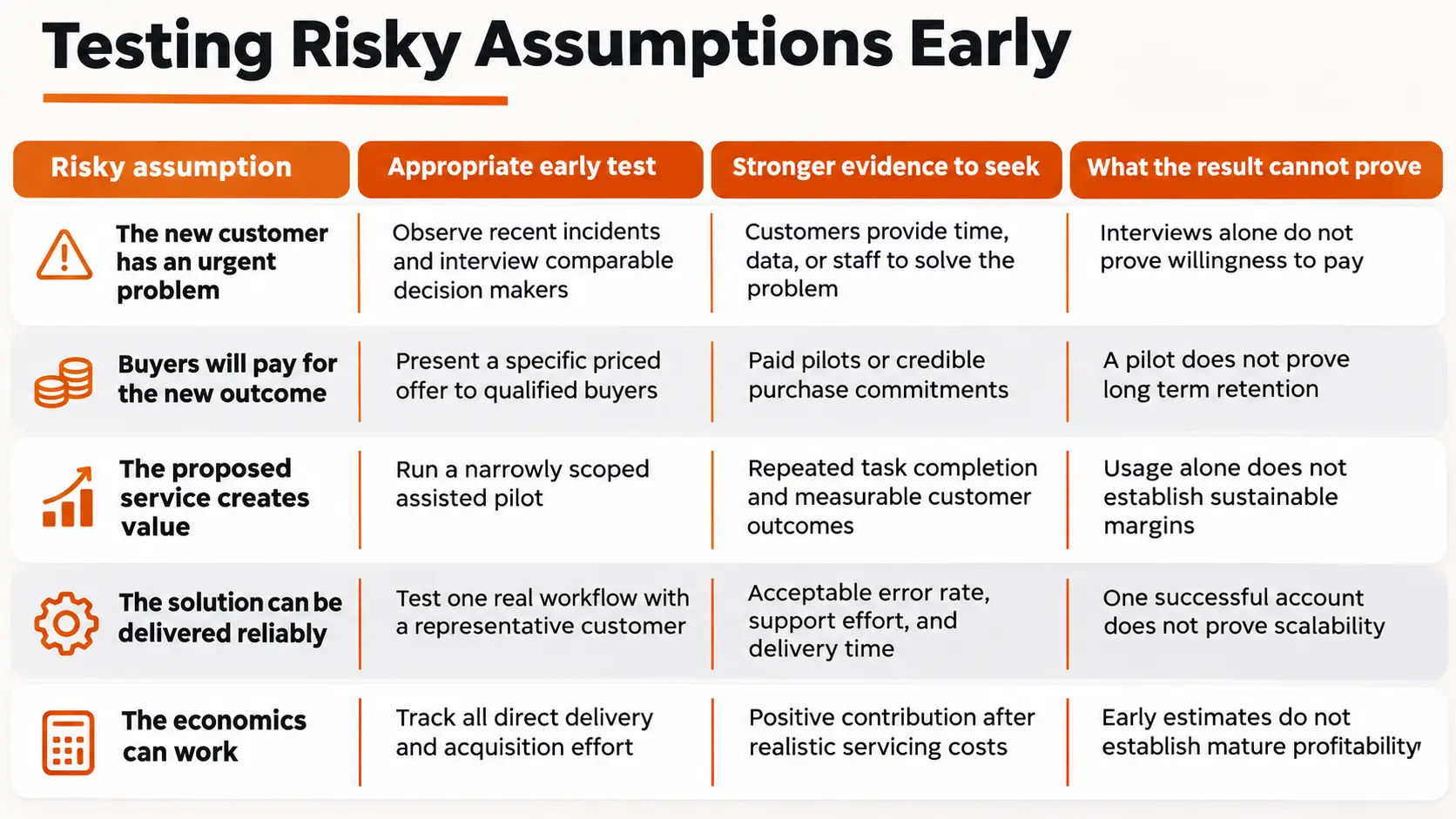
The evidence should become progressively harder to fake or misinterpret. Strategyzer's work on business experiments distinguishes quickly gathered opinions from stronger behavioral evidence. That is a useful principle, but founders should still choose tests that fit their sales cycle and ethical obligations. A regulated healthcare service cannot safely be validated with the same improvisation as a simple newsletter product.
Step 4: Set the Threshold Before You See the Results
A test without a decision threshold makes it easy to move the goalposts. Before approaching prospects, specify the population, offer, sample, observation period, primary metric, and minimum result that would justify another investment. Also define what failure or an inconclusive result would mean. The threshold is a management decision based on the business model, not a universal industry benchmark.
For example, the inventory startup could plan to approach 24 qualified distributor operations leaders using the same priced offer. It might decide in advance that at least six meaningful pilot commitments are needed to fund the next test, provided those prospects have relevant budgets and comparable operational needs. If only two agree, the team will review the problem definition and price rather than immediately build additional functionality. The numbers are illustrative, not a scientifically established rule for startups.
A commitment must be defined precisely. A signed paid pilot, an agreed implementation date with an authorized buyer, and a verbal expression of interest are not equivalent. If the goal is purchase intent, a waiting list of anonymous email addresses is a weak substitute. If the goal is technical feasibility, a purchase order cannot prove that the product works. Make the metric match the risk.
Also set guardrails around the experiment: a cash cap, a founder time limit, a requirement to preserve existing customer service, and a stop condition if security, compliance, or data quality proves unacceptable. These limits prevent an optimistic test from becoming an uncontrolled companywide pivot.
Step 5: Run a Small Test That Looks Like Real Buying and Real Use
The strongest early experiment usually contains an authentic customer decision. For a new business to business segment, offer a defined outcome at a real price to people who can approve the purchase. For a new workflow, let users attempt a representative task with the product or a carefully supervised manual prototype. For a change to a managed service, record the hours, interventions, and external costs needed to deliver each result.
Avoid designing the test to make agreement effortless. Friends, existing supporters, and discounted pilot customers may be useful for learning, but they are not necessarily representative of the buyers required for a repeatable business. Record how each prospect was recruited, how many declined, and why. Strong enthusiasm from one unusually motivated customer can signal an opportunity; it cannot establish a market by itself.
A manual or concierge pilot is useful when it reveals a customer's real workflow before automation is built. The customer should understand what is being provided, especially where human processing affects privacy or service promises. The test should reproduce the expensive or risky part of delivery closely enough to reveal constraints. A polished presentation that never attempts the promised outcome can validate interest, but not capability.
A Worked Example: Comparing Two Offers Without Overclaiming
Consider an illustrative startup that offers a generic analytics dashboard to small retailers and is considering an exception alert service for regional distributors. In the current offer, four of 24 qualified buyers agree to a paid trial. In the proposed offer, eight of 24 qualified distributors agree to a paid trial. The observed conversion rates are approximately 16.7 percent and 33.3 percent respectively.
The proposed offer appears more promising, but the two groups may differ in urgency, sales relationships, budgets, or recruitment channel. The startup should not call the pivot validated merely because the second rate is twice the first in small, nonrandom samples. A sensible next test would recruit another group of comparable distributor prospects, maintain a consistent offer, and examine whether the eight pilots produce the expected operational result.
Suppose each distributor pays $600 for a pilot and the team spends $420 per account on direct labor, software, and support. That leaves $180 in contribution per pilot before broader overhead and customer acquisition costs. This is encouraging only if the costs are measured honestly, the buyer can continue paying after the pilot, and service delivery does not become disproportionately more expensive with additional accounts. The founders have earned the right to test repeatability, not the right to declare a scalable business.
This example shows why validation is a sequence of decisions. The first round tests willingness to commit. The next tests reliable value and delivery cost. Later rounds test repeat buying, customer retention, and whether acquisition remains workable outside the founders' personal network.
Step 6: Separate the Signal From Selection Bias and Vanity Metrics
Small startup experiments rarely provide the statistical certainty of a large randomized trial. That does not make them useless, but it increases the importance of interpreting the evidence carefully. An attractive conversion rate from referrals may vanish in a colder channel. A highly customized pilot may delight a customer while failing to reveal what a standard product can achieve. A free trial with extensive founder assistance may conceal the real cost of onboarding.
Review the entire prospect funnel, including ignored messages, disqualifications, objections, accepted offers, completed pilots, and actual payments. Do not remove failed conversations from the denominator simply because they did not reach a demo. Segment results when relevant, but resist slicing tiny samples until one group looks impressive. Repeating a promising test with a new cohort often reveals more than collecting additional testimonials from the original participants.
Measure outcomes rather than activity whenever possible. Ten demos are activity. Three paid commitments from qualified buyers are stronger demand evidence. Weekly logins are activity. A reduction in missed shipments or time spent resolving an exception is evidence of delivered value. A pivot should become more convincing as the relationship between customer commitment, product outcome, and business economics becomes clearer.
Step 7: Decide What the Evidence Justifies Next
Validation is not a simple yes or no verdict on a company. The evidence may justify continuing a narrow experiment, changing one element of the offer, testing with a different cohort, or abandoning the proposed direction. Decide at the level the evidence supports. A paid pilot may justify building a limited product, but not hiring a large sales team. Repeatable results from several customers may justify expanding delivery capacity, but not assuming every geographic market behaves alike.
Hold a decision review on the date agreed before the experiment. Compare results with the original threshold, list what remains uncertain, and document the next investment that is actually being authorized. The record should include committed cash, ongoing obligations to existing customers, responsible owners, and the conditions that would stop or reverse the trial. This prevents enthusiasm from silently transforming an experiment into a permanent strategy.
If the results are weak, distinguish a failed hypothesis from a flawed experiment. Perhaps the selected buyers were not responsible for the budget, the offer was unclear, or the pilot never delivered the benefit it promised. Corrections may be worthwhile, but they need their own bounded test. Repeating the same ineffective sales approach without changing the hypothesis is not validation; it is merely repetition.
A Practical Four Week Validation Plan
A four week schedule can help a software startup organize a compact test, provided the buying and delivery cycle allows meaningful evidence in that period. During the first week, the founders document the old and new hypotheses, select a target buyer, rank the unknowns, and agree on an offer and decision threshold. During the second, they approach relevant buyers and record all responses, including refusals. In the third, they deliver a narrow pilot for customers who commit, measuring the promised outcome and the actual service effort. In the fourth, they compare the evidence with the initial threshold and authorize only the next appropriate step.
This timetable is illustrative rather than universal. An enterprise customer may need several months for procurement; a regulated product may require a security review before a pilot; a subscription service cannot prove annual retention in four weeks. The principle remains the same: budget a test that can observe its chosen signal, identify what it cannot observe yet, and avoid claiming more than the evidence supports.
The founder's final question is not whether the new direction feels exciting. It is what a rational outsider would conclude from the documented customer behavior, delivery results, unit economics, and constraints. A credible pivot can begin with limited proof, but it should require increasingly strong evidence as commitments become larger and harder to reverse.
FAQ
Can customer interviews validate a startup pivot?
Interviews can establish the problem, buying context, and language customers use, but they do not prove a purchase will occur. Combine them with an appropriately priced offer, observed behavior, or a meaningful commitment from qualified buyers before making major investments.
How many customers are needed to validate a pivot?
There is no fixed number. The appropriate sample depends on customer diversity, sales cycle, decision risk, and the cost of a false conclusion. A few real paid commitments may justify another experiment; they rarely establish repeatable demand across a whole market.
What is the best metric for a pivot experiment?
Choose the metric tied to the assumption most capable of invalidating the new direction. For demand, that may be a paid commitment. For usefulness, it may be successful completion of an important task. For viability, it may be contribution after realistic direct delivery costs.
Should a startup build an MVP before testing a pivot?
Not always. A priced offer, a manual pilot, or a workflow prototype may reveal more about the critical uncertainty at lower cost. Build software when actual use or technical performance is the question the experiment needs to answer.
What should founders do when pivot validation is inconclusive?
Identify why the evidence was inconclusive, then decide whether one sharper, budgeted test can resolve the uncertainty. If the company lacks resources to learn safely or the commercial case remains implausible, a disciplined stop may be preferable to extending the experiment indefinitely.

Mohsen Avid
Founder & Editor, PinerookMohsen Avid is the founder of Pinerook, covering entrepreneurship, startup strategy, digital business, and the decisions behind building new ventures.
 Seen first.