A founder does not need to change direction whenever growth slows. The decision is whether the current business hypothesis still deserves more time and capital. Persevere when credible customer behavior supports the core idea and the main obstacles look fixable. Pivot when repeated, well designed tests weaken that idea and a different direction has earned a serious test. If neither path can be funded or validated, pausing or stopping may be more responsible than either.
The broader Startup Pivot Strategy begins with understanding what needs to change. The pivot vs persevere decision goes a step further: it compares the evidence for continuing the current approach with the evidence for replacing a central assumption. The aim is not to reward persistence or celebrate a dramatic reinvention. It is to make a decision the team can explain and revisit.
Pivoting and Persevering Are Strategic Choices
To persevere is to keep the central hypothesis while improving how it is executed. A business may believe that independent accountants need a better way to collect client documents. If customers pay for the product but struggle with onboarding, improving the experience is an iteration, not a pivot. The target customer, underlying problem and economic logic remain intact.
To pivot is to change something fundamental about that logic while retaining the knowledge that still holds. The same software company might discover that accounting firms rarely pay for the workflow, but outsourced finance teams repeatedly request it and are willing to sign contracts. Changing the target buyer, packaging and sales process could become a customer segment pivot. The software is not necessarily discarded, but the company is testing a different route to a viable business.
Both choices require discipline. Perseverance without new learning can become an expensive habit. Pivoting without evidence can turn uncertainty into repeated resets. Founders should compare the two strategies as competing investments rather than treating one as brave and the other as timid.
Start With the Assumption That Matters Most
A useful decision begins by naming the belief on which the business depends. It may be that a particular customer has an urgent problem, that the product can solve it reliably or that customers will pay enough to cover delivery and acquisition costs. A startup can have several unresolved questions, but a pivot discussion becomes unmanageable when the team tries to settle all of them at once.
Write the current hypothesis as a claim that can be contradicted. For example: “Operations managers at regional distributors will pay $400 per month for a tool that resolves shipment exceptions without manual spreadsheets.” Now name the evidence that would support it: paid adoption by qualified buyers, repeated use on genuine work and delivery costs that leave room for a sustainable business.
Next write the alternative hypothesis with similar precision. Perhaps logistics service providers, rather than distributors, need the same capability more urgently. The alternative should not win just because its market sounds larger. It should face a comparable test of willingness to pay, usable outcomes and implementation effort.
Use Customer Behavior Rather Than Activity Metrics
Signups, demo bookings and page views can help diagnose acquisition, but they rarely settle a strategic decision. A well attended launch might conceal weak demand; an unimpressive launch might conceal a small group of customers who depend on the product. What matters is what a defined customer group actually does after receiving the offer.
For an early business selling software to other companies, that might mean qualified prospects who accept a priced pilot, users completing the intended task, repeated use after an initial novelty period and customers renewing or expanding their commitment. A marketplace needs evidence of useful transactions on both sides. A consumer product may rely more heavily on repeat behavior within comparable user cohorts.
Keep the denominator visible. “Ten customers converted” says little without knowing how many qualified buyers saw the offer, where they came from and whether the terms were similar. Compare cohorts with similar acquisition sources and enough time to observe the behavior under discussion. A two week trial cannot prove annual retention, and a pilot subsidized by the founder's labor cannot prove attractive unit economics.
The comparison should include qualitative evidence too. A customer who repeatedly uses a workaround to finish the job may reveal a missing capability. A buyer who praises the idea but repeatedly postpones payment offers weaker evidence than their words suggest. Use interviews to explain behavior, not to replace it.
A Decision Table for Pivot vs Persevere
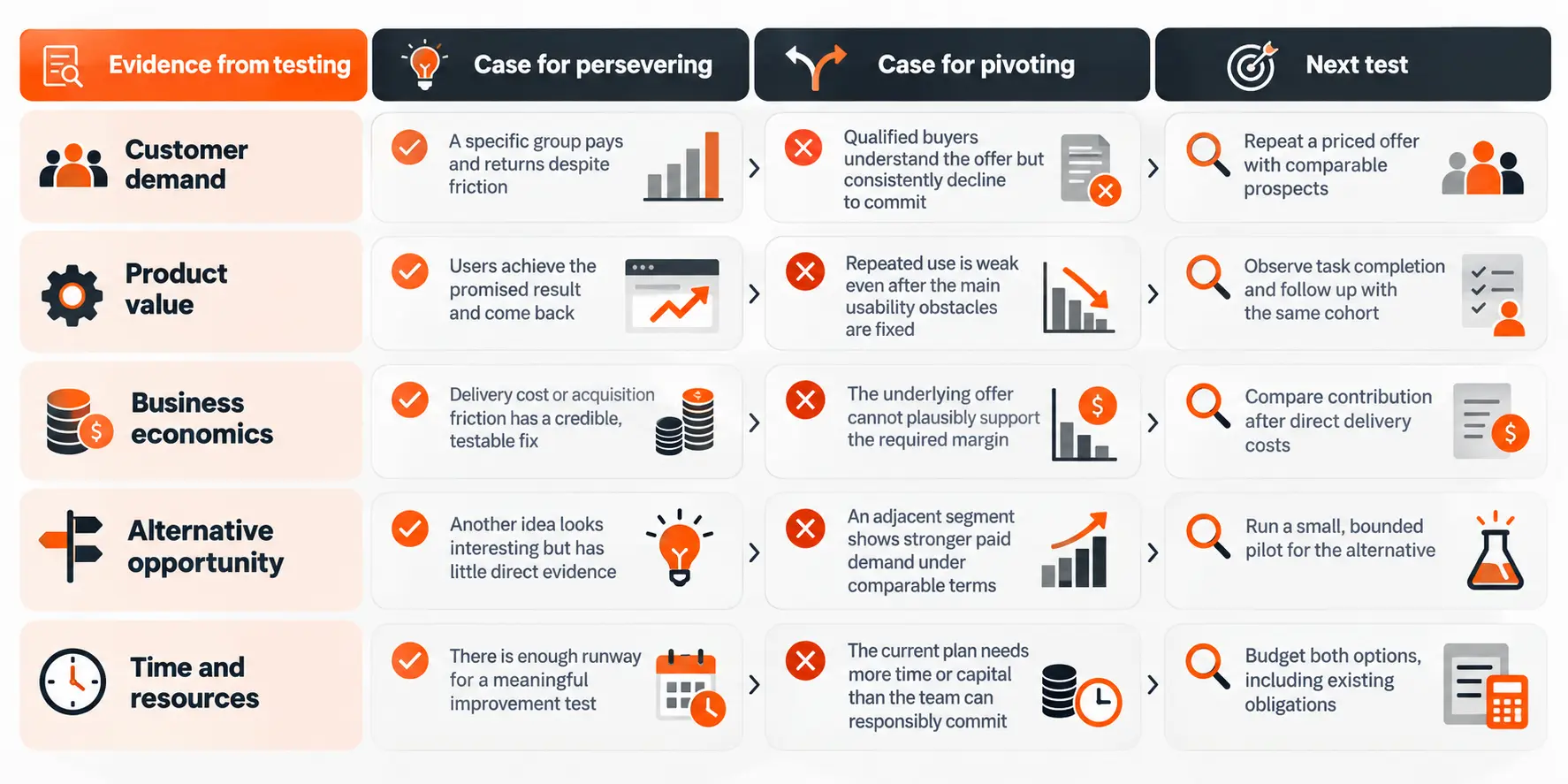
No single row decides the outcome. A company may have excellent retention but unsustainable delivery costs, or weak initial conversion that improves sharply once the right buyer is reached. The table helps expose which claim is supported and which remains an assumption.
Build a Fair Comparison Between the Two Paths
Set the criteria before reviewing the results
Founders are vulnerable to moving the goalposts. Before the next test, agree on the primary evidence, the minimum meaningful result, the time needed to observe it and the amount the company is willing to spend. These are decision rules for the specific business, not universal industry benchmarks.
A practical statement might be: “If at least six of the next 30 comparable qualified buyers commit to a paid pilot and most complete the core task, we will continue improving the offer. If demand remains below that threshold after the onboarding issue is fixed, we will test the adjacent segment.” The numbers here are illustrative. A real threshold should reflect the price, sales cycle, prior baseline and cost of being wrong.
Test the strongest explanation for weak performance
Before replacing the strategy, check whether an execution constraint explains the disappointing result. A poorly targeted sales campaign, unstable product or unclear purchasing process can make viable demand look absent. Run a focused correction instead of assuming that any weak metric condemns the entire model.
Do not turn this into endless optimization. If several credible fixes fail to improve the same relevant behavior, that itself becomes evidence. Record the tests performed so that a future team cannot dismiss the results by proposing the same untested explanation again.
Test the alternative with the same seriousness
An alternative usually feels attractive because its limitations are still hidden. Ask for a purchase commitment instead of praise. Measure how much time it takes to deliver the promised result. Learn whether the apparent demand comes from one enthusiastic contact or a repeatable customer group.
Avoid evaluating an existing product after months of exposure against a fresh idea after a handful of warm introductions. The goal is not a perfectly controlled laboratory experiment. It is a transparent comparison that accounts for differences in who was approached, what they were offered and how much support they received.
A Worked Example With Two Startup Options
Imagine a small software company selling a reporting tool to regional distributors. It has run two four week sales tests using the same advertised monthly price of $400 and comparable outreach. The original offer produced four paid pilots from 40 qualified prospects, a 10 percent observed conversion rate. After six weeks, three of those four pilot accounts were using the tool for the core task. Direct delivery costs averaged $90 per active account each month.
An adjacent offer aimed at logistics service providers produced ten paid pilots from 40 qualified prospects, a 25 percent observed conversion rate. After six weeks, eight of those ten accounts were using the product for the core task. Direct delivery costs averaged $130 per active account because these clients needed more integrations.
At the stated price, the illustrative monthly contribution before acquisition costs and shared overhead is $310 per active account for the original offer and $270 for the adjacent offer. The second audience therefore demonstrates stronger early demand and engagement in this sample, but a lower contribution per active account. Neither option has proven long term retention, repeatable acquisition or attractive lifetime economics.
The appropriate decision might be a bounded follow up test of the logistics segment while maintaining existing distributor customers. The team would test whether integration costs fall with reuse, whether acquisition works outside warm introductions and whether customers continue paying. It would not declare a permanent pivot solely because 25 percent looks better than 10 percent. Small samples can vary substantially, and the two groups may differ in urgency or buying process.
Persevere When There Is a Real Learning Curve
Perseverance is more convincing when the underlying customer problem is clear and successive tests show progress toward solving it. Suppose weekly completion of a critical workflow improves across comparable cohorts after reliability problems are fixed, paid customers renew and customer acquisition becomes less dependent on founder relationships. These are reasons to continue learning within the existing strategy.
The opposite is not always true. A company with a long enterprise sales cycle may have limited paid evidence after a short period, even if procurement discussions are credible. A new category may require customer education. In those cases, the team should use milestones appropriate to the actual buying cycle, such as security review completion, budget ownership and a formal pilot agreement, rather than borrowing thresholds from self service software.
Persevering should still have a review date and a maximum additional cost. “We need more time” is an argument only if the team can say what evidence the extra time is expected to produce.
Pivot When the Core Assumption Stops Improving
A pivot deserves consideration when repeated experiments undermine a central assumption, the most plausible execution fixes have been tested and the company can identify a better supported alternative. Sometimes the customers genuinely need the outcome but the original buyer cannot pay. Sometimes one feature is repeatedly used while the flagship product is ignored. Sometimes the product solves the problem but service costs make the model structurally unattractive.
The evidence should point toward the part of the strategy that needs to change. Weak acquisition does not automatically justify rebuilding the product. Poor margins do not necessarily mean the customer segment is wrong. Changing the wrong variable creates a new company without fixing the original constraint.
A founder can also choose to pause or wind down. If the current business lacks compelling evidence, the replacement idea remains unvalidated and cash cannot fund a credible experiment, another pivot may simply postpone a necessary decision. Ending an experiment is not the same as proving that no other business could ever work.
Protect Runway and Existing Commitments
The decision must be affordable. Estimate the cash and team capacity needed to test each path, the revenue that could be disrupted and the service obligations that continue regardless of the decision. The least costly experiment is not always the best one if it cannot produce evidence relevant to the decision.
Treat prior development spending as a sunk cost, not a reason to keep funding the strategy. At the same time, existing customers and reusable technology are real assets. The choice should account for future costs and benefits without pretending that the company can abandon obligations overnight.
When capital is limited, a narrow test can preserve optionality. A startup may reserve a defined portion of engineering and sales capacity to investigate the alternative while continuing to support existing users. The decision to shift the entire roadmap should follow the agreed evidence, not an emotional response to the last unsuccessful launch.
Document the Call and the Evidence That Could Change It
A strong pivot or persevere review ends with a short decision record. State the strategic hypothesis, primary customer evidence, economics, unresolved uncertainties, budget and next review date. Record who owns the decision and what result would trigger a reversal. Make the reasoning visible before outcomes become clear.
If the team perseveres, specify the one bottleneck it will address and the improvement it expects to observe. If it pivots, state what is changing and what valuable knowledge or customer commitments remain. If it pauses or stops, explain the resource constraint or evidence gap without claiming that the company had no future.
The practical value of a pivot vs persevere framework is not that it makes founders certain. It replaces indefinite debate with comparable evidence, explicit assumptions and a bounded commitment. Keep the course when the evidence is strengthening. Change a core assumption when it has been tested seriously and no longer earns the next investment.
FAQ
What is the difference between pivot and persevere in a startup?
Persevering means improving execution while retaining the core customer, problem and business hypothesis. Pivoting means changing a fundamental assumption based on what the team has learned. Both require measurable evidence rather than instinct alone.
How can founders decide whether to pivot or persevere?
Write the current and alternative hypotheses, choose customer behavior and economic metrics that matter, compare results from credible tests and set a budgeted decision date. Consider whether poor performance reflects execution or a failing core assumption.
Is low revenue enough reason to pivot?
Not by itself. Low revenue may reflect a long sales cycle, unclear positioning, weak onboarding or insufficient distribution. A pivot becomes more credible when the underlying demand or business model remains weak after relevant tests address those explanations.
How often should startups hold a pivot or persevere review?
A review should follow a meaningful learning cycle rather than an arbitrary weekly deadline. Simple paid offers can be assessed quickly, while enterprise products need longer observation. Set the cadence around the evidence that can realistically be collected.
Can the right decision be to stop rather than pivot?
Yes. When neither the current strategy nor an alternative has sufficient evidence and the company cannot responsibly fund more tests, pausing or shutting down may protect customers, employees and remaining capital better than another unvalidated change.

Mohsen Avid
Founder & Editor, PinerookMohsen Avid is the founder of Pinerook, covering entrepreneurship, startup strategy, digital business, and the decisions behind building new ventures.
 Seen first.