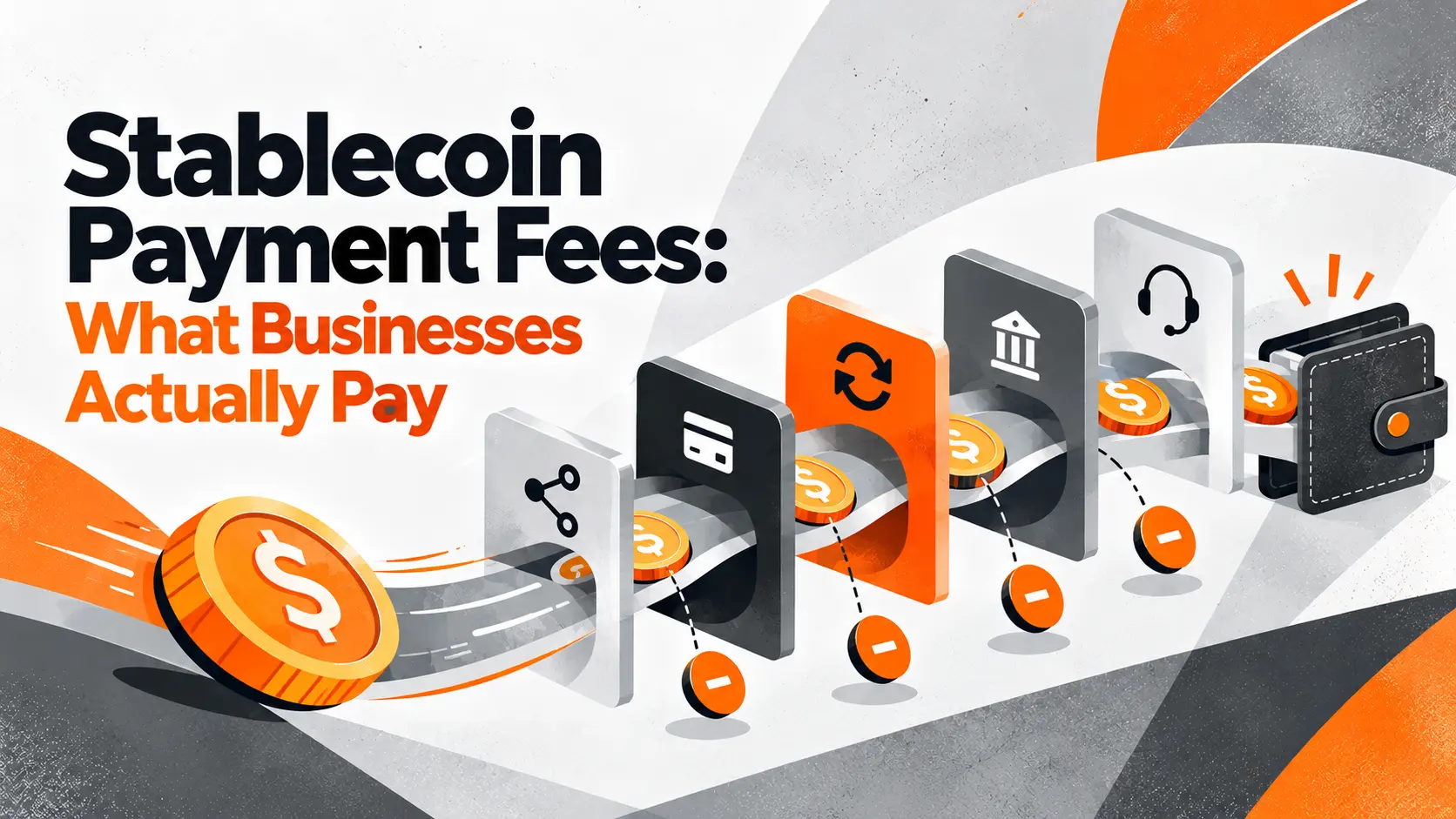
A stablecoin transfer can cost pennies on the blockchain and still leave a business with a surprisingly expensive payment. The network charge is only one line on the bill. Payment processors may take a percentage of the sale, conversion services may embed a margin in the exchange rate, and moving the proceeds into a bank account may create another charge. The customer and the merchant may also pay different parts of that bill.
For finance teams considering Stablecoins for Business, the useful number is the total cost of turning an invoice into spendable money. That means calculating every charge, identifying who pays it, and comparing the result with the payment method the business already uses. A headline fee can be a helpful starting point, but it is not a complete business case.
What Stablecoin Payment Fees Actually Include
A stablecoin is designed to track the value of a reference currency, but sending one does not eliminate the companies and infrastructure involved in collecting, converting, and paying out money. Depending on the route, a customer can pay from an existing wallet, acquire stablecoins immediately before checkout, or rely on a provider that handles the token movement in the background. Each route has a different cost structure.
Network charges and the selected blockchain
The network fee pays for a blockchain transaction to be processed. Its amount depends on the chain, current demand, transaction design, and sometimes the need for a separate approval. It does not necessarily rise in proportion to the invoice value. A simple transfer of a large token balance may use a similar amount of network resources to a much smaller transfer on the same chain, although complex contract interactions can cost more.
This is why descriptions such as “nearly free transfers” need context. A low fee on one network says nothing about the cost of converting the token or paying out the proceeds. A business also needs to confirm which token version and blockchain its processor supports. Sending the correct token on an unsupported network can create a costly exception, even if the original network charge was tiny.
Merchant processing and gateway charges
A hosted payment provider can supply checkout pages, wallet support, transaction monitoring, settlement reports, and refund workflows. It generally charges for these services through a percentage of the accepted payment, a fixed amount per transaction, a subscription, or a negotiated contract. The processor may absorb some network costs, pass them on to the buyer, or list them separately.
Public schedules show how different these models can be. As checked in October 2026, BitPay's published merchant pricing ranges from 2% plus 25 cents for lower monthly volumes to 1% plus 25 cents at its highest published volume tier. Higher pricing may apply to some industries. These are product specific terms, not a standard rate for all stablecoin merchants, and providers can revise them. A quote must identify the service, jurisdiction, transaction type, and settlement method that the rate actually covers.
Conversion spreads and cash withdrawal charges
The most easily missed cost is often the price of entering or leaving the stablecoin. Suppose an invoice is worth $1,000, but the buyer must exchange local currency to acquire USDC. The exchange provider might quote a rate that includes a spread rather than displaying a separate commission. The merchant may later incur another spread when converting its receipt to dollars, euros, or another operating currency.
A payment that goes straight into a company wallet may look inexpensive until the company needs fiat for payroll, suppliers, or tax liabilities. At that point, an exchange, bank payout provider, or withdrawal service can impose its own fee or minimum charge. The right comparison starts with the sender's actual debit and ends with the recipient's usable balance, without assuming that a token trading near one dollar always converts at precisely one dollar.
Operational and exception costs
Businesses also spend money on reconciliation, treasury controls, wallet security, vendor support, and resolving failed or incomplete payments. Some costs are occasional rather than charged on every sale. A customer sending the wrong asset can trigger a support case. A refund may require a separate blockchain transaction. If a merchant holds token balances, its staff may have to approve withdrawals, monitor exposure, and reconcile records that do not resemble a conventional card processor report.
These are real costs even when no vendor invoice labels them as a fee. They should be allocated across completed payments when comparing routes. Otherwise, self managed acceptance may look cheaper simply because the company's own labor is treated as free.
The Fee Payer Matters as Much as the Fee Amount
A merchant often quotes only what is deducted from its proceeds. That can hide a poor customer experience. If a buyer spends $6 obtaining stablecoins and another $1 moving them, a merchant saving $3 in processing charges has not necessarily made the payment cheaper overall. The total economic burden has increased, even though the merchant's ledger shows an improvement.
Pricing terms can assign network gas, token acquisition, and wallet charges to the customer while the merchant covers gateway and payout charges. A merchant sponsored checkout might instead absorb the network cost and present a simpler payment experience. Neither arrangement is automatically better. For an online retailer, high customer costs can reduce checkout completion. For a business paying a supplier, the contract should state whether the promised invoice amount is the amount sent or the amount that must arrive.
The finance team should therefore maintain two figures: merchant cost per completed payment and total cost across sender and recipient. Keeping those measures separate makes negotiations and customer experience decisions much clearer.
A Worked Example for a $1,500 Business Payment
Consider a business receiving a $1,500 invoice payment in a dollar denominated stablecoin. It can use a managed checkout that settles dollars into its payment balance, or accept the token directly and convert it later. The table uses hypothetical charges, not current market quotes or a claim that one model is always cheaper. It assumes the managed provider charges 1% and the customer pays any network gas on that route. For the direct route, the merchant pays the transfer related network cost.
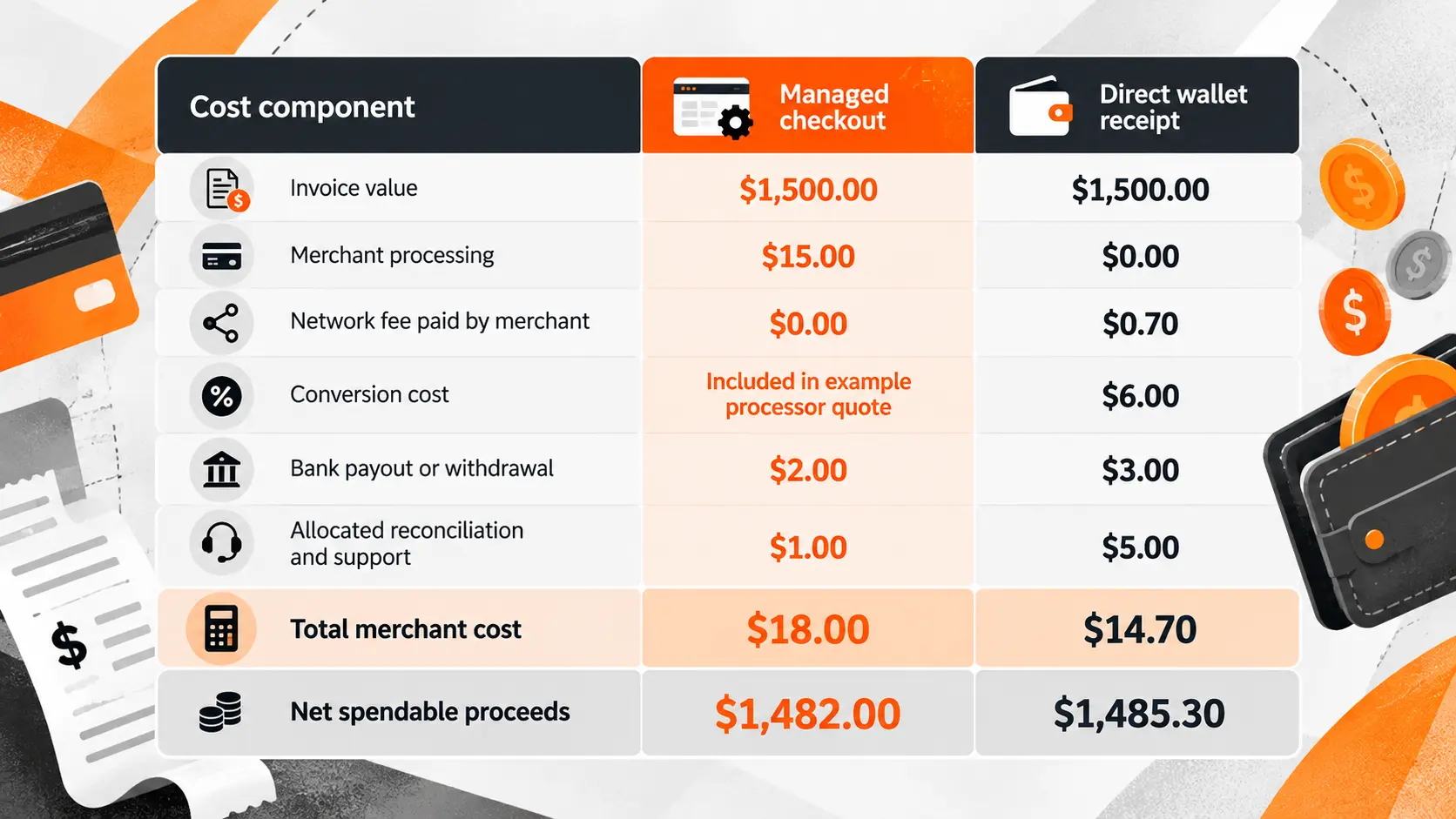
The direct route saves $3.30 in this example, but it also requires the business to manage more of the process. The table excludes the customer's token acquisition and network fees, taxes, and any exceptional incident cost. If those buyer charges are material, or the direct route generates extra support requests, the economic ranking may reverse.
For reference, a hypothetical card fee of 2.7% plus 30 cents would equal $40.80 on the same $1,500 invoice. That does not make stablecoins universally preferable. Card payments can come with established dispute procedures, familiar checkout experiences, recurring billing tools, and different fraud responsibilities. Compare actual completed sales and usable proceeds, not isolated percentage rates.
How Stablecoin Fee Structures Change With Payment Size
Fixed charges matter disproportionately on small orders. A $2 withdrawal charge represents 2% of a $100 receipt but only 0.2% of a $1,000 receipt. Percentage charges behave differently: a 1% processor fee remains 1% whether the invoice is $50 or $50,000. Combined percentage and fixed charges can therefore make two providers switch places as the average transaction size changes.
Merchants should segment their payments before choosing a provider. A store with hundreds of low value checkouts may care most about per transaction charges and completion rates. A service company receiving a few large invoices may be more sensitive to conversion spreads and the risk of holding funds before payout. A marketplace with many recipients may need to assess the cost of each payout, rather than simply the initial collection.
Volume discounts require a similarly careful reading. Some providers price by monthly transaction value, others by transaction count or enterprise agreement. An advertised top tier is not available to a merchant that has not met the required threshold. A finance model should use the merchant's actual tier and show what happens if volumes decline.
Cross Chain Transfers Can Create a Second Fee Layer
The token's network can matter after the customer pays. A merchant may receive USDC on one chain while its custodian or payout partner prefers another. Moving the tokens across supported chains can introduce source network gas, destination network gas, bridge service charges, and sometimes a premium for faster completion.
Circle's published USDC Bridge fee guidance, checked in October 2026, illustrates the distinction. It separates a bridge fee, CCTP protocol fee where applicable, a forwarding charge, and network gas on the source and destination. Standard and fast routes can have different fees, and quotes depend on the exact path. Those charges should not be confused with the price of simply accepting a merchant checkout, which may already include its own network arrangements.
A small blockchain fee can therefore become several fees when a business moves tokens more than once. The practical response is not automatically to choose the cheapest chain. It is to prefer an accepted token and network that both the payer and the eventual payout provider can use without unnecessary transfers.
Stablecoin Fees Versus Cards and Bank Payments
The most useful benchmark is the payment method a customer or counterparty would genuinely choose instead. For a domestic customer, that may be a card or a local bank transfer. For a foreign supplier, it might be a wire or a specialist cross currency payment provider. These alternatives have different consumer protections, exception processes, and settlement responsibilities, so a fair comparison includes more than transaction price.
A merchant should assess cost per successful order. If stablecoins lower the fee but reduce checkout conversion because buyers do not own a compatible wallet, the resulting lost revenue can exceed the saving. Conversely, where customers already hold the token and face expensive cross currency card payments, a stablecoin option can offer a practical benefit. It is a corridor and customer specific decision, not a universal ranking of technologies.
For supplier payments, compare the final amount delivered against the invoice and record any charges borne by the recipient. A bank route with a published transfer fee may still contain an exchange rate margin. A stablecoin route may avoid one intermediary but require the recipient to sell the token through another service. The relevant figure is the amount the intended recipient can actually use.
A Repeatable Method for Calculating the Real Fee
Start by defining one exact payment. Record the invoice value, the sender's starting currency, the token, the blockchain, and the recipient's required currency. Avoid comparing quotes for routes with different payout outcomes. An offer to deliver USDC to a wallet is not equivalent to an offer to deposit euros into a supplier's bank account.
Next, obtain an itemized quote or contract from each provider. Ask whether the stated price includes network fees, conversion margins, withdrawal charges, refunds, and any minimum or monthly charges. Request the same assumptions for every quote, including transaction size and expected monthly volume. If a provider cannot explain who pays a fee or when it becomes payable, treat the quote as incomplete.
Then calculate the effective merchant fee as the total charges attributable to one completed payment divided by the invoice value. In the worked example, the managed checkout's $18 cost on a $1,500 invoice is an effective merchant cost of 1.2%. The direct route's $14.70 is 0.98%. The calculation should be repeated across small, typical, and unusually large invoices to expose how fixed charges and spreads affect the result.
Finally, verify actual settlements. A quotation tells the business what should happen; reconciled payments show what did happen. For each pilot payment, keep the quoted amount, confirmed transfer record, fees in the provider report, final credited balance, and time until the proceeds became usable. Review unsuccessful checkouts and refund cases separately so their costs do not disappear from the analysis.
Preventing Fee Surprises During Operations
A predictable fee policy needs clear responsibilities. The checkout should tell customers whether they pay network fees and whether their wallet may charge for acquiring the token. Invoices should specify the settlement currency and whether the amount owed is measured before or after provider fees. Finance staff should know when a shortfall requires a new payment and when an adjustment can be booked under the company's payment terms.
Refunds deserve particular attention. A blockchain payment typically cannot be reversed through the network like a card chargeback. The merchant or its provider may need to send a new transaction, which can add network or service costs. BitPay's support documentation, for example, explains that merchant ledger deductions can apply to the network cost of refunds. Businesses should verify who bears those charges before advertising free refunds on stablecoin purchases.
Treasury decisions can also change the cost. A company that instantly converts every payment may pay conversion charges frequently, while a company that holds tokens may reduce some conversions but take on issuer, custody, and liquidity exposure. The fee question should be answered alongside the company's cash policy, not by assuming that avoiding a withdrawal is always a saving.
Choosing a Payment Route Based on Net Proceeds
Low network fees are useful, but they are not the final outcome a business buys. A good route delivers the required value to the right account, with a known cost, adequate records, and a manageable exception process. The best choice may be a managed provider, direct token acceptance, or an established payment method depending on invoice size, customer readiness, jurisdiction, and how the business uses the proceeds.
Start with a limited sample of real transactions, calculate both merchant and customer costs, and compare the final settlement with your existing baseline. If the economics improve consistently and the process remains reliable, there is a case to expand. If the savings disappear after conversion, support, and payout charges, a low gas estimate is not a reason to switch.
FAQ
Are stablecoin payments free when network fees are low?
No. A small network fee does not eliminate processor charges, exchange spreads, withdrawals, or the operational cost of handling payments. The relevant cost is the full route from the customer's funds to the merchant's usable proceeds.
Who pays the blockchain fee for a stablecoin checkout?
It depends on the provider and checkout arrangement. The customer may pay gas directly, a processor may absorb it, or the merchant may sponsor the transaction. The payment terms should make this clear before the customer confirms the transfer.
Do stablecoin payment fees increase with the transfer amount?
Some fees are percentage based and increase with payment value. Network gas is generally driven more by the chain and transaction than by the dollar amount sent. Fixed withdrawal charges and service minimums can make smaller payments relatively expensive.
Is direct wallet acceptance always cheaper than using a processor?
Not necessarily. Direct acceptance can remove a gateway fee but adds responsibility for payment matching, security, conversion, reconciliation, and refunds. Those costs can outweigh the visible savings, particularly at small transaction volumes.
Are published stablecoin processing rates guaranteed?
No. Rates can depend on country, business type, payment volume, selected product, settlement method, and temporary promotions. Confirm the current contractual price and an end to end payment quote before using a published rate in a budget.

Masoumeh Jahangard
Markets & Economy Writer at PinerookMasoumeh Jahangard covers markets, economic trends, and business conditions for Pinerook, focusing on how they affect startups and growing companies.
 Seen first.