A company may receive revenue in one market, pay contractors in another, and need funds available before a bank's next processing window. Stablecoins can make selected transfers more flexible, particularly when subsidiaries or payment partners operate in different time zones. Yet faster movement is not the same as better liquidity. A finance team still needs to know where its money sits, who can move it, how quickly it can be redeemed, and whether it is available for the next payroll run.
The broader decision to adopt digital dollars belongs within a company's Stablecoins for Business strategy. Stablecoin treasury management addresses a narrower question: how should the finance function hold, deploy, monitor, and recover stablecoin balances without weakening the company's cash controls? For most businesses, the answer begins with a defined use case and limited exposure, not a plan to replace bank deposits.
Stablecoin Treasury Management in Everyday Finance Operations
Treasury management involves maintaining enough accessible money to meet obligations, moving funds between accounts and entities, and reducing the chance that a financial or operational disruption prevents payment. Stablecoins add a form of digitally transferable value to that existing work. The asset might be held briefly during a transfer or, subject to policy, kept as a small working balance for recurring settlements.
The distinction between a payment rail and a treasury asset matters. A company can send a stablecoin through a service provider while starting and ending with bank balances. In that case, the stablecoin may never appear on the company's balance sheet. A company holding tokens directly, by contrast, takes on questions about issuer exposure, custody, redemption rights, valuation, and authorized access. Similar transfer speeds can conceal very different responsibilities.
A stablecoin targeting one US dollar is not necessarily a US dollar bank deposit. The issuer's legal obligations, reserve quality, holder rights, and available conversion channels determine the practical value of a position. A treasury policy should measure the amount that can be recovered under realistic conditions rather than assume that the displayed wallet balance is immediately spendable cash.
Where Stablecoins Can Improve Treasury Workflows
Moving liquidity between business entities
Consider a software group whose US entity holds most of its working funds while an overseas entity must pay local contractors. A stablecoin route may allow the group to initiate a transfer outside conventional bank processing hours. That can reduce a timing gap when both entities and their financial service providers support the transaction. The finance team must still confirm the recipient entity's legal ability to receive the token, its authorized account or wallet, and access to the currency required for local bills.
Moving funds between affiliated entities does not eliminate intercompany documentation, accounting entries, legal restrictions, or transfer authorization. A fast token transfer may still require the same underlying explanation as a conventional intercompany payment. Treasury should record which entity owns the funds at each stage and whether any provider holds them in the interim.
Reducing idle balances without weakening liquidity
Some firms preposition money in several countries to avoid delays before supplier or contractor payments. If a stablecoin rail offers dependable access to local payouts, a business may be able to reduce part of that prefunding requirement. The potential benefit is lower idle working capital, not a free source of additional cash.
A sensible analysis compares the amount of money released against token holding costs, conversion charges, operational work, and the cost of a fallback payment. If the receiving bank or local conversion service is unavailable during a weekend, funds that moved onchain within minutes can still be unusable until that provider resumes operations.
Creating a controlled settlement window
A business may hold a stablecoin for only the period between buying it and paying a counterparty. This short holding window can reduce continuous exposure while retaining the benefit of a flexible transfer route. An operational policy can require conversion of remaining tokens into the business's primary operating currency once the settlement purpose is complete.
Longer term treasury positions require a stronger justification. A company should not retain a large token balance merely because its treasury dashboard displays it beside bank accounts. That comparison can obscure differences in redemption rights, account protections, and the ability to obtain fiat currency during stress.
Stablecoin Balances Versus Available Operating Liquidity
The most useful treasury question is not how many tokens a company owns but how much usable value it can access before each financial obligation comes due. Treasury should separate the nominal token amount, the estimated realizable value after fees, and the portion that can be converted within a required timeframe.
Imagine a startup with $400,000 in total operating funds. Its next 30 days include $180,000 of expected payroll, taxes, and fixed costs, plus a $45,000 contingency buffer. That leaves $175,000 before considering any other planned spending. The company is testing a recurring cross entity transfer of $20,000 and proposes holding that amount in a stablecoin for no more than 48 hours. The $20,000 should not be counted as available for immediate payroll unless the firm has verified that it can redeem and return the funds before payroll is due.
The following figures are illustrative policy choices, not recommended thresholds for every company.
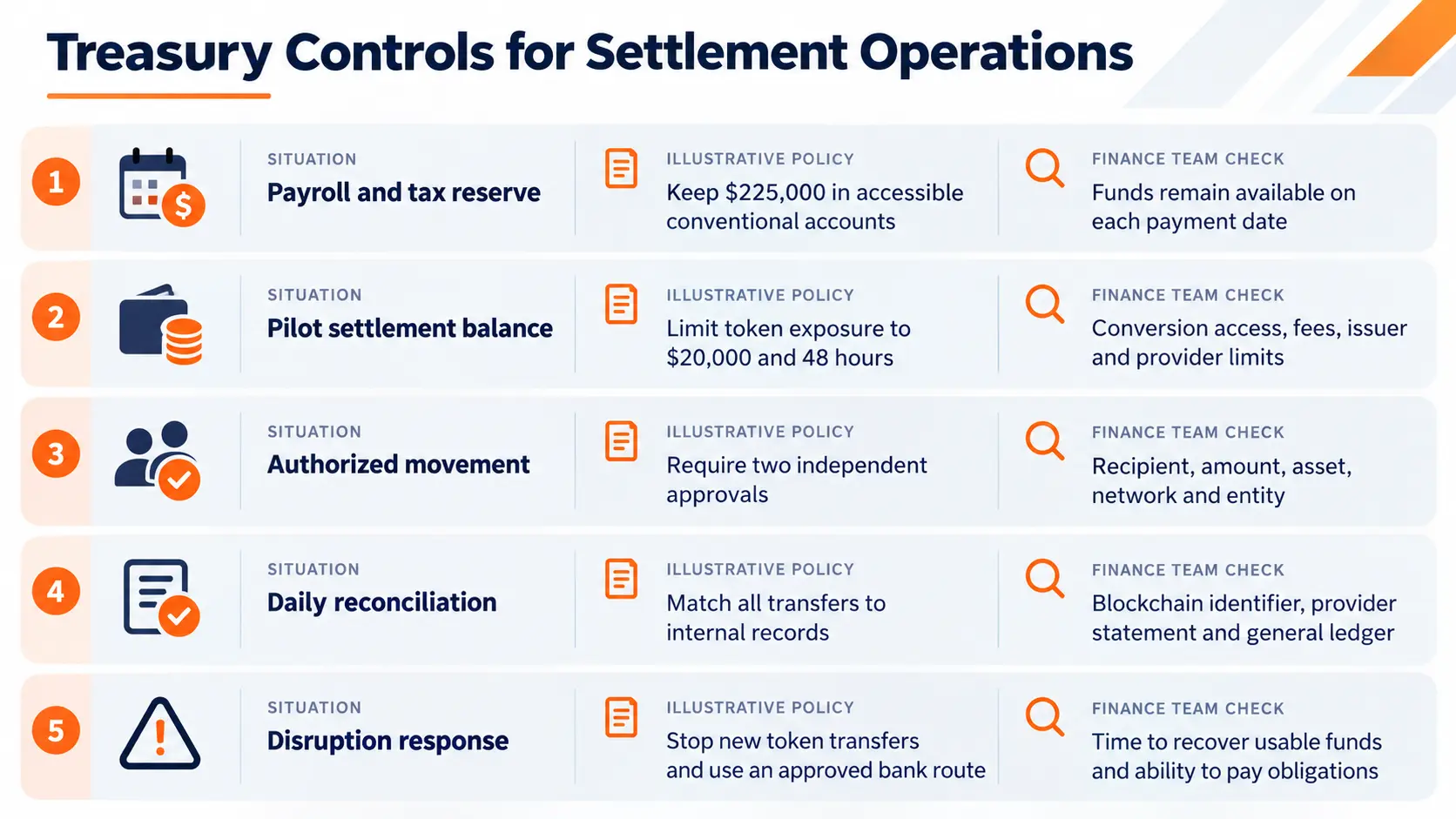
A company with the same total balance but a payroll deadline tomorrow should assess the pilot differently from one with stable incoming cash and a two week payment horizon. Policy limits should reflect the timing of obligations, the strength of fallback routes, and the firm's capacity to withstand a delay or loss. Treasury teams should also distinguish a useful transfer buffer from a speculative allocation that is unrelated to operating needs.
Building a Treasury Policy Before Holding Digital Dollars
Asset and counterparty approval
The finance team should approve a specific stablecoin and issuer, not a broad category labeled digital dollars. Review the issuer's legal status, reserve disclosures, independent reporting, redemption terms, and any conditions affecting who may redeem directly. Then review the custodian, exchange, conversion provider, settlement bank, and supported blockchain network as separate dependencies. Each can fail independently.
A company that can sell tokens on an exchange is not necessarily entitled to redeem those tokens directly from the issuer for their stated value. If only intermediaries have that right, the firm's exit depends on market liquidity and counterparty availability. Treasury should test how the actual account, not a hypothetical institutional account, can obtain fiat money.
Holding limits and approval roles
Document which entities and business purposes are eligible, the maximum outstanding token balance, the largest permitted transfer, and the maximum holding period. Set separate limits for issuer concentration, custody providers, and conversion partners where practical. These controls should apply to actual available liquidity and exposure, not only the number of wallets in use.
No single employee should be able to create a payment, approve the recipient, and execute the transfer without independent review. Depending on the operating model, firms may use role based permissions, multiple approvers, institutional custody, or secure signing systems. A small business can start with simpler tools, but it still needs clear accountability, documented authorization, and an emergency process when an approver is unavailable.
Wallet and network safeguards
Treasury should maintain an approved register of recipients, token contracts, and networks. Before a first transfer, staff should independently verify destination details through a trusted channel and consider a small test payment. An incorrect address or unsupported network can create a loss that ordinary bank reversal procedures cannot repair.
The company should establish a process for compromised keys, suspicious instructions, blocked addresses, network congestion, and provider outages. Where the service provider controls the wallet, the finance team still needs to know who can freeze withdrawals, what incident reporting is available, and how an authorized employee can recover access after a personnel change.
Monitoring Redemption, Concentration, and Liquidity Risk
Stablecoin treasury risk has several layers. Issuer risk concerns the institution responsible for the token and the reserves supporting it. Redemption risk concerns whether the business can exchange tokens for money at the intended value and within the required timeframe. Custody risk concerns loss or interruption of access. Market liquidity risk concerns what a buyer will pay if the company needs to sell through an intermediary. Operational risk includes errors, scams, network failures, and unresolved reconciliation differences.
Price stability during normal trading is not enough to demonstrate resilience. Treasury teams should ask what happens if a stablecoin temporarily trades below its target, if redemptions are delayed, or if an exchange restricts withdrawals. Even a fully functioning blockchain cannot force a bank, issuer, or conversion service to operate when a critical downstream system is unavailable.
Monitoring should connect exposure to action. A preapproved response might reduce balances when redemption delays increase, stop new transfers when a provider fails, or move future payments to a conventional bank route after a compliance hold. The policy must name who can invoke those responses, which payments take priority, and what evidence is needed to resume operations.
Using several stablecoins does not always create meaningful diversification. If they depend on the same custodian, exchange, banking partner, or source of liquidity, a single disruption may affect them together. The treasury team should map common dependencies rather than count different token tickers as separate safeguards.
Reconciling Stablecoins With Treasury and Accounting Systems
Blockchain records can show the movement of tokens, but a transaction identifier does not say whether the transfer was a loan between entities, a vendor payment, a customer refund, or an internal wallet movement. Treasury needs an internal record linking each transfer to its business purpose, the approving people, the legal entity, and the invoice or funding instruction.
A practical reconciliation process compares the company's treasury ledger, the custody or wallet balance, the provider statement, and relevant bank movements. Staff should resolve missing confirmations, duplicate entries, unexpected network fees, partial conversions, and transfers posted on the wrong date. The reconciliation cadence should reflect payment volume and materiality; an active treasury operation may need daily checks and alerts for exceptions.
Accounting classification is not a detail to infer from a token's name. US financial reporting guidance on whether some stablecoins meet the definition of cash equivalents has been under active consideration in 2026, including an August proposal from the Financial Accounting Standards Board. The outcome can depend on direct redemption rights, reserve attributes, the holder's legal position, and applicable rules. Finance teams should document their facts and consult qualified advisers instead of automatically treating every stablecoin as cash. This article focuses on treasury controls rather than the separate technical accounting analysis.
A 30 Day Pilot for Treasury Teams
Days 1 to 7: Establish the current baseline
Choose one recurring use case such as a transfer between two approved group entities. Record the present bank route, total fees, time to usable funds, cash prepositioned for the payment, manual steps, and frequency of delays. Identify a real operational problem and define what measurable improvement would justify introducing an additional rail.
Days 8 to 14: Approve a narrow operating route
Select the asset, issuer, custody model, conversion partner, recipient, network, and fallback method. Establish the permitted amount, the intended holding period, the people authorized to approve transfers, and the documentation required for each transaction. Test the ability to obtain money out of the stablecoin arrangement, not just send money into it.
Days 15 to 23: Run small transactions and reconcile results
Execute low value transfers within the approved limit and verify the end recipient's usable balance. Log the time of each stage, conversion rate, fees, approval steps, transfer status, and reconciliation outcomes. Confirm that a late or failed payment can be completed through the fallback route. Do not increase the limit simply because the first blockchain transfer succeeded.
Days 24 to 30: Decide whether the route earns a place in policy
Compare the pilot with the baseline on end to end completion time, total cost, accessible liquidity, exceptions, and staff effort. Include the cost of controls and the operational consequences of a failed conversion. If the new route adds complexity without improving a material outcome, keep the established banking process. If it works, expand only with documented approval and limits that reflect the next use case.
The strongest success measure is not tokens moved or minutes to network confirmation. It is the share of business obligations fulfilled accurately, on time, and at an acceptable total cost while preserving liquidity and auditability.
The Role of Stablecoins in a Resilient Treasury
Stablecoins can be valuable as an additional settlement rail for specific treasury workflows, particularly where time zone differences or banking interruptions create genuine friction. But resilience comes from combining speed with recoverability. A treasury team needs accessible reserves, tested redemption paths, independent approvals, clear records, and an established fallback to conventional banking.
A company should increase its reliance on stablecoins only when repeatable evidence shows that the arrangement improves a defined treasury outcome. If a digital dollar balance cannot be reliably converted into money needed for the next obligation, its apparent speed is not a substitute for sound cash management.
FAQ
Is a stablecoin balance the same as cash in a business bank account?
No. A stablecoin may track the value of a currency, but the holder's rights and protections depend on the issuer, provider, custody arrangement, and applicable law. The accounting classification can also differ. Businesses should verify redemption access and usable liquidity rather than assume the balances are interchangeable.
Can stablecoins reduce the cash a company must hold abroad?
Potentially, for particular routes with dependable conversion and payout access. A company may reduce some prefunded balances if it can move funds reliably when needed. It still needs contingency reserves and must assess the risk that a local payout provider or bank becomes unavailable.
How long should a company hold stablecoins in treasury?
There is no universal period. Holding time should follow the commercial purpose, treasury policy, liquidity forecast, and risk limits. A company using tokens only for settlement may choose a short time window, while ongoing holdings require separate justification and stronger monitoring.
What should a finance team measure during a stablecoin treasury pilot?
Measure the total cost and time to accessible funds, amount of liquidity tied up, failed or delayed transfers, reconciliation exceptions, authorization failures, and performance of the fallback route. Network confirmation speed alone is not an adequate measure of treasury success.

Masoumeh Jahangard
Markets & Economy Writer at PinerookMasoumeh Jahangard covers markets, economic trends, and business conditions for Pinerook, focusing on how they affect startups and growing companies.
 Seen first.