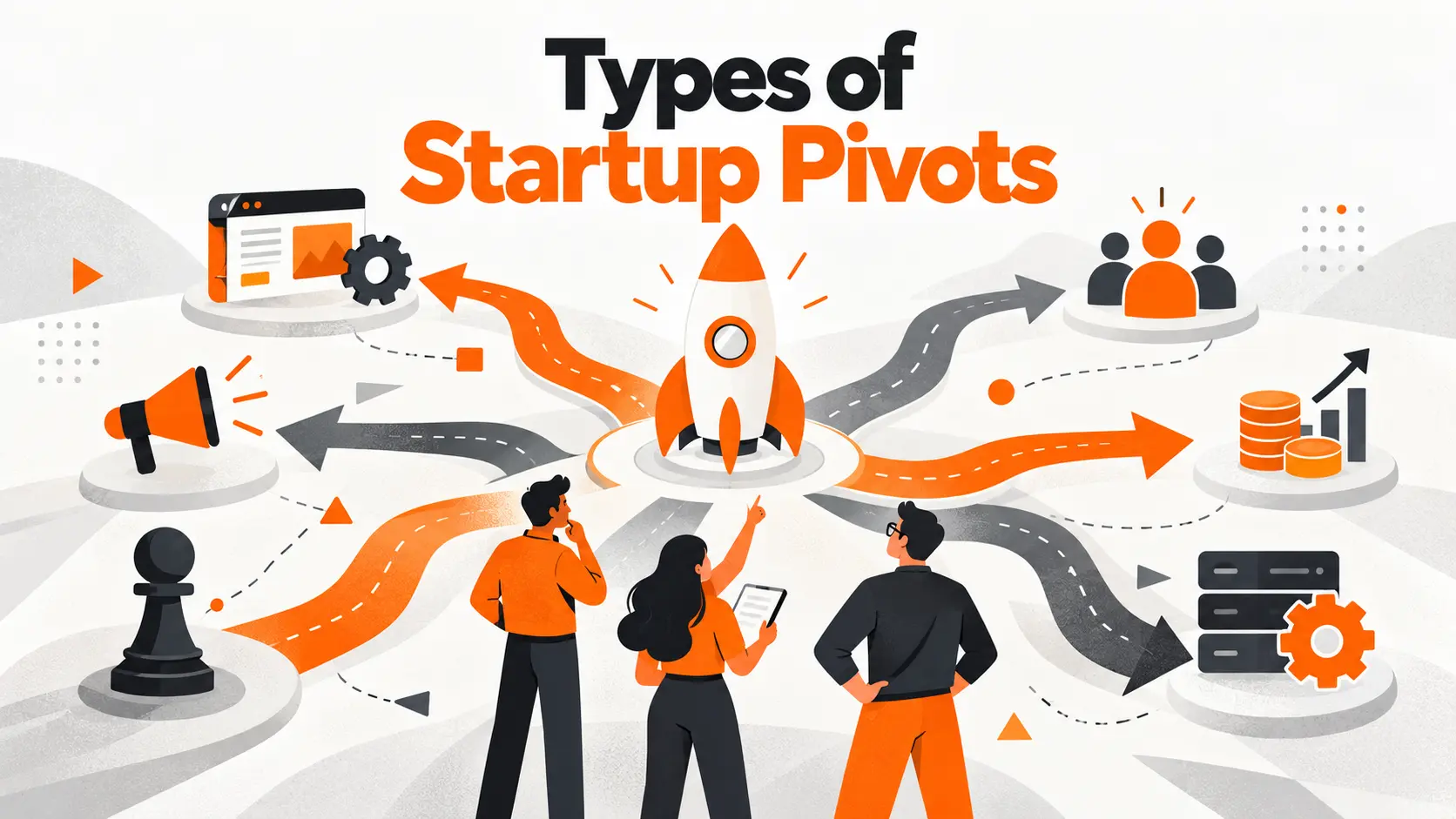
A startup pivot is a deliberate change to a core business assumption, not simply a new feature, campaign, or company name. The change might concern who buys the product, which problem it solves, how customers find it, or how the company earns money. Knowing the types of startup pivots helps founders identify the part of the business that needs to change without discarding everything that already works.
The wider Startup Pivot Strategy begins with evidence that a central assumption is not holding. This guide addresses the next question: what exactly should change? Eric Ries described ten useful pivot types in The Lean Startup. They are categories for thinking, not a sequence every company must complete. One pivot may affect several parts of a business, but a founder should be able to name the primary hypothesis being tested.
A Startup Pivot Changes an Assumption, Not Just an Activity
Imagine a scheduling software company whose trial users complete onboarding but rarely become paying customers. The team could redesign the homepage, launch another advertising campaign, or discount the price. Those actions may improve execution, but they do not necessarily change the business hypothesis.
A customer segment pivot would ask whether the software is more valuable to a different buyer. A customer need pivot would ask whether the same buyers have a more urgent problem. A value capture pivot would ask whether the pricing mechanism prevents customers from paying. Each path requires a different test. Calling all three a generic product pivot would hide the decision the team actually needs to make.
That distinction matters because the cheapest experiment depends on the assumption being replaced. A buyer interview can challenge market selection. A paid pilot can test willingness to pay. An integration prototype can test a technical approach. A pivot becomes useful when its proposed direction can be described and falsified.
The Ten Types of Startup Pivots at a Glance
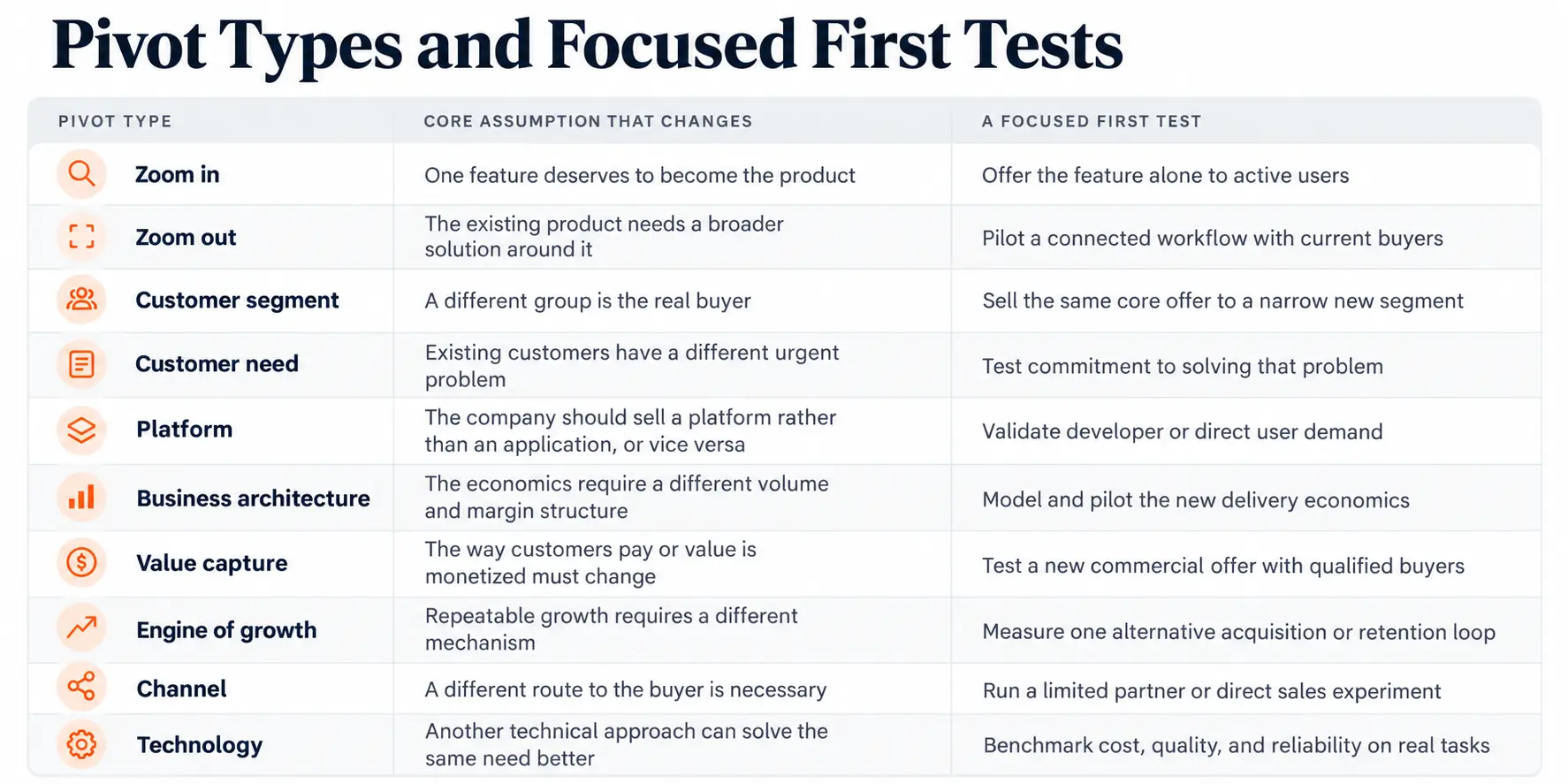
This table is a diagnostic map. A promising test does not establish that the pivot will succeed; it identifies what the team needs to learn before making a larger commitment.
Product and Problem Pivots
Zoom In Pivot
A zoom in pivot turns one part of a larger product into the whole offer. The evidence often appears in usage patterns: most features are ignored, while one task brings customers back or inspires them to invite colleagues.
Instagram is a well documented illustration. Its founders narrowed the more complicated Burbn application around photo sharing. The useful lesson is not that every startup should delete features. It is that repeated user behavior can reveal a clearer product than the founders originally designed.
For a small business software company, the equivalent might be customers returning only for invoice approval while ignoring the broader operations suite. Before rebuilding, offer approval as a standalone pilot and observe whether users will adopt and pay for that narrower promise.
Zoom Out Pivot
A zoom out pivot moves in the opposite direction. The original product becomes one component of a more complete solution because buyers cannot obtain the outcome they want from the isolated tool.
Consider a reporting dashboard that helps a retailer spot inventory shortages but cannot trigger replenishment. Customers may value the insight yet still do the important work in spreadsheets and email. The startup could test a wider purchasing workflow, keeping the dashboard as one feature.
The risk is mistaking a request for additional features for evidence that customers will buy a broader product. Start with one adjacent workflow, not an entire software suite. Measure completion of the full job and willingness to pay for the integrated result.
Customer Need Pivot
A customer need pivot keeps a meaningful relationship with the customer group but changes the problem the company addresses. Buyers may appreciate the current product without considering its problem urgent enough to fund.
Suppose a clinic operations startup sells appointment analytics to practice managers. Interviews reveal that managers are far more concerned about collecting overdue patient balances. The team might explore collections workflow tools for the same buyers. This is not merely a better dashboard; it changes the value proposition.
The first test should be a concrete offer with a buyer decision, such as a paid pilot or signed scope of work. Polite interest is insufficient evidence that the new problem is commercially important.
Customer and Market Pivots
Customer Segment Pivot
In a customer segment pivot, the basic product remains useful but the company discovers that its intended audience is not its strongest market. An internal tool designed for freelancers, for example, may attract more consistent demand from agency operations teams.
Watch for concentrated activation, faster sales cycles, repeat purchases, or stronger retention in a segment the company did not initially prioritize. These signals justify investigating a different ideal customer profile, not automatically abandoning existing customers.
Keep the core offer stable during the first test. If the startup changes the product, price, message, and buyer simultaneously, it will struggle to identify why the new segment responded. A dedicated Customer Segment Pivot analysis can go deeper into segmentation and validation, but the immediate task is to test whether a particular group has a stronger problem and a realistic buying process.
Business Architecture Pivot
Business architecture describes the relationship between sales volume, margins, service intensity, and the operating model. A company built for a small number of high value accounts might discover that the opportunity requires simpler delivery to many customers. The reverse can also happen.
Imagine a compliance service sold for $200 a month with considerable manual support. If every account needs hours of specialist attention, a high volume, low price strategy may never work. The company might move toward fewer enterprise clients with higher contract values and defined service commitments.
Before changing the sales model, calculate the cost to serve, gross margin, expected acquisition effort, and implementation capacity under both structures. More revenue per customer is not automatically better if winning those customers becomes disproportionately expensive.
Commercial and Distribution Pivots
Value Capture Pivot
A value capture pivot changes how a business receives economic value from its product. The product and customer problem may remain intact while the payment unit changes from seats to usage, from subscription to transaction fees, or from a license to a service contract.
A founder should distinguish customer objections to price level from objections to the pricing mechanism. A team may have budget for software but reject a seat based plan because its usage fluctuates. A carefully limited usage based pilot tests a different assumption than a temporary discount.
This is narrower than a complete Business Model Pivot, which may also change who pays, which customer receives value, or how the business delivers the service. Here, the key question is whether a different mechanism for capturing value improves paid adoption and sustainable margins.
Channel Pivot
A channel pivot changes the route through which the product reaches customers. A startup selling directly to independent restaurants might discover that accounting firms or point of sale providers already have the buyer relationships needed to reach its market.
Partner distribution is not necessarily cheaper than direct sales. Revenue sharing, partner onboarding, limited access to customers, and dependence on a single intermediary can weaken the economics. A trial should compare qualified opportunities, conversion, sales cycle, customer ownership, and contribution margin across channels.
Changing advertising creative inside the same acquisition channel is an execution adjustment. Moving from self service signup to reseller distribution changes the business assumption about how customers are acquired and served.
Engine of Growth Pivot
The engine of growth is the underlying repeatable mechanism that produces new customers. Ries distinguished sticky, viral, and paid engines. A company may discover that its growth depends more on retention and account expansion than on bringing in a constant stream of new customers.
For example, a collaboration product that does not spread through invitations may still expand through team adoption after one department starts paying. The team could test an account expansion motion instead of continuing to design for consumer style virality.
Choose one growth mechanism to test and measure its actual behavior. Referral invitations are not proof of a viral engine if invited users do not activate. Paid acquisition is not a viable engine if contribution margin cannot cover acquisition costs over a realistic time frame.
Platform and Technology Pivots
Platform Pivot
A platform pivot changes whether the business delivers a finished application or the underlying capabilities on which others build. A startup might find that customers want an API and developer tooling more than a standalone dashboard, or that customers actually prefer a complete application over raw infrastructure.
A platform carries a different burden: documentation, uptime commitments, integrations, support, permissions, and a credible path to third party adoption. Developer interest alone is not a business model. Test whether outside teams can build something valuable without extensive founder support and whether there is a clear paying customer.
For an application business, the reverse test may be even simpler: package a frequently requested workflow into a complete product and compare its adoption with the underlying toolkit.
Technology Pivot
In a technology pivot, the customer, problem, and business proposition largely stay the same while the company adopts a substantially different method to deliver the solution. A document processing startup might replace a rules based workflow with a model assisted approach, or move computation onto devices to reduce latency and data transfer.
This only qualifies as a strategic pivot when the technology change meaningfully alters the ability to serve the market. Routine refactoring or swapping a library is not enough. The new approach should be tested on the same customer tasks for accuracy, reliability, operating cost, security, and maintenance burden.
A demo that performs better on selected examples can still lose in production. A founder should require a clear performance improvement under realistic conditions before committing the roadmap to the new stack.
Choosing the Right Pivot Type from the Evidence
The labels are useful only when they help narrow a decision. I would start by writing down three statements: what customers actually do, which assumption no longer fits that behavior, and what evidence would convince the team that a new assumption is better.
Consider an illustrative startup offering scheduling software to small clinics. In one month it books 80 product demonstrations. Only six clinics agree to a paid pilot, while interviews reveal that buyers already have scheduling tools and care more about reducing denied insurance claims. The demo volume is a real signal of attention, but not evidence of demand for the original product.
The founder has at least three possible hypotheses. A customer segment pivot would test the current tool with a different buyer. A customer need pivot would address claims processing for the same clinics. A value capture pivot would keep scheduling intact but revise how clinics pay. Running all three at once would produce confusing results.
A disciplined team could begin with the strongest new observation: several clinics independently describe the claims problem and agree to share anonymized workflow samples. The next step is a narrowly scoped claims pilot, with an explicit success measure such as completed cases, time saved, and willingness to pay. If the problem attracts commitment, the customer need hypothesis becomes more credible. If not, the team has learned something without replacing its entire product.
The numbers above are hypothetical and illustrate how to design a test, not a universal conversion benchmark. A startup with a long enterprise buying cycle would need a different observation period and commitment standard.
Limits of the Ten Type Framework
These categories can overlap. A customer segment pivot may require a new channel, and a platform pivot can change pricing, support costs, and distribution. Name the primary hypothesis first, then track secondary changes. Otherwise, the team may declare victory without knowing which change created value.
Equally important, not every improvement is a pivot. Improving activation, fixing a costly bug, or refining sales messaging may be exactly what the current strategy needs. A pivot is warranted when a core assumption changes, not when the team wants to signal momentum.
Avoid treating the famous outcomes of companies such as Instagram as a recipe. A story that looks obvious after success rarely captures the uncertainty of the decision. The practical standard is more demanding: preserve the evidence that still holds, specify what changes, and design a test that could prove the new direction wrong.
Final Perspective
The useful question is not which pivot type sounds ambitious. It is which assumption the business can no longer defend. Product scope, customer need, market, monetization, distribution, architecture, and technology can each demand a different response. Founders who name the change precisely can run smaller experiments, protect scarce runway, and learn more from every decision.
FAQ
How many types of startup pivots are there?
Eric Ries described ten classic types: zoom in, zoom out, customer segment, customer need, platform, business architecture, value capture, engine of growth, channel, and technology. They are a useful framework rather than a complete classification for every business change.
Can a startup make more than one type of pivot at once?
Yes. A change in target customers may require a different sales channel or pricing model. It is still helpful to identify the primary hypothesis and measure related changes separately so the team can understand what produced the result.
Is a pricing change always a pivot?
No. A discount or modest price adjustment is often an experiment within the same business model. A value capture pivot changes the mechanism by which the company earns money, such as moving from subscriptions to usage based pricing, and tests a substantive commercial assumption.
Which pivot type is best for an early stage startup?
There is no universal best type. The appropriate choice depends on the assumption contradicted by customer behavior. A startup with a useful product and the wrong buyers faces a different problem from one with an attractive market but an unsustainable delivery model.
Is a technology upgrade the same as a technology pivot?
Not necessarily. Ordinary updates improve implementation without changing the commercial hypothesis. A technology pivot involves a material change in the way the company solves the same customer problem and requires evidence that the new approach works better at a sustainable cost.

Mohsen Avid
Founder & Editor, PinerookMohsen Avid is the founder of Pinerook, covering entrepreneurship, startup strategy, digital business, and the decisions behind building new ventures.
 Seen first.